
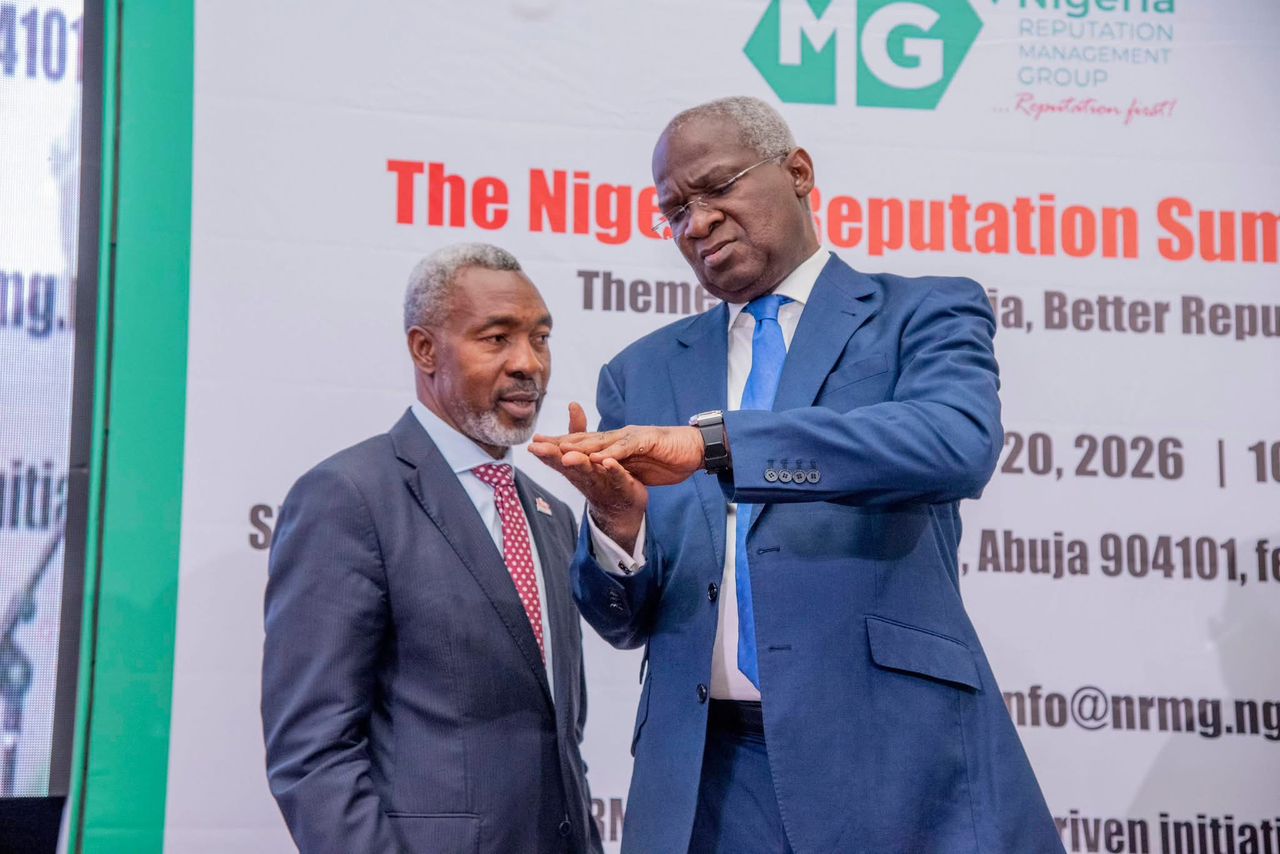




Babatunde Fashola has drawn a sharp and timely distinction between criticizing government and damaging Nigeria’s reputation, warning that careless language and persistent negative framing now pose serious risks to the country’s global image. Speaking pointedly, the former Lagos State governor and two time minister cautioned that while holding leaders accountable is essential, conflating governance failures with the nation itself undermines Nigeria’s standing at home and abroad.
A Call for Responsible Criticism
Delivering the keynote address at the Nigeria Reputation Summit 2026 held on Tuesday at the Shehu Musa Yar’Adua Centre in Abuja, Fashola urged Nigerians to separate legitimate criticism of government from attacks on the country. In his words, “Government is different from country. We must criticize government and politicians without throwing our country under the bus.” He stressed that governments and political actors are temporary, while Nigeria as a sovereign territory will endure long after individuals have exited the stage. Through this framing, he made clear that accountability must coexist with national responsibility.
Leadership, Perception and the Cost of Silence
Under the theme “Better Nigeria, Better Reputation,” Fashola examined how leadership decisions, governance structures and institutional consistency shape how Nigeria is perceived, both locally and internationally. Importantly, he argued that Nigeria’s reputational challenge is not rooted in a lack of achievement but in weak collective ownership and the absence of deliberate, positive storytelling about the country’s strengths. As he explained, achievements lose their value when citizens fail to speak about them with intention and pride.
Early Encounters That Shaped His Worldview
Reflecting on formative experiences, Fashola recounted a childhood incident in 1976 during a family holiday in Paris. At age 13, after getting lost while searching for the Eiffel Tower, he and his siblings walked into an ice cream parlor for directions. When they mentioned they were from Nigeria, the shopkeeper’s response left a lasting impression. “He said, great country, rich country, powerful country,” Fashola recalled. The shopkeeper even returned their money, an experience he said he had never publicly shared before.
Soon after, in Cameroon, another encounter reinforced that perception. A shopkeeper, upon learning they were Nigerians, called his family to come downstairs to take photographs with them. These moments, Fashola noted, occurred during a period when Nigeria faced domestic challenges such as armed robbery and foreign exchange violations. Yet, despite those issues, the country’s reputation remained strong because Nigeria was actively responding to its problems. As he put it, every country has challenges, but how those challenges are confronted defines national character.
Small Details, Big Reputational Impact
Transitioning to professional lessons, Fashola shared how an international correspondent once paused an interview to correct his sitting posture before going on air. The moment, he explained, underscored how reputation management often extends to seemingly minor details. Proper posture, presentation and comportment, he said, all shape how leaders and countries are perceived on the global stage.
Diplomacy, Preparation and Missed Opportunities
Drawing from his time as a minister, Fashola turned to Nigeria’s diplomatic practice, calling for structured and continuous training for ambassadors before and during foreign postings. He recalled an official visit to an African country where Nigeria’s ambassador lacked basic knowledge of Nigeria’s policy position in the sector under discussion. Over a preparatory dinner, he said, it became clear that the ambassador was unaware of the country’s stance, a gap he described as damaging and avoidable.
He went further to criticize what he termed a misplaced approach to economic diplomacy. According to him, many ambassadors focus on inviting Nigerian ministers to visit their host countries instead of attracting investors to Nigeria. “Very often, I would get letters from ambassadors asking us to come and visit the countries where they were posted,” he said, adding that most of such requests were discarded. Development challenges, he argued, are at home, and serious investors should be encouraged to experience Nigeria directly.
Ownership as a National Responsibility
On the issue of national ownership, Fashola stressed that Nigerians must collectively take responsibility for the country’s image. He expressed frustration with Nigerians holding dual citizenship who refer to Nigeria as “your country” in conversations with him. Each time, he said, he stops them to insist that Nigeria belongs to all citizens equally. Without shared ownership, he warned, problems will persist unsolved.
Reframing the National Conversation
Fashola also called attention to the country’s increasingly negative public discourse. According to him, Nigeria has become careless with language, often amplifying pessimism rather than possibility. He urged Nigerians to become deliberately positive in how they speak about their communities and the nation. Words, he argued, shape beliefs, perceptions and ultimately behaviour.
He illustrated this point by referencing how other countries use entertainment and storytelling to project strength and invincibility. In contrast, he said, Nigerians have sometimes used similar tools to promote harmful myths, such as the belief that wealth can be acquired through rituals. He questioned the logic behind such narratives, asking where anyone has ever seen money printed with blood, and warned that unchecked beliefs can distort national perception.
Rule of Law as a Reputation Anchor
Turning to governance and security, Fashola identified predictability and respect for the rule of law as Nigeria’s most valuable potential reputational assets. He said investors closely observe whether governments obey court orders, enforce contracts and uphold basic rules. In his view, a reputation for lawful conduct and institutional reliability would do more for Nigeria than any advertising campaign.
Hosting the World, Telling Nigeria’s Story
Fashola advocated for Nigeria to deliberately host more international conferences, sporting events, concerts and exhibitions, describing this strategy as a proven global tool under Meetings, Incentives, Conventions and Exhibitions. Such platforms, he said, allow countries to tell their own stories by inviting the world to experience them firsthand. He described Nigeria as a land of vast opportunity, where stories of humble beginnings leading to national leadership are part of its lived reality.
He noted that Nigeria’s leadership history shows no dominance by royalty or inherited wealth, reinforcing the country’s commitment to merit. Yet, he questioned whether Nigerians truly value this narrative. According to him, the country often celebrates other nations’ success stories while neglecting its own unfolding experience of opportunity.
Commending Action Over Complaints
In closing, Fashola praised the Nigeria Reputation Management Group for choosing action over complaint. He described the group as problem solvers who have taken responsibility for shaping perception rather than merely criticizing outcomes. While acknowledging the difficulty of that choice, he said it sets them apart from those who only highlight what is not working.
A Final Charge on Talent and the Future
Fashola concluded by urging participants to focus on right thinking and well meaning Nigerians. He observed that talent is being rewarded globally more than ever before, with activities once dismissed as hobbies now forming some of the world’s most lucrative professions. According to him, Nigeria must align its mindset with this reality, nurturing talent, projecting confidence and consciously shaping a reputation that reflects its true potential.



Comment
No comments found.