
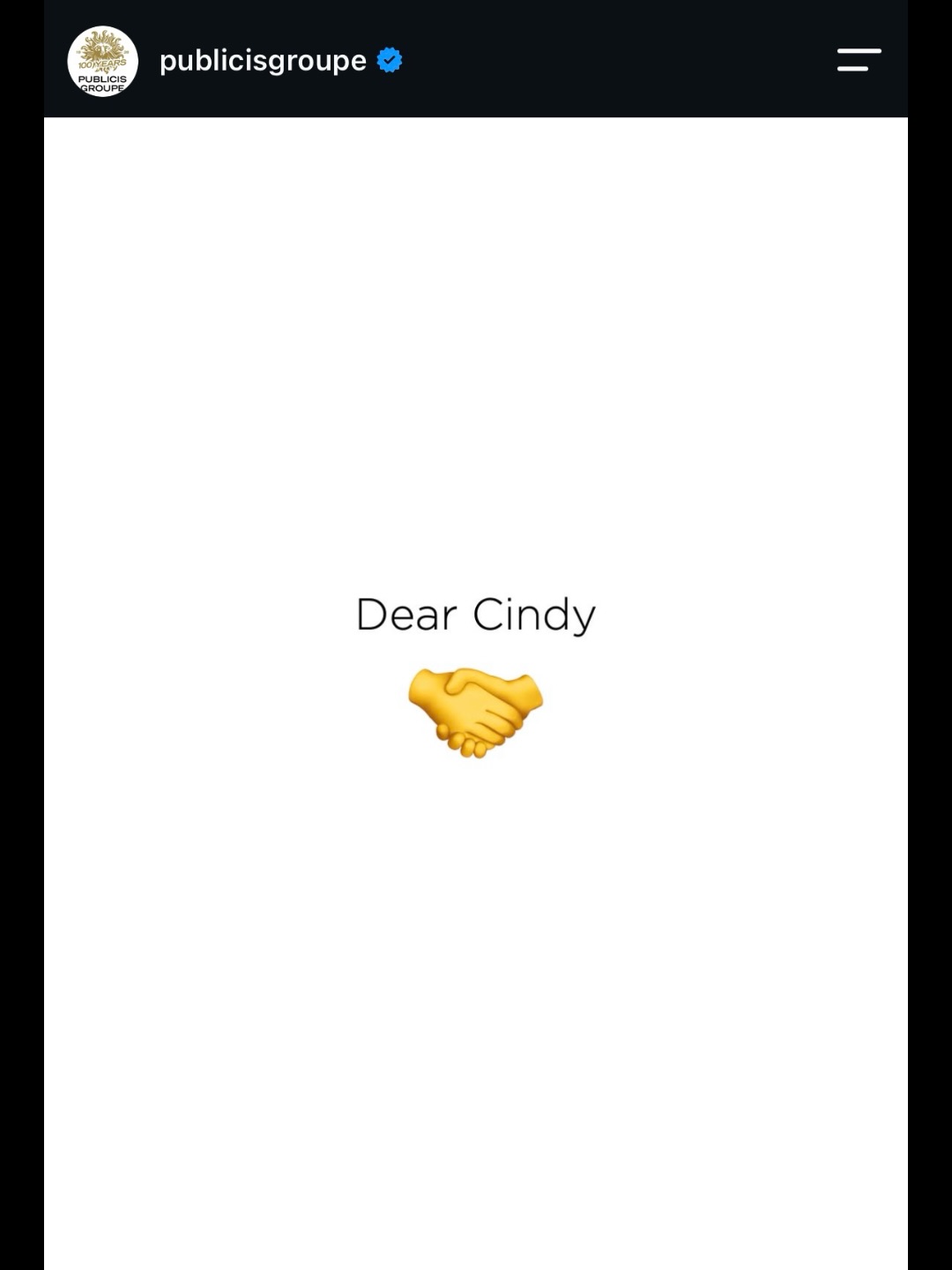


If the advertising industry needed a reminder that competition does not always end in the boardroom, Publicis Groupe has provided one. And this time, the creative execution came in the form of an open letter, a handshake emoji and a rather pointed message to WPP chief executive Cindy Rose.
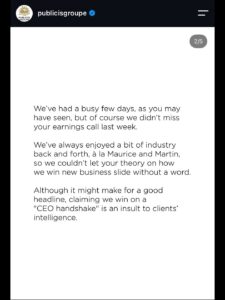
The French advertising group has publicly challenged Rose over her comments on agencies winning major accounts without traditional competitive pitches, turning what began as an earnings-call discussion into one of the industry’s most entertaining corporate exchanges in recent times.
The disagreement began during WPP’s third-quarter earnings call on 29 October, when Rose was asked about the growing practice of awarding major advertising assignments without conventional agencies reviews. Referring to what she called the “pitch-less, CEO handshake thing”, she questioned whether clients were carrying out sufficient due diligence before making decisions with significant commercial consequences.
Cindy did not mention Publicis by name. However, the timing was difficult to ignore.
Publicis had recently secured PepsiCo’s reported $1.9 billion global media account without a traditional competitive pitch, alongside other major assignments, including LVMH’s Asia-Pacific media business. The development attracted attention because it came while Publicis was also involved in the competitive review for Coca-Cola’s global media business.
Publicis eventually withdrew from the Coca-Cola contest after accepting the PepsiCo mandate. WPP retained Coca-Cola’s business in the markets where it competed, while Omnicom secured North America and Dentsu took select Asia-Pacific markets.
WPP’s decision not to participate in the North American review became another talking point. Cindy Rose explained that the group had to choose between spending another six weeks pitching for the business and concentrating on delivering the mandates it had already secured.
Publicis, apparently, had a different interpretation of events.
The handshake that started an industry argument
In an open letter addressed directly to Cindy Rose and shared on its social media platforms, Publicis rejected the suggestion that major accounts could be secured through executive relationships and informal conversations.
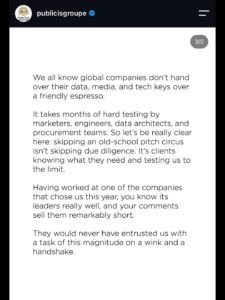
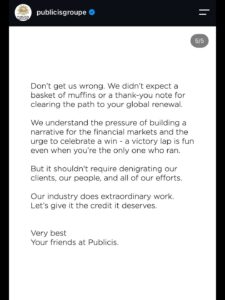
Its argument was straightforward: global companies do not surrender their media, data and technology operations because two chief executives have enjoyed a pleasant coffee meeting.
The group insisted that winning major business without a traditional pitch does not mean bypassing scrutiny. According to Publicis, its appointments involved months of technical and commercial evaluation by marketers, engineers, data architects and procurement teams.
Its sharpest point was that skipping the traditional pitch process should not be confused with skipping due diligence. In other words, a client does not need to organise an elaborate agency beauty contest to conduct a rigorous assessment of its preferred partner.
But Publicis was not finished
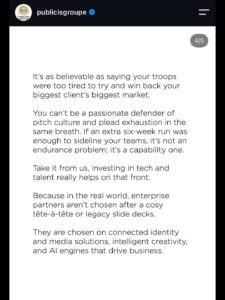
The letter turned towards WPP’s decision to sit out Coca-Cola’s North America review, questioning how a company could defend the traditional pitch process while citing the demands of another six-week competition as a reason not to participate.
Its remark that the issue was not endurance but capability made the exchange consistently more personal. The group also took a swipe at WPP’s financial-market narrative, suggesting that its celebration of the Coca-Cola business should not come at the expense of clients, competitors or the professionals doing the work.
The accompanying social media caption was equally pointed: “We’re not angry, we’re just disappointed.”
Is the traditional agency pitch losing its power?
Beneath the humour and corporate sparring lies a serious question about how global brands choose their advertising partners.
For decades, competitive pitches have been a familiar feature of agency selection. They allow brands to compare strategic thinking, creative capabilities, commercial proposals and chemistry before awarding major assignments.
However, the process can be expensive, time-consuming and demanding for both clients and agencies. As marketing operations become more dependent on data, technology, identity solutions and artificial intelligence, some advertisers are increasingly interested in evaluating an agency’s actual operating capabilities rather than judging it solely through a presentation.
That does not make the pitch obsolete. Nor does it mean every appointment made without one is automatically the right decision. Due diligence remains essential, regardless of the selection process.
The real distinction is between the format of an evaluation and its quality. A competitive pitch can be rigorous, just as a direct appointment can be thoroughly scrutinised.
For agencies, the lesson is becoming harder to ignore: winning the presentation is not the same as winning the business. Brands want partners that can demonstrate their capabilities, integrate into complex operations and deliver measurable commercial outcomes.
Publicis may have delivered the industry’s most memorable response of the week, but the larger conversation is far from over.
And if this exchange proves anything, it is that while agencies may disagree on the best way to win a client, nobody wants to be accused of winning one over coffee.
ALSO WATCH: MARKETING EDGE ONTV



Comment
No comments found.