


By Sam Adeyinka | Full-Stack Digital Marketing Specialist & Growth Strategist
A few days ago, I was reading a very interesting piece on Marketing Edge written by Mofeoluwa Awe, where she talked about how artificial intelligence is making marketing content easier to create, but leaving brands in a serious battle to stand out.
And she hit the nail on the head!
She quoted Kanika Saxena, the Vice President at Vodafone Idea, who asked an all-important question during the Marketing Conclave… “AI can help produce faster. But can it think?”
That question made me smile, because if you spend even five minutes scrolling through LinkedIn, Instagram, or X today, you already know exactly what I am talking about.
You see someone post an AI-generated picture of an African professional sitting in an office, and something immediately feels off. The skin looks like melted candle wax, the smile looks frozen, the teeth are a little too perfect, and the caption starts with something tired like “In today’s fast-paced digital landscape, unlocking your brand’s potential is paramount…”
Everyone reading it knows within two seconds that a human being didn’t write it, so they roll their eyes, swipe past it, and forget the brand even exists.
This isn’t an isolated grievance; it is a structural crisis across modern digital media. Enterprise research from Gartner projects that over 80 percent of companies will deploy generative AI models in active production workflows over the next two years, driving an unprecedented flood of synthetic assets. But when speed replaces substance, generic content becomes the single biggest threat to enterprise brand equity.
It leaves us with one big question that every business owner, tech founder, and marketing specialist needs to answer right now… if everyone has access to ChatGPT, Midjourney, Gemini, and Claude, and everyone is pressing the same buttons to make content faster, how do you actually make sure your brand doesn’t become invisible or obsolete?
The answer is simple, but most people are making it overly complicated.
You see, the secret is not in treating the technology as Artificial Intelligence; it is in treating it as Augmented Intelligence.
The Big Mistake People Make with AI in Marketing
The reason so many brands are sounding identical today is that they are treating generative AI like an automated replacement for their own strategic thinking.
A business owner or a junior marketer, and even some so-called senior marketing communications experts, will wake up in the morning, open a chat window, type “Write me five social media posts for a B2B SaaS startup in Lagos,” and then copy and paste whatever the screen spits out directly onto their page.
Then they sit back and wonder why nobody is engaging, clicking through, or converting into paying customers.
AI is a mathematical probability engine. It takes whatever already exists on the public internet, averages it all together, and gives you back the most statistically predictable response possible. When you ask it to do all the creative heavy lifting for you, what you get back is pure digital vanilla. It is grammatically polished, but it has zero pulse, zero friction, and zero soul.
Augmented Intelligence in marketing is the exact opposite of that lazy approach.
With Augmented Intelligence, you don’t hand over the driver’s seat to the machine. You sit firmly in the driver’s seat as the Creative Director, and you use the technology as a high-speed execution engine to scale what you already envisioned.
The machine brings the processing speed and the ability to test twenty distinct creative angles in five minutes; but you bring the human perspective, the real-world street smarts, and the cultural nuance that no algorithm in Silicon Valley can ever replicate.
The 3-Stage Empirical Test… From Algorithmic Slop to Editorial Masterwork
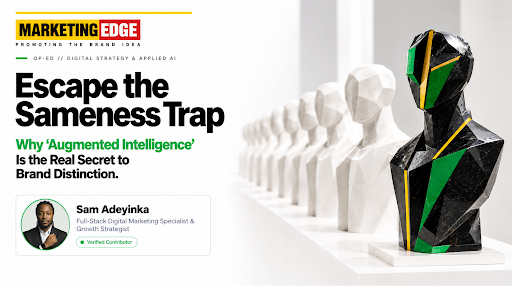
To demonstrate the practical difference between passive prompting and directed Augmented Intelligence, I conducted a controlled, three-stage empirical experiment using the design of this article’s official cover banner as a live benchmark. The goal was straightforward; test how an identical generative model responds when moved from an unconstrained prompt to a fully calibrated creative brief.
Stage 1: The Baseline Prompt and Algorithmic Slop
In the first stage, I gave the model a minimalist, single-sentence prompt asking for a standard blog graphic for this topic. Left without human strategic guidance, the algorithm defaulted to tired sci-fi clichés… a literal floating holographic brain surrounded by neon light rings, an anonymous lineup of faceless figures facing backward, and a glossy, plastic-skinned character in an emerald polyester suit. It looked like an amateur stock graphic because the algorithm was forced to guess the context.
| STAGE 1 PROMPT (THE MINIMALIST BASELINE): “Please I need a 1376×768 blog graphic for this topic: Escape the Sameness Trap and Why ‘Augmented Intelligence’ Is the Real Secret to Brand Distinction. Author name is Sam Adeyinka and he’s Full-Stack Digital Marketing Specialist & Growth Strategist.” |
Stage 2: The Uncalibrated Technical Prompt and the Vanity Trap
In the second stage, I dramatically upgraded the technical parameters, specifying Hasselblad medium-format camera optics, 5600K studio strobe lighting, and authentic epidermal micro-textures. While the aesthetic quality improved instantly, it introduced a new failure mode… the vanity trap. The model produced a high-gloss personal portrait, but hallucinated random champagne-gold accents, completely missed Marketing Edge’s brand identity, and failed to communicate the actual thesis of the article. It proved that technical jargon without brand strategy only produces prettier irrelevance.
| STAGE 2 PROMPT (THE UNCALIBRATED TECHNICAL PROMPT): “Cinematic 1376×768 editorial header, Hasselblad H6D-100c medium-format portrait of Sam Adeyinka, 5600K Profoto studio lighting, natural skin micro-textures, photorealistic rendering. Incorporate champagne-gold modern typography and high-tech digital studio elements.” |
Stage 3: The Calibrated Augmented Intelligence System
In the third stage, I applied the full Augmented Intelligence framework. Instead of a casual prompt, I fed the engine a comprehensive 15-parameter Executive Creative Director brief. I enforced strict brand constraints… matching Marketing Edge’s live editorial design system with Canary Yellow, Optical White, and Jet Black; mandating heavy Swiss grotesque typography; eliminating floating sci-fi brains in favor of an intellectual physical metaphor on a white pedestal; and locking in exact compositional padding.
| STAGE 3 PROMPT (THE CALIBRATED AUGMENTED BRIEF): “Act as a world-class Executive Creative Director, Master Advertising Designer, and Senior Art Director for Marketing Edge Magazine. Create a completed, print-ready 1376 x 768 px editorial cover graphic for a featured industry op-ed on marketingedge.com.ng… [Full 15-parameter architectural brief with exact publisher brand hex codes #FFD500, #1EB53A, #111111, medium-format Hasselblad 80mm optics, fine-art physical sculpture metaphor on white pedestal, 1:1 circular avatar geometry, and anti-slop negative constraints]” |
NOTE: The complete prompt architecture, including the full 15-parameter creative briefs, diagnostics, and the side-by-side visual progression across all three stages, is published open-source on GitHub.
The result of Stage 3 was the master editorial banner you see at the top of this article. The model didn’t suddenly become smarter between Stage 1 and Stage 3; the human directing it provided the taste, the brand rules, and the strategic guardrails.
AI is incredibly powerful, but its ability to deliver pure gold lies in the power of your imagination and your ability to spar with it in a smart and intelligent way.
One thing to take note of from my test sprint above is that one prompt was basic, while the other was not just advanced but had an enormous level of context, physics, brand rules, and negative constraints to help the AI be more creative, intuitive, and elevated in its delivery. This is what I call augmenting and collaborating with Artificial Intelligence.
Why Audiences Instantly Spot Fake AI and How to Fix Brand Distinction
This distinction matters because audiences are developing immediate cognitive immunity to synthetic content. In their landmark State of Marketing & AI Report, conducted in partnership with The Harris Poll across 1,415 marketing leaders and 3,547 consumers globally, Canva revealed a startling paradox. While 97 percent of marketing leaders now use AI in daily creative work, 70 percent of consumers state AI-generated advertisements feel like they are missing something, and 78 percent actively prefer ads made by people even if AI could produce a technically cleaner version.
Consumers do not hate technology, but they despise feeling like a brand couldn’t even be bothered to think before hitting publish.
When you look at visual advertising, for instance, you see brands posting images of people that look like synthetic plastic mannequins. When I direct AI-driven commercial visual campaigns for growing brands, I mandate strict negative constraints against artificial smoothing. I make sure generative prompts specifically enforce real biological textures… natural laugh lines, organic facial asymmetry, realistic melanin undertones, and visible epidermal pores.
Across more than 40 bespoke commercial AI visual campaigns I have directed and deployed over the past month alone, this commitment to biological realism and authentic human texture is consistently what stops users mid-scroll and drives genuine ad engagement.
Aside from biological realism, brand distinction requires deep cultural truth.
An AI prompt might know how to draw a yellow Danfo bus, but it doesn’t know what it feels like to run through the frantic evening rush at Oshodi under heavy rain. It doesn’t know the exact humor, the local slang, the quiet family pride, or the everyday tension that makes a Nigerian or an African consumer stop and say, “Yes! This brand actually understands my world.”
When you put those real, grounded cultural details into your creative assets, the content stops looking like a generic AI shortcut, and it starts feeling like an authentic story that commands immediate attention and consumer trust.
Stop Chasing Vanity Posts, Start Building Applied AI Conversion Funnels
Mofe also asked another great question in her article that really resonated with me… “More content, but what is the impact?”
This is where so many marketing teams lose the commercial plot.
They get so excited because AI allows them to publish four graphics a day on Instagram or post twenty times a week on LinkedIn; but when you look at their pipeline value or their Customer Acquisition Cost, nothing is moving.
Publishing twenty generic posts a week does not grow a business. In fact, it often hurts your reach, because when your audience sees that your content is generic noise, they stop clicking, and social recommendation algorithms quietly bury your account.
In my work as a Full-Stack Digital Marketing Specialist and Growth Strategist, I don’t use AI to flood social feeds with noise; I use applied AI to build high-retention customer intake systems that put revenue on the board.
For example, instead of giving away a boring, generic 10-page PDF lead magnet that nobody ever reads, you can build an intelligent diagnostic assessment funnel. A prospect answers five or six targeted questions about their business operations, the system immediately pinpoints their exact bottleneck, and it gives them a personalized diagnostic breakdown right on the spot. We see completion rates on assessment funnels like that hit 90 to 97 percent, because people love discovering actionable insight about themselves.
Or take customer inquiry qualification. Instead of letting inbound B2B enterprise leads sit in an unmonitored inbox or a crowded WhatsApp channel for twelve hours while the lead goes cold, you can deploy trained, low-latency synthetic workflows that greet the customer in thirty seconds, qualify their budget, and book them directly into an appointment with a senior consultant.
That is how you deploy modern generative technology to scale product-led growth. You don’t use it to churn out more noise; you use it to eliminate conversion friction, qualify high-value leads faster, and slash your Customer Acquisition Cost!
Wrapping Up… Taste, Strategy, and Creative Direction Are the Ultimate Moat
Whenever a new wave of technology arrives, people always panic and claim that creative skill is dead.
When digital cameras came out, people said professional photography was over. When computers entered the design world, people said graphic design was finished. But history shows us the exact opposite every single time.
When technical execution becomes cheap and accessible to everyone, the basic ability to push a button becomes worth zero. What suddenly becomes priceless is your taste, your judgment, your deep understanding of human psychology, and your ability to direct the tools toward an actual commercial outcome.
AI is not going to replace marketers and brand builders. But the growth specialist who masters Augmented Intelligence… combining machine computational speed with deep cultural insight, compelling storytelling, and data-backed performance funnels… will completely outperform anyone still copy-pasting generic prompts from a chatbot.
Visibility might get someone to look at your brand for half a second. But authentic human distinction is the only currency that will ever earn genuine customer loyalty and long-term commercial success.
READ ALSO: As AI makes marketing content easier, brands face a new battle for distinction
Author Byline & Bio (For Marketing Edge)
Sam Adeyinka is a Full-Stack Digital Marketing Specialist and Growth Strategist with over 14 years of hands-on experience helping technology startups, digital product founders, and growing brands scale their customer acquisition funnels, performance media buying, and applied AI systems. You can check out his portfolio here, connect with him on LinkedIn or via email. Read my Open-Source AI Benchmark on Github.




Comment
No comments found.