
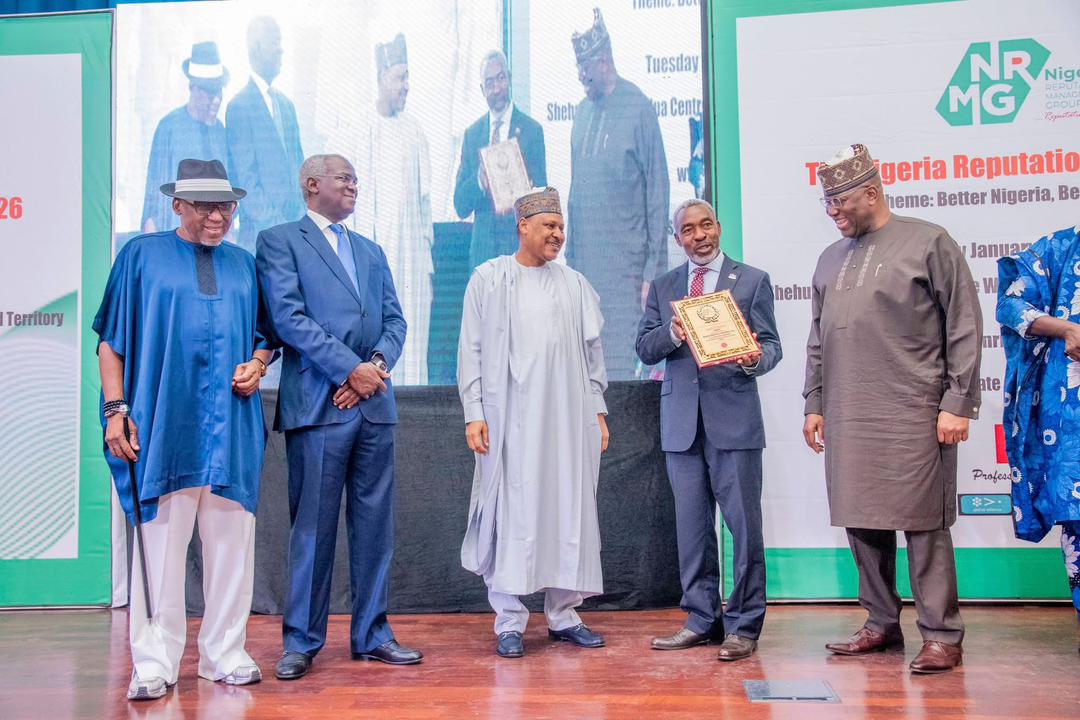




At the heart of the conversation, Nigeria’s reputation crisis was framed not as a government problem alone but as a collective responsibility.
In other words, it that demands coordinated action from citizens, businesses, media and policymakers, stakeholders heard at the inaugural Nigeria Reputation Summit in Abuja.
Setting the stage for honest reflection, speakers on Tuesday at the Shehu Musa Yar’Adua Centre presented a sobering assessment of Nigeria’s global standing while, at the same time, outlining pathways toward reputation recovery built on ownership, consistency and strategic communication.
Data Sets the Tone for National Reflection
Opening the discourse with empirical insight, Dr. Ike Neliaku, president of the Nigerian Institute of Public Relations, set the tone by presenting findings from the newly launched Nigeria Reputation Perception Services report, a scientific framework that provides the first baseline measurement of how the country is perceived globally.
“Nigeria’s overall reputation score is 35.2 out of 100, positioning our national reputation in the poor category and confirming what the report describes as high potential but low trust,” Neliaku told the gathering. “The challenge we have is the challenge of trust.”
Breaking the data down further, the report measured reputation across seven pillars: culture scored highest at 49.4, followed by leadership at 37.6, sociality at 37.3, communication at 33.7, innovation at 33.1, performance at 32.3, and credibility at 30.7.
People as Nigeria’s Strongest Reputation Asset
Despite the troubling statistics, Neliaku emphasized that Nigeria’s greatest reputation capital remains its people.
“Nigeria’s greatest reputation capital is our people. This comprises our creativity, our music, our fashion, our sports, our food, our resilience and our audacity,” he said.
However, he was quick to caution, culture alone cannot sustain national reputation.
“Culture can open the door, but it cannot keep the door open,” he said, calling for coherence in government communication.
Expanding on this concern, he expressed frustration with fragmented messaging from government officials.
“If you don’t have coherence, that’s the challenge. One is talking this way, the other one is talking that way. Sometimes, they say they are confused. They don’t even know which one to believe. We must have a way of addressing these issues.”
Fashola Draws Line Between Criticism and Sabotage
Reinforcing the theme of shared responsibility, Babatunde Fashola, former Lagos State governor and two-time minister, drew a critical distinction between legitimate criticism and national sabotage.
“Government is different from country. We must criticize government and politicians without throwing our country under the bus,” Fashola said in his keynote address. “Governments will change, politicians will come and go, but the territory of the Federal Republic of Nigeria will outlive all of us.”
Anchoring his argument in law, he pointed to Section 24 of Nigeria’s Constitution, which imposes a duty on every citizen to “help enhance the power, the prestige and good name of Nigeria.” Yet Fashola questioned how many Nigerians actually know or fulfill this constitutional obligation.
Looking to history for perspective, Fashola argued that Nigeria once commanded global respect despite domestic challenges.
“There is no country without challenges, and how we embrace those challenges is what defines us, not the challenges themselves,” he said.
Ownership as the Foundation of Reputation Recovery
Moving from critique to solution, Fashola called for ownership as the foundation of reputation recovery.
“Let us own the idea of Nigeria, because I don’t think we have owned it enough,” he said, expressing frustration with dual citizens who refer to Nigeria as “your country” rather than taking collective ownership.
Equally important, he emphasised the power of language, warning that Nigerians have become extremely negative in their conversations about the country.
“We have to become positively intentional now as we speak about ourselves, as we speak about our communities, as we speak about our country.”
Reputation Framed as a Strategic National Asset
Adding a strategic dimension, Yomi Badejo Okusanya, chairman of the Nigeria Reputation Management Group and convener of the summit, framed reputation as a national asset rather than a cosmetic concern.
“Reputation is no longer a soft issue. It is not cosmetic and is certainly not optional,” Badejo Okusanya said. “In today’s hyper connected, digitally amplified world, reputation has become a strategic national asset that influences investment flows, citizens’ trust, diplomatic standing, consumer confidence and even national security.”
Clarifying the mechanism of reputation, he emphasised that reputation is not what people believe about a nation but what leadership consistently proves.
“The nation that does not manage its reputation leaves its story to chance and to others. Not through propaganda, but through credibility, consistency, transparency and performance.”
Institutionalising Reputation Management
In a move toward long-term structure, Badejo Okusanya announced that the Nigeria Reputation Management Group has designated October 15 of every year as Nigeria Reputation Day to focus national attention on deliberate reputation management.
Further reinforcing institutional commitment, he revealed plans to establish a University of Public Relations and Leadership in Nasarawa State, which would be the third of its kind in the world.
“For government, it needs policy delivery and trust building. For business, it needs ethics and stakeholder engagement. For media, it needs balance, accuracy and national responsibility,” he said, outlining sector-specific responsibilities.
Extending the call beyond policymakers, he appealed to corporate Nigeria to support the initiative.
“The change we are looking for in Nigeria’s reputation is not just in Abuja. It’s not just with the leaders, it’s for each and everyone of us. The story of Nigeria is being written. Let us ensure that it’s written with truth, responsibility and strategic intent.”
Evidence That Reputation Recovery Is Already Underway
Bringing the discussion full circle, John Momoh, chairman of Channels Media Group, highlighted Nigeria’s recent achievements across multiple sectors, demonstrating that the foundation for reputation recovery already exists.
“Nigeria is a powerhouse. We’re about 200 million and counting. We are the creative and digital economy helping to redefine global culture.
But too often our stories of excellence are overshadowed by headlines that do not reflect who we actually are,” Momoh said.
So, backing his position with concrete examples, he cited Nigerian music artists dominating global streaming charts in 2025, with Grammy winner Burna Boy securing placement on global impact lists.
Continuing, he pointed to 99 Nigerian students recognised in the 2025 Cambridge Outstanding Learner Awards, including multiple best in the world distinctions, and two Nigerian girls who won a global tech competition, defeating teams from Japan, Canada and Spain with an AI safety app.
Again, adding another global indicator, Momoh referenced Nigeria’s ranking first in the 2025 World Giving Report for generosity.
“Nigeria is not just talked about. Nigeria is celebrated too. When we talk about better Nigeria, better reputation, we’re not imagining an aspiration. We are building on actual achievements, achievements that reflect the brilliance and generosity of our people.”
Reputation in a Fast-Moving Digital World
Still, he acknowledged the tension, noting the competing narratives that continue to challenge Nigeria’s image.
“For every headline of genius, there’s sometimes a competing headline of frustration, but attention itself tells us something powerful. Nigerian reputation is dynamic. It’s not fixed, and it is shaped not just by what we say but by what we do and how consistently we do it.”
Therefore, highlighting the urgency of action, the veteran broadcast journalist emphasized how reputation now moves faster than facts.
“Reputation today moves faster than policy cycles. One viral image can travel the world before a committee is convened to study it. Investors now price trust alongside interest rates when deciding where to commit capital.”
Aligning Systems With the Excellence of the People
In conclusion, Momoh stressed that culture and creativity must now be treated as national assets.
“We are here not to defend Nigeria or even merely to celebrate it. We are here to strengthen it, to make sure our systems, our communication and our actions match the excellence of our people.”


Comment
No comments found.