
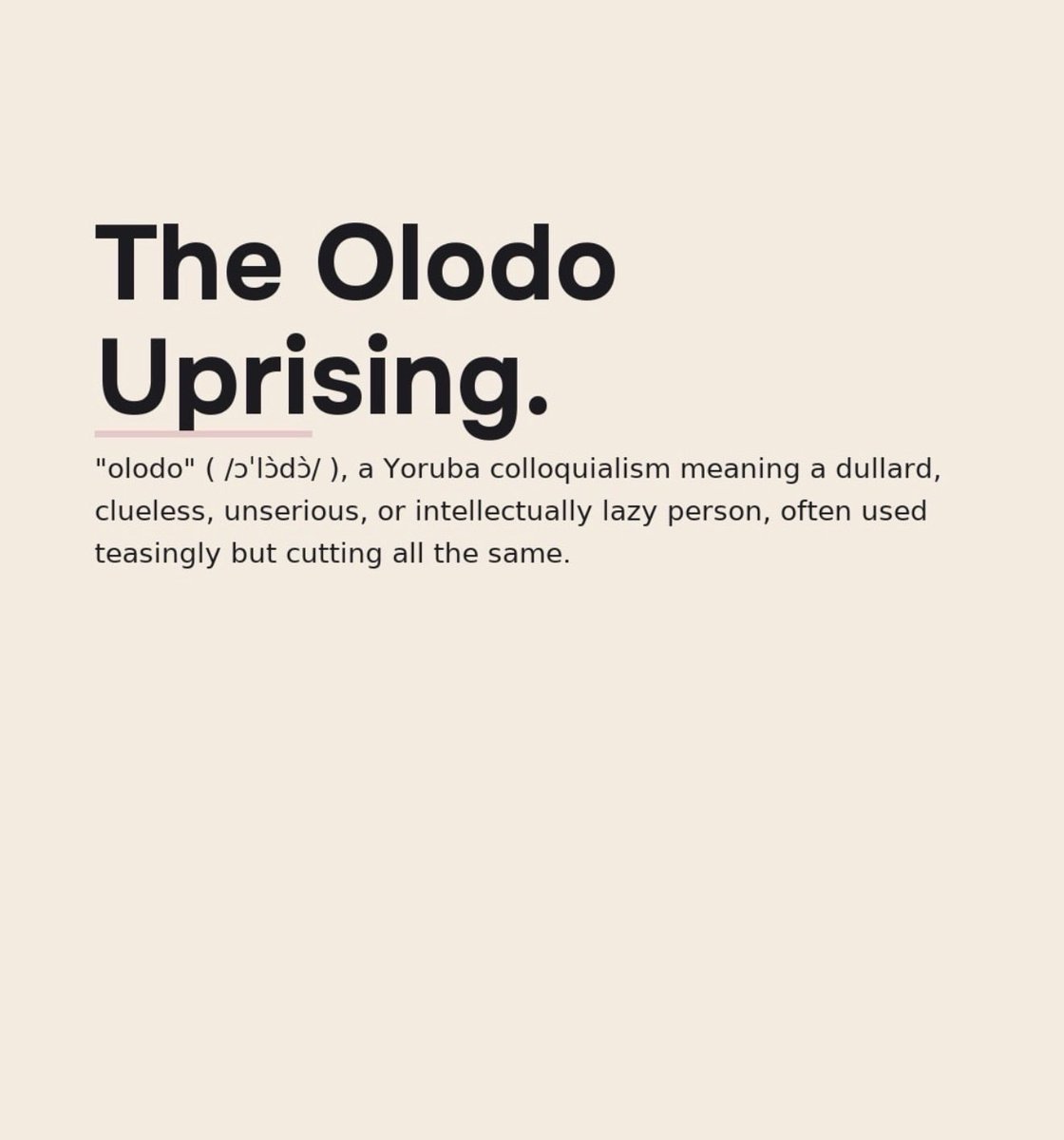


Rapper Ycee didn’t just start a celebrity feud when he coined the term “Olodo Uprising” on the Afropolitan Podcast last week. He named a mechanism that’s been running quietly in plain sight: Nigeria’s reward system has drifted away from what it claims to value.
The phrase has since dominated timelines, splitting public opinion into two camps. One side defends academic excellence as a cultural priority worth protecting. The other insists that content creators like Peller are simply adapting to a broken economy. Both sides are partly right. But the more useful question isn’t who’s correct, it’s what the disagreement reveals about incentives.
The Yoruba word olodo traditionally described academic strugglers, students who repeatedly failed exams. Today, the meaning has shifted. Being called an “olodo” online no longer signals limited access to education. It increasingly describes something else: a confident rejection of expertise, paired with a demand to be taken just as seriously as those who have it.
That shift matters more than the insult itself. It suggests the culture isn’t just tolerating ignorance; in some corners, it’s rewarding the performance of it.
- To Pitch or Not To Pitch:The problem is not pitching, but the people and the process
- Black At unveils ‘Through Her Lens’ Initiative, launches platform to power women across creative economy
- Fearless Energy Drink powers Felabration 2026 finale, celebrates boldness, music and unapologetic self-expression
The reward structure is the real story
Media personality Daddy Freeze made a strong point. He cited a paediatric cardiologist friend earning under N700,000 monthly, compared to creators earning multiples of that from a single viral moment. He concludes that we should blame Nigeria’s institutions, not individual content creators.
He’s not wrong. A country’s culture rarely drifts far from its incentive structure. If a best graduating student earns a token prize while a reality TV winner earns life-changing money for a few months on camera, young people will rationally adjust their ambitions. That isn’t moral failure. It’s price-signal literacy.
This is the pattern researchers and commentators have pointed to repeatedly this week: Nigeria doesn’t have an ignorance problem so much as a misaligned rewards problem. Academic excellence carries prestige but little income security. Virality carries both income and prestige, often within weeks.
The real complaint is about content design, not credentials
Strip away the celebrity names, and the sharper version of Ycee’s complaint isn’t about whether any individual creator is intelligent. It’s about what kind of content is winning. A specific format now dominates Nigeria’s digital space: low-effort, low-cognitive-demand content built around flaunting wealth, mocking or “fooling”, or manufacturing outrage for a clip.
Peller draws specific criticism partly because his content rarely leaves that lane. Grammar errors aside, his streams centre on money, insults, and spectacle, rarely sustaining an exchange of ideas. He isn’t being singled out for lacking a degree. He’s being singled out because the content format itself asks nothing of the viewer beyond reaction.
This pattern extends well beyond one creator. Content like Egungun of Lagos’s interview series, built around women’s bodies and attention rather than ideas, follows the same template: low intellectual demand, high shareability, built for a reaction rather than a thought. None of this requires formal education to critique. Entertainment can absorb real wit, timing, and craft — Nigerian comedy and music have proven that for decades. The issue isn’t entertainment itself. It’s a specific genre of entertainment that has crowded out everything that asks the viewer to think.
Why the format matters more than any single creator
The more concerning claim in this debate isn’t about any one personality. It’s about what habitual consumption of this format does to the audience over time. Attention, like most cognitive habits, adapts to what it’s repeatedly fed. A media diet built almost entirely on low-effort spectacle can recalibrate what feels watchable, gradually narrowing appetite toward content that demands nothing and rewards nothing beyond a laugh or a share.
This is the harder argument hiding underneath the celebrity feud: it isn’t really about whether Peller or any single creator is smart. It’s about a digital ecosystem that has scaled one content genre: flaunting, fooling, and friction, far beyond any other, training both children and adults toward a shrinking appetite for anything more demanding.
Beyond one creator
Peller didn’t design the incentives that reward spectacle over substance, and removing him from the equation changes little. Another creator fills the same format tomorrow, because the format itself is what the algorithm and the audience keep paying for.
That’s the harder problem the “Olodo Uprising” label points to, once the celebrity feud is set aside. It isn’t really a referendum on Peller’s intellect, or anyone else’s. It’s a referendum on what an entire generation is being trained to expect from fifteen seconds of content, and what that training does to its patience for anything longer.




Comment
No comments found.