


Nigeria’s young population is often described as either its greatest asset or its greatest risk, depending on whether young people can find skills, work and a platform for their ideas. The difference is usually made by institutions that invest in them over many years and not for a single season.
Consider the numbers. In the second quarter of 2024, the National Bureau of Statistics recorded unemployment of 4.3 per cent overall and 6.5 per cent for Nigerians aged 15 to 24, while 12.5 per cent of that age group were neither working nor in school or training. Behind each percentage is a young person with talent and ambition, still searching for a way in.
That is the gap Nestlé Nigeria has set out to close. The company says it has invested over ₦6 billion in youth skills, and it has built three bridges: from classroom to factory floor, from school pitch to wider opportunity, and from job seeker to job creator.
The Bridge From Classroom to Factory Floor
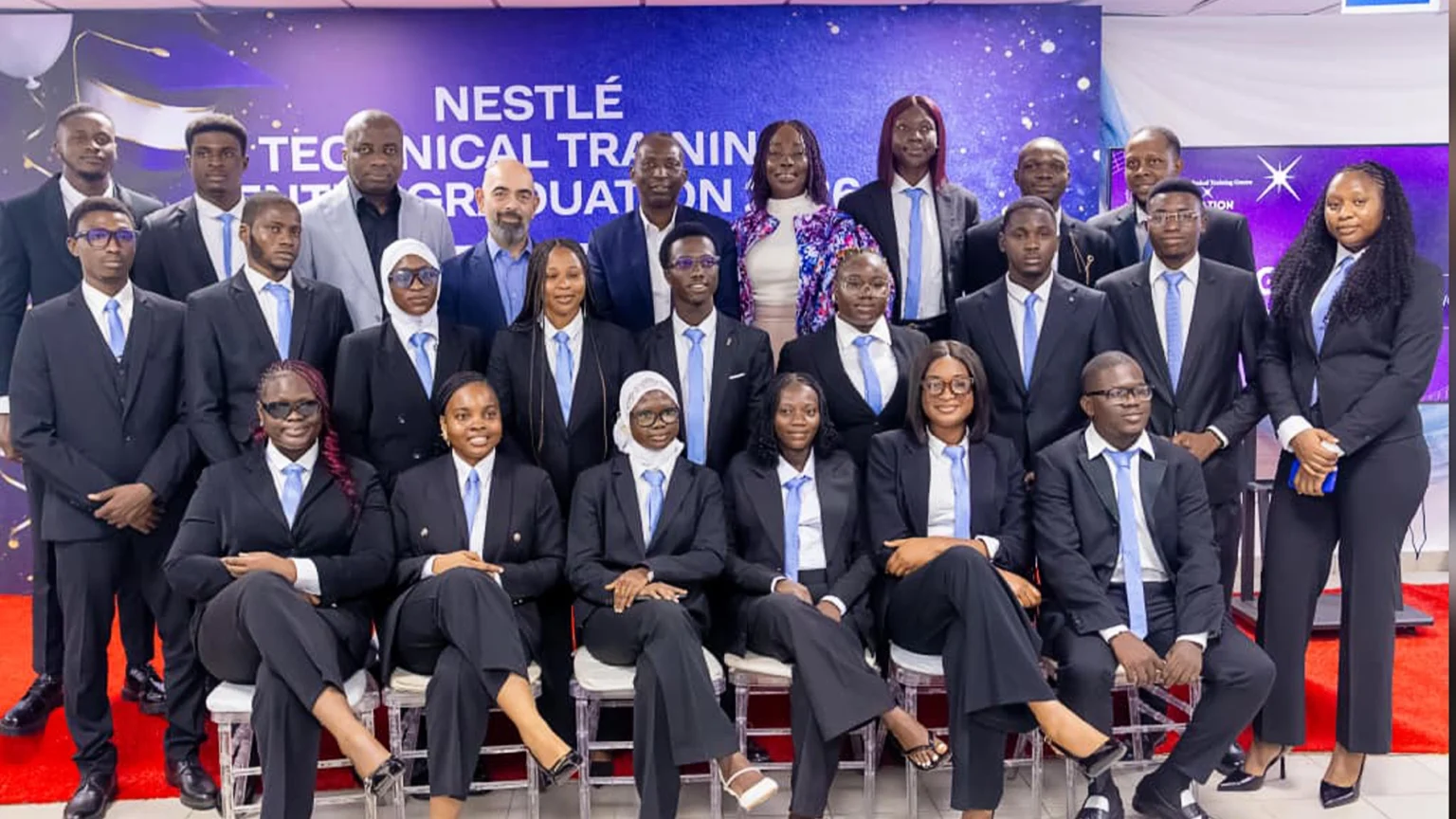
In 2011, Nestlé Nigeria opened its own technical school at the Agbara factory. Fifteen years later, the Nestlé Technical Training Initiative runs in Agbara, Flowergate and Abaji. Trainees spend 18 months moving between the classroom and live production, studying food technology, engineering and manufacturing operations, and they finish with the City & Guilds of London Technicians’ Certification. The company transitions 98 per cent of its graduates into its workforce.

The 15th anniversary year closed in 2026 with graduations at Flowergate and Abaji. At Abaji, 20 trainees, 10 young men and 10 young women, collected an internationally recognised certificate and, for almost all of them, a job.
Wassim Elhusseini, Managing Director and Chief Executive Officer of Nestlé Nigeria, urged them to treat it as a beginning. Every meaningful career is built step by step, through resilience, curiosity, and consistent performance,” he said.
Shakiru Lawal, Country Human Resource Manager at Nestlé Nigeria, said the company is playing a long game. “At Nestlé, youth development is not a one-off intervention; it is a long-term commitment to building skills, expanding opportunity, and preparing young people for the future of work,” Lawal said.
At the Flowergate ceremony, the valedictorian, Samuel Oladokun, said graduates were leaving the centre “not only with technical competence”, and described a training that built discipline, confidence and readiness for demanding industrial work.
Earlier graduates say the same. In 2025, Dolapo Adedoyin Okunola, then 25, described what a Swiss internship added to her Nigerian training. “The training in Nigeria combined with Swiss exposure gives me advantages most Nigerian graduates can’t access,” she told Marketing Edge. “I learned technical skills, experienced different work cultures, and even picked up basic French.”
At the Abaji ceremony, His Excellency Patrick Egloff, Ambassador of Switzerland to Nigeria, welcomed the gender balance of the class. “Technical excellence belongs equally to young women and young men,” he said.
Courts and Pitches as Classrooms
In Kano, two weeks of football gave 2,500 young players something talent cannot supply alone: structure. The inaugural MILO × Ahmed Musa Sports Clinic and Tournament, held in partnership with former Super Eagles captain and MILO brand ambassador Ahmed Musa, offered participants 10 coaching sessions, mentorship and competitive matches, and it closed with a tournament at the Ahmed Musa Sports Complex, where Khamis Football Academy emerged as champions. Participants also received cash prizes, certificates and football equipment.
“Nigeria has incredible football talent, but talent alone is not enough. Young players need good coaching, regular competition and people who will guide them.”
Gilbert Tweneboah-Koduah, Category Lead at MILO, explained the thinking behind the partnership. “At MILO, we believe sport is a powerful platform for young people to discover their abilities, build confidence and develop values that extend beyond the field of play,” he said.
The clinic is the newest chapter in a story that began on the basketball court. The Milo Basketball Championship is now in its 26th edition, and the 2026 edition reached more than 13,000 schools across Nigeria. For many students, it is the first place they learn what discipline, teamwork and resilience feel like under pressure.

L-R: Gilbert Tweneboah-Koduah, MILO Category Lead; young footballers; and Ahmed Musa, former Super Eagles captain and Nigerian football legend
Its reach shows in unexpected places. In April 2026, members of the Nigerian Institute of Public Relations (NIPR) paid a courtesy visit to the Vice-Chancellor of Ahmadu Bello University, Zaria, Professor Adamu Ahmed.
The delegation included Victoria Uwadoka, Head of Corporate Communications, Public Affairs and Sustainability at Nestlé Nigeria. During the visit, the Vice-Chancellor mentioned that he was among the early beneficiaries of the Milo basketball programme. He credited it with shaping his academic and career journey, and he commended Nestlé for keeping the dream alive.

Nigerian Institute of Public Relations (NIPR) visits the Vice-Chancellor of Ahmadu Bello University, Zaria, Professor Adamu Ahmed
The platform is about to widen. Nestlé and the National Basketball Association (NBA) have announced a multi-year marketing partnership that makes Milo, Nescau and Nesquik official partners of the NBA across 21 markets on four continents, Nigeria included, from 1 January 2027.
It will bring youth programmes such as Jr. NBA/Jr. WNBA, NBA Basketball School and Her Time to Play to participating markets. “This partnership with the NBA builds on that strong foundation, connecting our longstanding commitment to basketball in Nigeria with a truly global platform,” Elhusseini said.
From Job Seekers to Job Creators
Not every young Nigerian will work in a factory, and not everyone should. A graduate placed in a job supports one household, while a trained entrepreneur may employ others.
That is the thinking behind the enterprise side of Nestlé Needs YOUth, the company’s global youth initiative, which aims to reach 10 million young people worldwide by 2030.
At the National Youth Entrepreneurship and Empowerment Summit (YEEP) 2026 in Abuja, organised by the Activate Success International Foundation, Nestlé Nigeria renewed a partnership that has run for eight years.
Uwadoka told young participants that opportunity follows usefulness. “Your ideas are only ideas until you bring them to life,” she said. She added that “money, support, and finances flow to solutions”, and she commended the foundation for staging the conference for the ninth consecutive year.
Skills, sport and enterprise: Nestlé Nigeria’s long bet on the country’s young people
According to Nestlé Nigeria’s 2025 reporting, more than 5,000 participants completed its Youth Entrepreneurship Platform, over 1,000 undergraduates took part in Nesternship virtual internships, 80 science and technology students received scholarships, and 20 young innovators received seed funding and mentorship at an entrepreneurship challenge in Abuja.
The Alliance for YOUth Nigeria, founded with Jobberman Nigeria and other partners, was reported to have reached more than 25,000 young Nigerians by its fourth anniversary in August 2025.
What It Adds Up To
Put the three bridges side by side and a pattern emerges. Technical graduates enter factories with internationally recognised certificates and a job waiting. Thousands of students find discipline and confidence on courts and pitches, from 13,000 schools to a football complex in Kano.
Young entrepreneurs find mentors, partners and platforms to turn ideas into businesses. Each programme answers a different gap, and together they serve one national need: a generation equipped to work, lead and build.
What gives the programmes weight is how long they have lasted. A school competition in its 26th edition, a technical centre in its 15th year and an enterprise partnership in its eighth are not one-season campaigns.

The Path Forward
Moving forward, the momentum is building. The NBA partnership begins in January 2027, the technical centres will keep producing certified graduates, and the clinics, summits and partnerships will keep opening doors for new cohorts of young Nigerians. For a country counting on its young people, Nestlé Nigeria’s long bet is already visible in its graduates, its players and its young entrepreneurs, and it offers a clear lesson: invest early, stay long and partner widely.




Comment
No comments found.