
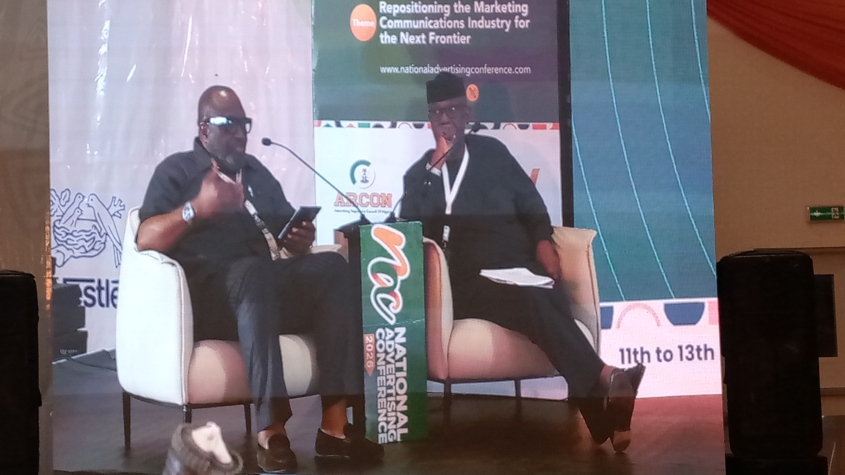



Advertising veterans, Lolu Akinwunmi, group managing director of Prima Garnet Africa, and Idorenyen Enang, managing director of Corporate Shepherds, have said that despite the rapid rise of artificial intelligence and technological disruption, the fundamentals of marketing communications remain unchanged.
They made the submission at the 2026 National Advertising Conference (NAC) in Abuja, during a session titled “Some Things Will Never Change – Enduring Principles.” The session, held at the Abuja Continental Hotel, came at a time when the industry is contending with automation, media fragmentation and growing client-side capabilities.
Akinwunmi and Enang argued that consumer understanding, differentiation, creativity, trust and strong agency-client partnerships will continue to determine success, regardless of the technology available.
AI Is Not a Mind
Akinwunmi described artificial intelligence as the first major marker of where the industry currently stands, noting that its full impact is still unfolding.
“Everybody in this room can now develop a campaign on your telephone,” he said.
He said AI is only one part of a wider disruption that includes changing tools, platforms and processes, many of which did not exist a few years ago. He also identified media fragmentation, changing consumer behaviour, the democratisation of creativity, data and automation, and competition from clients as forces reshaping the business.
Akinwunmi, however, cautioned against treating AI as a substitute for human understanding. He recalled asking a large language model for information about himself and being surprised by the detailed response it generated. On reflection, he said, the system had simply retrieved and synthesised information it had been fed.
“AI, in other words, is an extraordinary retrieval and synthesis engine, not a mind,” he said. “It does not understand people. It cannot do consumer behaviour.”
For him, the consumer must always come first. While data and technology can support marketing, he said understanding human needs, motivations and behaviour remains a distinctly human responsibility.
Principles That Endure
Akinwunmi said advertising must continue to solve a problem or satisfy a need, even as consumer needs evolve. He identified differentiation as the heartbeat of the business and stressed that creativity remains essential because original thinking influences purchasing decisions.
He also emphasised consistency as a critical brand-building tool, citing the familiarity of a Coca-Cola bottle as an example of how reliability becomes a commercial asset.
Strategy, he added, remains the thinking part of creativity, while ethics and integrity must continue to guide industry practice.
On the changing agency model, Akinwunmi recalled that when he joined Lintas in 1982, agencies operated with seven or eight key departments. Today, he said, an agency can function with three or four.
“If the service has shrunk, the remuneration model must follow,” he said.
He argued that clients paying for fewer services have a right to negotiate, adding that the likely outcome is smaller, leaner and more efficient agencies. He also noted that competition has intensified, with some clients now building in-house capabilities and negotiating media directly.
Partnership and Trust Matter
Enang brought a personal dimension to the discussion, recalling his early career as an account executive on Satzenbrau more than three decades ago. He said he organised a pitch at the National Theatre involving LTC, Campaign Palace, Insight and Prima Garnet, with Prima Garnet emerging victorious.
Years later, while at Cadbury, he said he insisted on opening the company’s business to competition again. Once more, Prima Garnet won.
“If I had compromised, you would not want to share this stage with me,” he said, drawing applause.
Enang said chemistry builds great work and honest agency partnerships. Behind every iconic campaign, he argued, is a client who provides an honest brief and an empowered agency willing to challenge ideas when necessary.
“Automation may streamline workflows and media buying, but it cannot replace mutual respect,” he said.
He warned that when clients treat agencies as vendors and agencies behave as order-takers, “no amount of AI will save the work.”
Enang also stressed that trust and integrity remain non-negotiable. According to him, a broken product promise cannot be advertised out of existence, while a brand without credibility is merely making noise.
The Real Threat
The session concluded with a clear message: the industry’s anxiety about AI may be misplaced.
The technology itself is not the threat. The real danger, according to Akinwunmi and Enang, is an industry that forgets its purpose—one that confuses execution with understanding, speed with insight, and visibility with trust.



Comment
No comments found.