
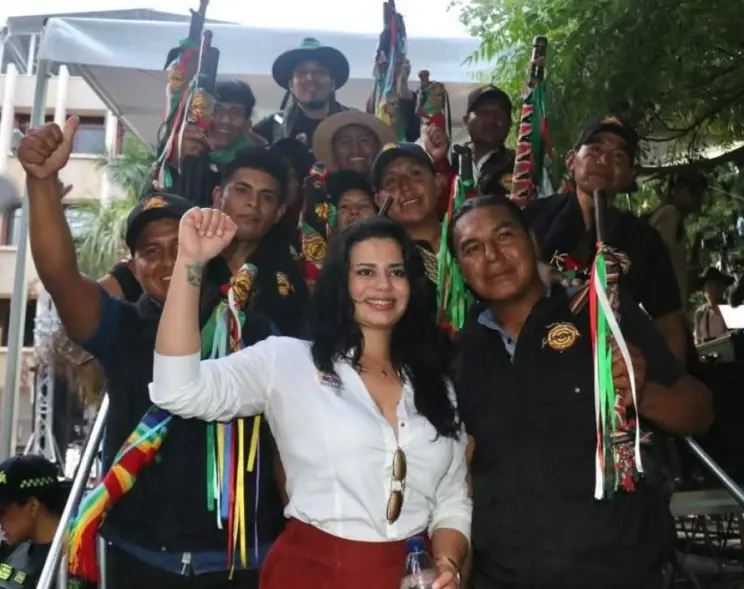


Most political campaigns are built around reinvention. Deyci Alejandra Omana Ortiz chose the opposite, and won a Senate seat in Colombia doing it.
Ortiz, 33, known professionally as Amaranta Hank during her time in the adult content industry between 2017 and 2019, was sworn in as a senator for Colombia’s left-wing Historic Pact party in Bogotá on Monday. However, what makes her victory remarkable is not simply that a former adult content creator won public office. It is how she won it.
She did not hide her past. She did not apologise for it. Instead, she built her entire campaign around it, positioning her lived experience in an unregulated, stigmatised industry as the very thing that qualified her to legislate for the millions of content creators the state had failed to protect.
“These women have been unprotected by the state because, due to misinformation, prejudice and double standards, no one has declared to regulate it,” she said in a campaign video that circulated widely across Latin America.
Furthermore, when critics argued that former adult stars should not run for office, Ortiz did not retreat. She pushed back with a question that reframed the entire debate. “Why can’t a woman who was in the adult industry aspire to a popularly elected office?” she asked. “The problem is that society consumes adult films but denies us the possibility of speaking in spaces of power.”
That response is not just a political statement. It is a brand positioning masterclass.
The PR lesson hiding inside the politics
From a communications and brand strategy perspective, Ortiz executed something that most politicians, and most brands, spend entire careers avoiding. She leaned into the thing that her opponents thought would disqualify her and turned it into her most powerful credential.
Consequently, her campaign did not need to manufacture authenticity. It was built entirely on it. Her audience; the millions of content creators, sex workers, and marginalised workers operating in unregulated digital economies, did not need to be convinced that she understood their problems. She had lived them. Moreover, her willingness to be publicly identified with that experience, rather than quietly distance herself from it, built a level of trust with her constituency that no polished campaign could have replicated.
Additionally, the media attention her candidacy generated was entirely organic. Her story travelled internationally not because of a PR budget but because it was genuinely compelling, a narrative with conflict, courage and a clear protagonist who refused to be defined by other people’s shame.
Therefore, the strategic lesson for Nigerian brand managers, communications professionals, and marketers is direct. The most powerful brand stories are not built on reinvention. They are built on ownership. The brands and people, that win in the attention economy are the ones willing to stand fully in who they are, speak directly to the audience that needs them most, and refuse to let critics define the narrative before they do.
Ortiz did not rebrand herself for public consumption. She simply told the truth; loudly, consistently, and without apology. That is not just good politics. It is the oldest and most effective form of brand building there is.
ALSO WATCH: MARKETING EDGE ONTV




Comment
No comments found.