


Some brand collaborations ask you to think. This one just asks you to feel something.
On 6 June 2026, Adidas Originals and Coca-Cola dropped a 25-piece collection timed to the FIFA World Cup 2026, and it landed less like a product release and more like a cultural mood board. Footwear, apparel, accessories. Bold red. Archive energy. The unmistakable visual grammar of two of the most recognisable brands on earth, sharing the same label for the first time since they first joined forces around the 2002 World Cup in Japan and South Korea.
Twenty-four years later, they are back. And they brought the early 2000s with them.
The footwear is where the collection announces itself loudest. Six silhouettes, each one a piece of adidas Originals history, reimagined through a Coca-Cola lens. The lineup centres on four signature 2000s adidas silhouettes, the Adistar Control 5, the Predator Sala, the Climacool 1 and the Megaride F50, each reworked to echo a different Coca-Cola can, complete with droplet effects and gloss hits that mimic condensation. The Megaride F50 goes further still, paying homage to the iconic Coca-Cola glass bottle. There are also two colour ways of the Samba OG, two of the Superstar II, and co-branded Adilette slides, the kind of thing you wear to the viewing party and somehow look intentional doing it.
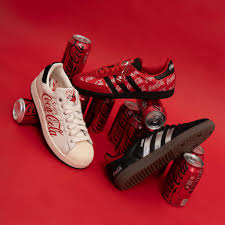
Prices run from $45 for the slides to $190 for the Megaride F50, with most of the footwear sitting between $110 and $140. Not cheap. Not inaccessible either. The sweet spot for a collection that wants to be worn, not just displayed.
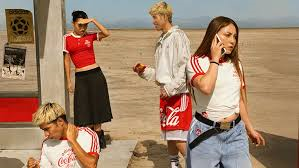
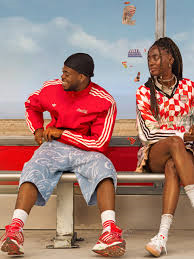
The apparel is equally considered. Retro football jerseys, track tops, graphic t-shirts, and a bright red airliner bag that has no business being as covetable as it is. The campaign behind the collection is titled “Originals are the Real Thing” and is fronted by rising football star Lamine Yamal, 2024 Euros winner, Barcelona’s teenage phenomenon, and the kind of face that connects archive aesthetics to a generation that was not yet born when the original Adidas-Coca-Cola partnership launched. Shot on a hot summer day, the campaign follows a group of distinct, slightly offbeat characters waiting for a bus to the 2026 World Cup, with the styling doing the heavy lifting, loose jerseys, shiny shorts, old-school track jackets and that unmistakable Coca-Cola red.

It is an interesting creative choice. No stadium. No pitch. No match footage. Just people, heat, and the feeling of going somewhere.
That choice is not accidental. What Adidas and Coca-Cola are selling here is not football exactly, it is the culture that grows around football. The bus journey to the ground. The corner-shop fridge. The jersey you wore until it fell apart. The collection builds around a recognisable cultural memory: tournament summers, old advertising, streetwear silhouettes and football’s long relationship with colour, commerce and identity. Nostalgia is the creative strategy, and it is being deployed with real precision.
Which brings us to the wider picture.
The 2026 World Cup is shaping up to be one of the most commercially contested tournaments in the history of the game. Adidas and Nike have both arrived early, each enlisting some of the biggest names from sport and entertainment to front high-concept campaigns. Adidas has built on its campaign with a Bad Bunny signature shoe, a Bringback Collection of iconic national team jerseys, and an activation that turns the football emoji into the official match ball on WhatsApp, all alongside this Coca-Cola collaboration. Nike, for its part, is not standing still.
And then there is the other rivalry running parallel to everything on the pitch.
While Adidas and Coca-Cola are doing this together, two official FIFA partners, two brands with decades of tournament history, sharing creative real estate, the question their link-up quietly raises is what their rivals are doing about it. Nike has its campaigns. Pepsi has its activations. Industry observers have noted that the Nike-Adidas battle feels like the cola wars, a feud that has been running forever and shows no sign of cooling down. Adidas and Coca-Cola did not just drop a collection. They moved first, moved loudly, and anchored themselves to the emotional centre of the tournament, nostalgia, culture, and the feeling of summer football, before a single group stage match had been played.
Nike. Pepsi. The floor is yours.
ALSO WATCH: MARKETING EDGE ONTV


Comment
No comments found.