
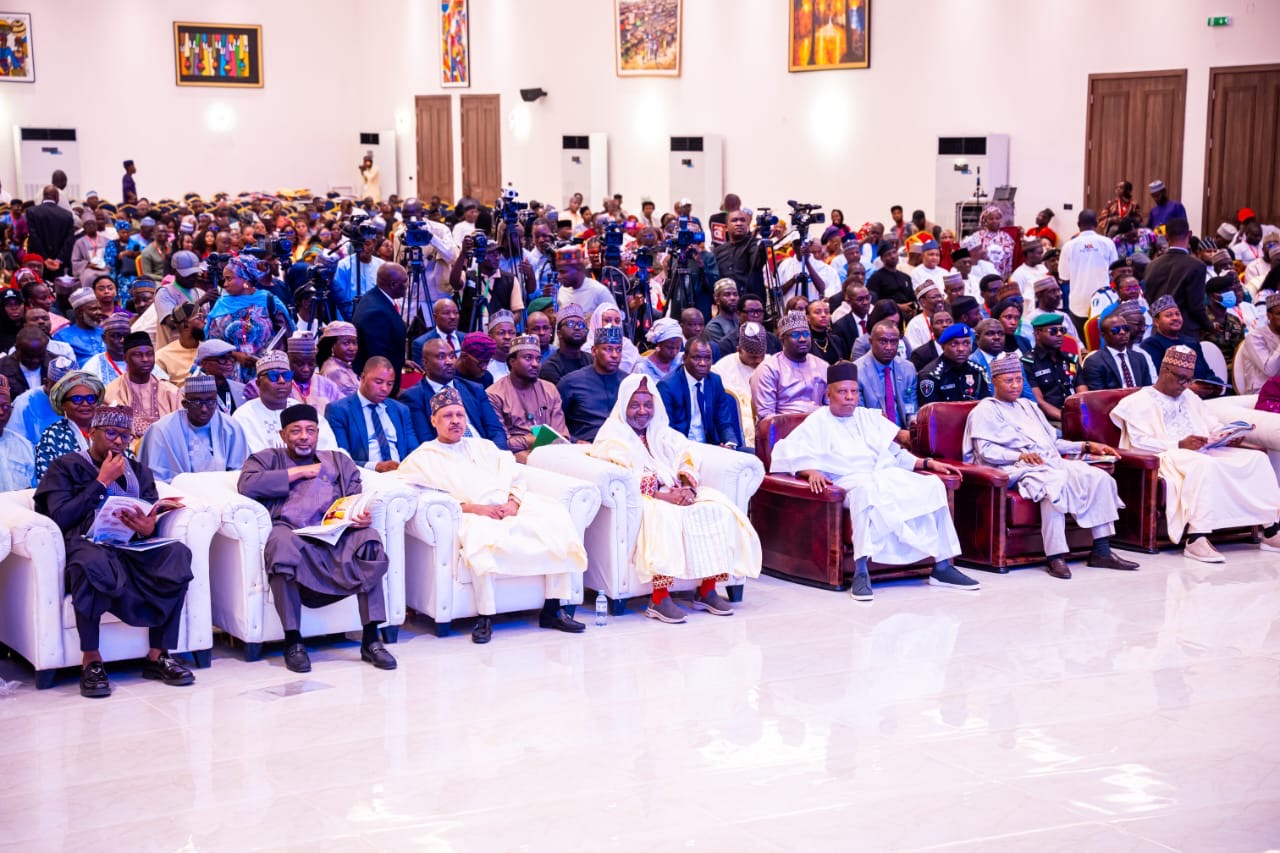


The third edition of the Nigerian Public Relations Week (NIPRW), tagged Croc City 2026 and held in Kaduna, the first edition to be hosted in northern Nigeria, opened at the newly commissioned Brigadier General Abba Kyari Banquet Hall, Sir Kashim Ibrahim House, with a convergence of voices from government, the public relations profession and international practice.
Each speaker, from the Vice President of Nigeria to a food security ambassador from South Africa, arrived at the same essential conclusion from different directions: that the distance between policy and the people it is meant to serve is fundamentally a communication problem, and that public relations is the profession best positioned to close it.
Dr. Ike Neliaku, President and Chairman of Council of the Nigerian Institute of Public Relations (NIPR), opened the proceedings by framing the week not merely as a professional gathering but as a statement of national intent. He described Kaduna as the symbolic launch ground for NIPR’s expanded mission in nation-building and used the occasion to issue a challenge about how Nigeria tells its own story.
“We have our issues, we have our challenges, just like other nations, but what has happened to us is that we are so good at promoting our challenges and our differences, while others manage theirs carefully, pretending that all is well. We give them the information that they use against us,” he said.
His call was for the profession to step into the space of national identity, shifting Nigeria’s narrative from one defined by its problems to one shaped by its possibilities and potential.
Vice President Kashim Shettima delivered what was arguably the most direct articulation of the relationship between public relations and governance heard at the event.
He made clear that his administration does not treat communication as an afterthought.
“As a government, we regard public relations as a strategic function of governance. It is integral to building trust, managing uncertainty, and sustaining reform. We must communicate not only what we are doing, but why we are doing it, how it serves the public good, and what place the citizen occupies in the success of that effort,” he said.
He condensed the governance communication challenge into three lines that carried the weight of both diagnosis and prescription.
“Governance cannot afford to be distant. Policy cannot afford to be opaque. Leadership cannot afford to speak a language the people no longer understand.”
On the event’s theme of food security, Shettima outlined the Tinubu administration’s interventions, including the declaration of a state of emergency on food insecurity, the deployment of 2,000 tractors, the establishment of a N100 billion agricultural fund, dry season farming expansion and targeted input subsidies. But he was equally clear that these efforts remain incomplete without effective communication. “A policy that does not reach the farm, the market, and the home remains unfinished business,” he said.
Governor Senator Uba Sani of Kaduna State, who was invested with the Honorary Fellowship and Grand Patron designation of NIPR at the same event, spoke as both host and practitioner of the principles being discussed. He welcomed the theme with genuine ownership, noting that it aligned with what his administration has been building since 2023.
“The journey from policy paper to plate is neither automatic nor guaranteed. It is a deliberate process built on credibility, clarity, and connection. Policies succeed not only because they are well designed, but because they are understood, trusted, and embraced by the people they are meant to serve,” he said.
He backed these words with figures. When his administration assumed office in 2023, Kaduna State’s agriculture budget stood at N1.48 billion, representing 0.4 per cent of the total state budget. By 2026, that allocation had grown to N108 billion.
Through the Tallafin Noma programme, over 120,000 smallholder farmers have received improved seeds, fertilisers, agrochemicals and mechanisation support. The state also executed what the governor described as the largest fertiliser distribution in Kaduna’s history, distributing over 900 truckloads amounting to 540,000 bags to 300,000 smallholder farmers across all 23 local government areas. “Agriculture must be continuous, not seasonal. Inclusive, not selective,” he said.
Minister of Information and National Orientation Alhaji Mohammed Idris brought a personal dimension to the occasion, describing Governor Uba Sani as one of the most communication-conscious governors in Nigeria.
He recalled how the Kaduna State Ministry of Information had been scrapped by a previous administration and how, following his intervention at a National Council on Information meeting in December 2024, Governor Sani immediately restored it.
“In December of 2024, His Excellency, Governor Uba Sani, joined us at the National Council on Information and National Orientation meeting. At that time, Kaduna State had no Ministry of Information. It had been scrapped by the previous administration. When we gave the advice to His Excellency the Governor, to restore that Ministry, he immediately did that,” the Minister said.
He described the governor as someone who identifies with information management rooted in public relations, and said this quality was central to why NIPR chose to honour him. NIPR President Neliaku echoed this sentiment, commending the Minister himself for his commitment to responsible communication. “He speaks when it is necessary because he is a responsible communicator,” Neliaku said.
Keynote speaker Ambassador Dr. Brylyne Chitsunge, Food Security Ambassador of the Pan African Parliament and Chief Executive Officer of Elpasso Farms in South Africa, grounded the conversation in the agricultural realities facing the continent. She commended Nigeria’s progress in food security while noting that the country’s vast agricultural potential remains constrained by implementation gaps that communication can directly address.
“Many policies fail to reach farmers and local communities due to poor communication. Closing this implementation gap is where public relations becomes indispensable,” she said.
She was equally direct about where the real obstacle lies. “The real obstacle is not a lack of policy, but the gap between planning and implementation. Effective public relations is key to bridging that divide,” she said, positioning the theme of the week not as a metaphor but as an operational challenge requiring professional intervention.
President of the African Public Relations Association, Ali Karani, closed the circle of international perspectives with a message that was both affirmative and instructive. He urged Nigerians to tell their stories with greater confidence, noting that the country has made genuine and measurable progress across multiple dimensions.
He cited Nigeria’s improved visa processing system and the seamless airport experience for foreign visitors as examples of real change that is not being adequately communicated to the outside world. His message complemented Neliaku’s earlier call on Nigerian PR professionals to shift from amplifying challenges to projecting opportunities, and reinforced the week’s central argument that the gap between what Nigeria is and what the world believes Nigeria to be is itself a public relations problem waiting to be solved.




Comment
No comments found.