
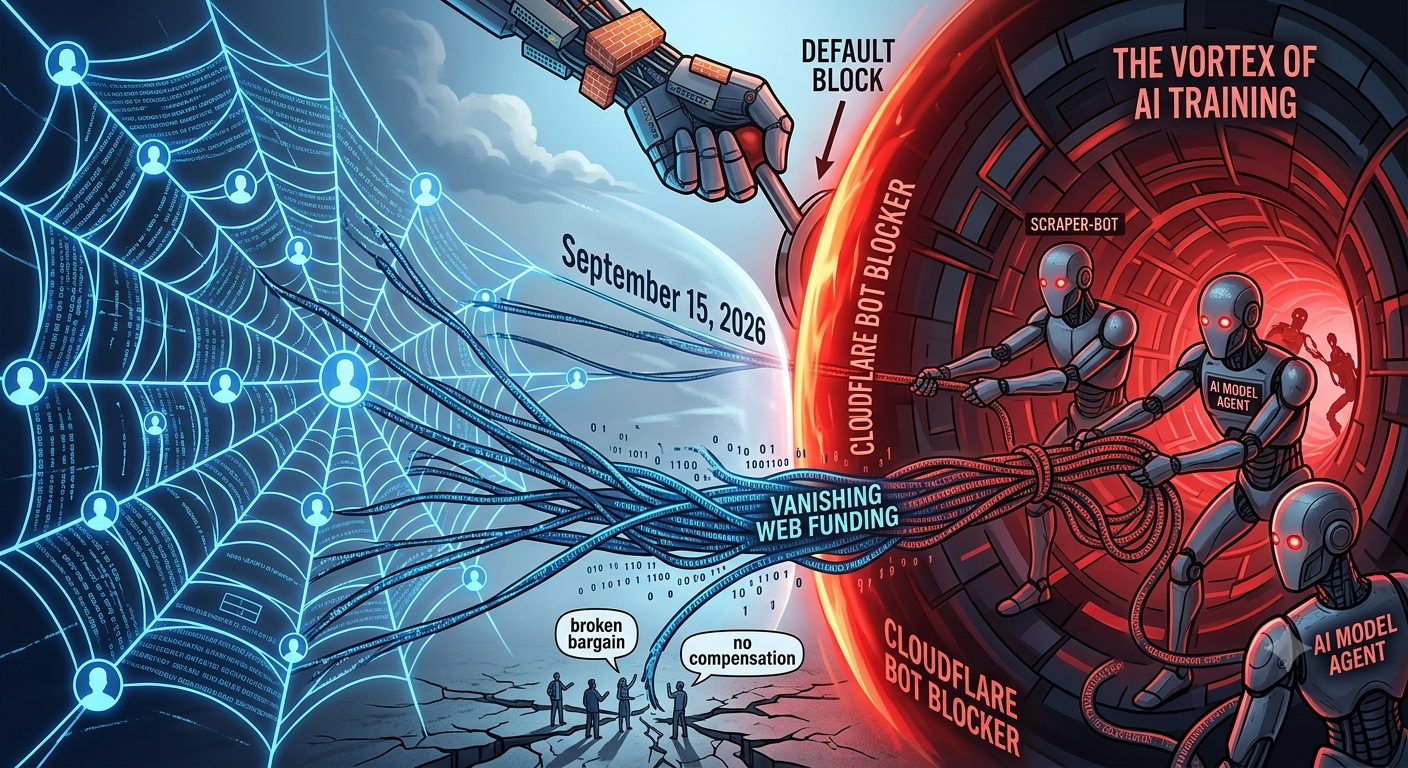


On July 1, 2026, Cloudflare announced that, starting September 15, 2026, its default settings will block AI training and agent bots from any website page that carries advertising, unless the site owner explicitly opts in. The change applies automatically to new customers, new sites from existing customers, and all existing free-tier users, covering a substantial share of global web infrastructure, given that Cloudflare handles traffic for a significant portion of the world’s websites.
The trigger for the announcement is a number that reframes the entire debate. Bot traffic has overtaken human traffic on the internet for the first time, a milestone Cloudflare CEO Matthew Prince said was not expected to occur until next year. The majority of traffic flowing across the web is now non-human. “Now that the majority of traffic on the Internet is non-human, we must go further and act faster so that a sustainable ecosystem can emerge,” Prince said.
Cloudflare’s new framework separates web crawlers into three distinct categories: Search, Training, and Agent, and treats them differently by default. Search bots, which index content to drive traffic back to publishers, remain allowed. Training bots, which harvest content to build or improve AI models, and Agent bots, which act on behalf of users in real time, will be blocked on ad-supported pages. The logic is direct; an advertisement is a signal that a site owner intended human attention to land on that page.
The catch that nobody is saying loudly enough is the Google problem. Google’s search bot and its AI training bot are the same bot. So, if a website blocks AI training, it also risks disappearing from Google search. That is the trap publishers are stuck in; you cannot say no to AI without also saying no to being found online.
Running alongside the blocking policy is a significant evolution of Cloudflare’s Pay Per Crawl marketplace, now rebranded as Pay Per Use. Under the new model, publishers will be able to charge AI companies not when their content is fetched, but when it generates value, when it shapes an AI answer or powers an agent response. Initial partners are Ceramic.ai and You.com. No major AI company has publicly committed to the framework yet.
AI-generated answers are cutting the clicks that fund the web, keeping users on Google or inside a chatbot rather than on the sites that did the work. One field study found Google’s AI Overviews cut outbound clicks by about 40 per cent. Cloudflare’s data adds another dimension; over 50 per cent of AI crawler traffic is spent re-fetching pages that have not changed, representing wasted bandwidth that publishers bear the cost of without compensation.
For Nigerian publishers, content creators, and digital media operators whose revenue depends on advertising and search traffic, the September 15 deadline is not a distant regulatory development. It is a structural shift in how the economics of content on the internet are being renegotiated, and it is happening with or without their input.
The question is not whether Cloudflare can fix the broken bargain between AI companies and content creators alone. It almost certainly cannot. But it has picked a date, drawn a line, and put the AI industry on notice that the era of free content may be ending.
September 15 is ten weeks away.
ALSO WATCH: MARKETING EDGE ONTV




Comment
No comments found.