
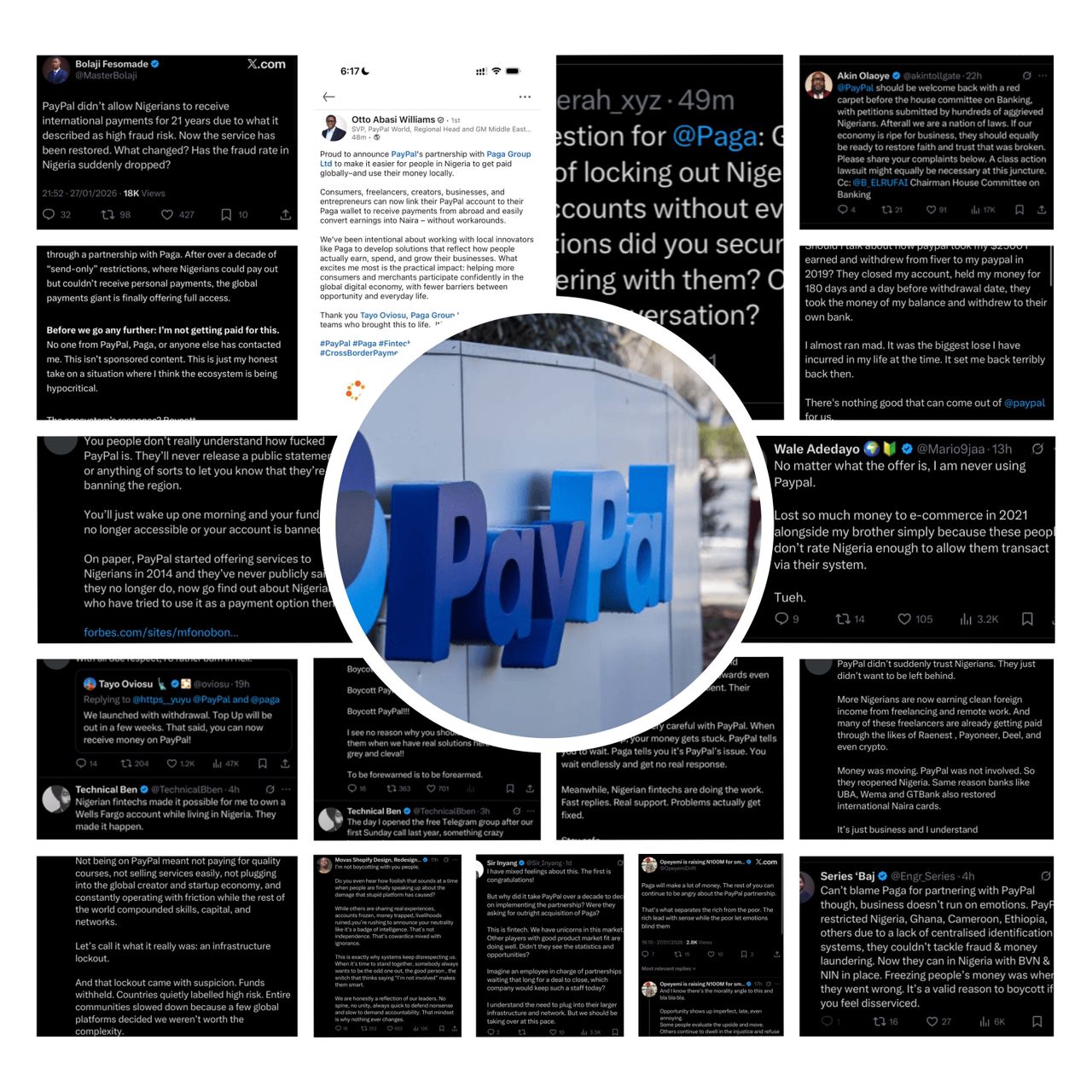





PayPal’s announcement of its partnership with Paga to enable full payment services in Nigeria has triggered mixed reactions from users, with many expressing lingering resentment over frozen accounts and lost earnings from the platform’s two decade absence.
What the PayPal–Paga Deal Means
The partnership, announced on Monday, allows Nigerian users to link their PayPal accounts to Paga wallets, receive payments from more than 200 countries, and withdraw funds instantly in naira. The development marks PayPal’s first full re entry into Nigeria since 2004, when it restricted Nigerian accounts to send only status, citing fraud concerns.
PayPal Explains Its Strategy
Otto Abasi is Regional Head and GM middle East and Africa, PayPal, described the partnership as intentional collaboration with local innovators. “We’ve been intentional about working with local innovators like Paga to develop solutions that reflect how people actually earn, spend, and grow their businesses,” Williams said in a LinkedIn post.
Public Backlash and Online Outcry
However, the announcement has been met with skepticism and anger from Nigerian internet users who shared experiences of account restrictions, frozen funds and lost income during PayPal’s absence. Social media platform X became a forum for users recounting their frustrations with the payment service.
Historical Context of PayPal’s Exit
PayPal shut out Nigerians and citizens of several other countries, including Ghana, in 2004, citing fraud concerns, according to reports. A 2014 partnership with First Bank, Nigeria’s oldest bank, only enabled outbound payments, leaving freelancers and online businesses unable to receive international payments for nearly two decades.
Personal Stories from Affected Users
One user, posting as @ShugarDaddy on X, reflected on the impact of PayPal’s absence during Nigeria’s early tech development. “Back in 2013/14, when Nigeria’s tech scene was still taking shape, the economy was stable, the exchange rate hadn’t collapsed, and UX designers were still being called front end designers, there were real opportunities many of us never got to touch because PayPal wasn’t accessible from Nigeria.”
He described the situation as an infrastructure lockout that came with suspicion, withheld funds and countries quietly labelled high risk. “African fintechs eventually stepped in and built what PayPal wouldn’t. Paystack. Flutterwave. Wise. Grey. Systems created under pressure so people could finally participate in the global economy.”
Skepticism Around PayPal’s Motives
Another user, @Finaltoucch, suggested that PayPal’s return was driven by business considerations rather than renewed trust. “PayPal didn’t suddenly trust Nigerians. They just didn’t want to be left behind. More Nigerians are now earning clean foreign income from freelancing and remote work. And many of these freelancers are already getting paid through the likes of Raenest, Payoneer, Deel, and even crypto.”
Fintechs That Filled the Gap
@TechnicalBben highlighted the role of Nigerian fintechs in filling the gap left by PayPal. “Nigerian fintechs made it possible for me to own a Wells Fargo account while living in Nigeria. They’ve increased the number of Nigerians earning in dollars. They host events that teach and empower people. They give monthly rewards even when you don’t get paid or land a client.”
He warned remote workers to be careful with PayPal based on past experiences. “When issues come up, your money gets stuck. PayPal tells you to wait. Paga tells you it’s PayPal’s issue. You wait endlessly and get no real response.”
Calls for Boycott and Lingering Trauma
@Mario9jaa shared a personal loss. “No matter what the offer is, I am never using Paypal. Lost so much money to e commerce in 2021 alongside my brother simply because these people don’t rate Nigeria enough to allow them transact via their system.”
@Chidima|Software Engineer, called for a boycott. “If you’re a Nigerian reading this, boycott PayPal. I see no reason why you should go back to using them when we have real solutions here already like Grey and Cleva. To be forewarned is to be forearmed.”
Another user, @Iameziokwu, recounted a significant financial loss. “Should I talk about how PayPal took my $2,500 I earned and withdrew from Fiverr to my PayPal in 2019? They closed my account, held my money for 180 days and a day before withdrawal date, they took the money off my balance and withdrew to their own bank. I almost ran mad. It was the biggest loss I have incurred in my life at the time.”
Calls for Accountability, Not Closure
Some users took a more measured approach. @Akintollgate suggested PayPal should face accountability. “PayPal should be welcomed back with a red carpet before the house committee on banking, with petitions submitted by hundreds of aggrieved Nigerians. After all, we are a nation of laws. If our economy is ripe for business, they should equally be ready to restore faith and trust that was broken.”
@Derah_xyz posed a direct question to Paga. “Given PayPal’s 20 year history of locking out Nigerians, seizing funds and banning accounts without evidence or apology, what protections did you secure for Nigerian users before partnering with them? Or was this history not part of the conversation?”
Contrarian Views on Opportunity
Not all reactions were negative. @OpeyemiDrift focused on the business opportunity. “Paga will make a lot of money. The rest of you can continue to be angry about the PayPal partnership. That’s what separates the rich from the poor. The rich lead with sense while the poor let emotions blind them. Opportunity shows up imperfect, late, even annoying. Some people evaluate the upside and move. Others continue to dwell in the injustice and refuse to move forward.”
@Sir_Inyang expressed mixed feelings about the partnership timeline. “Why did it take PayPal over a decade to decide on implementing the partnership? Were they asking for outright acquisition of Paga? This is fintech. We have unicorns in this market. Other players with good product market fit are doing well. Didn’t they see the statistics and opportunities?”
Nigeria’s Payments Ecosystem Without PayPal
During PayPal’s absence, Nigerian fintechs, including Paga, Flutterwave, and Paystack, built robust local and cross border infrastructure, plugging Nigeria into global payments. Digital payments within Nigeria totalled ₦1.07 quadrillion ($754.08 billion) in 2024, up from ₦600 trillion ($422.85 billion) in 2023, demonstrating the significant growth of Nigeria’s digital payment sector without PayPal’s participation.
How Long the Partnership Took
Tayo Oviosu, Paga co-founder and chief executive, revealed that the company first proposed a partnership to PayPal more than a decade ago. “In August 2013, I emailed the PayPal team. Nigeria’s fintech ecosystem was still young,” Oviosu said, according to reports. “I shared a simple belief: that Nigeria would become one of the most important economies in the world. It would take more than a decade for that belief to fully materialize.”
In 2025, Paga processed ₦17 trillion ($11.98 billion) across 169 million transactions, and the company expects the PayPal partnership to significantly increase volumes, particularly from international inflows.
PayPal’s Message to Nigerians
@Williams, who was born and raised in Nigeria, acknowledged the country’s potential. “I was born and raised in Nigeria, so I have seen the potential firsthand. We are here to listen, learn, and support Nigeria’s digital economy,” he said.
A Broader Shift in Global Payments
The partnership comes as global payments firms increasingly work with local infrastructure providers in Nigeria. Visa has invested in local payment rails, international processors like AZA Finance’s BT Payment have secured payments service provider licences to offer naira collections, and American Express has partnered with Flutterwave to expand merchant acceptance.
What the Integration Enables
Under the integration, merchants in Nigeria can accept payments from PayPal’s network of over 400 million global users in up to 25 currencies. Funds received can be settled locally through Paga, transferred to bank accounts, or used to pay bills and merchants within Paga’s ecosystem.
The partnership also enables Nigerians to receive payments from Venmo users in the United States, following Venmo’s interoperability with PayPal. Currency conversion will be done at willing buyer, willing seller rates, positioning the solution as competitive with informal channels and crypto based alternatives that Nigerians have relied on for cross border payments.
Trust Remains the Central Question
For many Nigerians, however, the question remains whether PayPal will address past grievances and provide assurances against future account restrictions. The platform’s ability to rebuild trust among users who experienced frozen accounts and lost funds during its absence will likely determine the success of its re entry into Africa’s largest economy.
PayPal has not publicly addressed questions about restitution for users whose funds were frozen or accounts closed during the period of restrictions



Comment
No comments found.