



On August 2, 1959, Pelé scored the most beautiful goal of his career.
Three consecutive sombreros, the ball flicked over an opponent’s head, never touching the ground, in a sequence so extraordinary that witnesses struggled to describe it in ordinary language. The goal, scored on the Rua Javari pitch in São Paulo and forever known as the Gol da Rua Javari, passed immediately into football legend. And then, like so many moments from that era, it disappeared.
No camera caught it. No footage exists. For sixty-seven years, the most beautiful goal ever scored by the greatest footballer who ever lived existed only in the memories of those who were there, and in the imaginations of everyone who came after.
Until now.
At Cannes Lions 2026, Google DeepMind revealed the behind-the-scenes story of one of the most ambitious cultural preservation projects in recent memory: the reconstruction of the Gol da Rua Javari using frontier AI models, historical archives, and the full cooperation of Pelé’s family and estate. The result is a moving image of a moment that was never filmed, brought to life with the rigour of historical scholarship and the precision of some of the most advanced generative technology in the world.
The timing is not incidental. The 2026 FIFA World Cup is the first major tournament since Pelé’s passing in December 2022. Across stadiums in the United States, Canada, and Mexico, a new generation of football fans is experiencing the sport’s greatest spectacle for the first time — many of them too young to have watched Pelé play, all of them inheriting a legacy they can only access through what history managed to preserve. The Gol da Rua Javari was not among those preserved moments. Google DeepMind set out to change that.
How the reconstruction was built
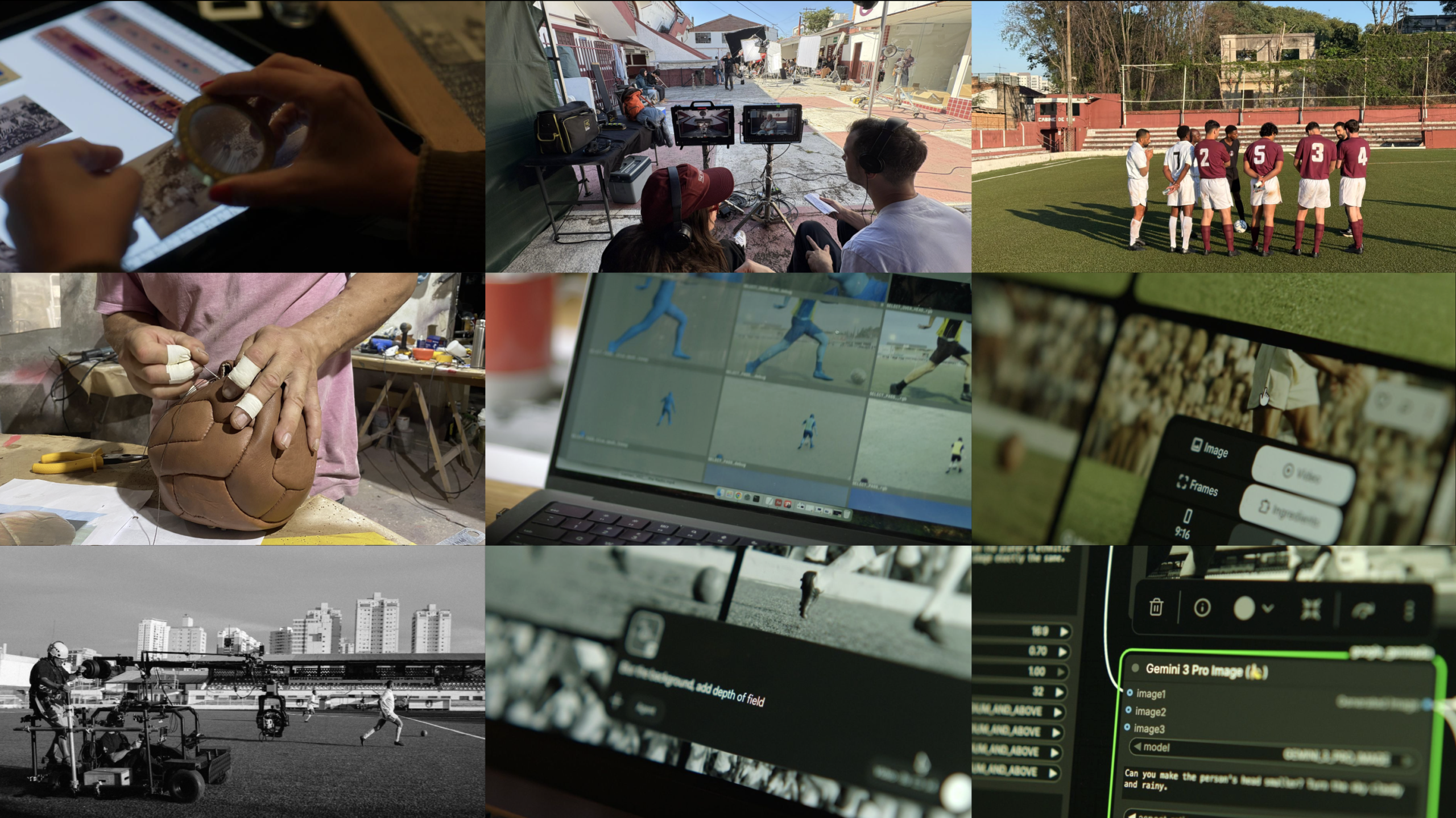
The project was built on collaboration before it was built on technology. Teams from Google DeepMind worked alongside historians, sports journalists, football legends, and members of Pelé’s family to establish the historical and cultural parameters of the reconstruction before a single frame of AI-generated imagery was produced. The work was created in full partnership with Pelé Brand, the official managers of the Pelé estate, a detail that matters enormously for a project of this sensitivity.
To reconstruct the goal, the team used Google DeepMind’s frontier models, Gemini Omni and Veo 3, to transform historical fragments into moving imagery. The reconstruction was filmed on the original Rua Javari pitch, with authentic uniforms from the era and a vintage match ball. Today’s top footballers served as stunt players, conditioning the models with real athletic movement that could be shaped by historical and cultural archives from Pelé’s playing days.
Doug Eck, Senior Research Director at Google DeepMind, described the technical and creative challenge:

“Recreating the ‘lost’ goal of a legend like Pelé meant respecting the athleticism and artistry of football, something generative tools have struggled with. To get it right, we used Performance Control to blend motion performance with historical and cultural archives from Pelé’s era, and worked with some of today’s best footballers as stunt players to further condition the models. These steps ensured the video felt true to life. This project reflects our long-standing approach: give artists the best generative tools to expand their craft and tell entirely new stories.”
KK Walker, Executive Creative Director at Google AI and Gemini, spoke to the weight of the collaboration:

“This project was a massive collaboration between historians, creatives, technologists, and the Pelé brand. Because we are visualizing a legendary moment ensuring historical accuracy and authenticity has been our paramount objective.”
The family’s blessing, and their standard
For any project involving Pelé’s image and legacy, the position of his family and estate was not a formality. It was the foundation.
Neymar Santos Sr., Founder and President of NR Sports, which manages Pelé Brand, set out precisely what that standard looked like: “Pelé’s legacy must always be treated with care, respect, and responsibility. This project reflects exactly what Pelé Brand stands for: preserving his history, keeping his impact alive, and finding meaningful ways to introduce his genius to new generations. Together with Google, we are using innovation not to reinvent the past, but to help the world experience a real moment that was never captured on film.”
That last distinction, not reinventing the past, but recovering a real moment, is the principle that separates this project from the growing number of AI reconstructions that use technology to imagine rather than to restore. The Gol da Rua Javari happened. The people who were there saw it. The reconstruction is not speculation. It is an attempt to give visual form to something that existed and was simply never recorded.
Where it goes next
The project will head to the Pelé Museum later this year, where it will become part of the permanent cultural record of one of football’s most important figures. The full story will also be available on Google’s YouTube channel.
Rooted in education and cultural preservation, the Gol da Rua Javari reconstruction stands as something rarer than a technology demonstration. It is a tribute, to the man, to the moment, and to the responsibility that comes with using powerful tools in the service of memory.
The first World Cup without Pelé is being played right now. Somewhere in that tournament, a teenager is falling in love with football for the first time. Soon, they will be able to see the goal that started it all.



Comment
No comments found.