
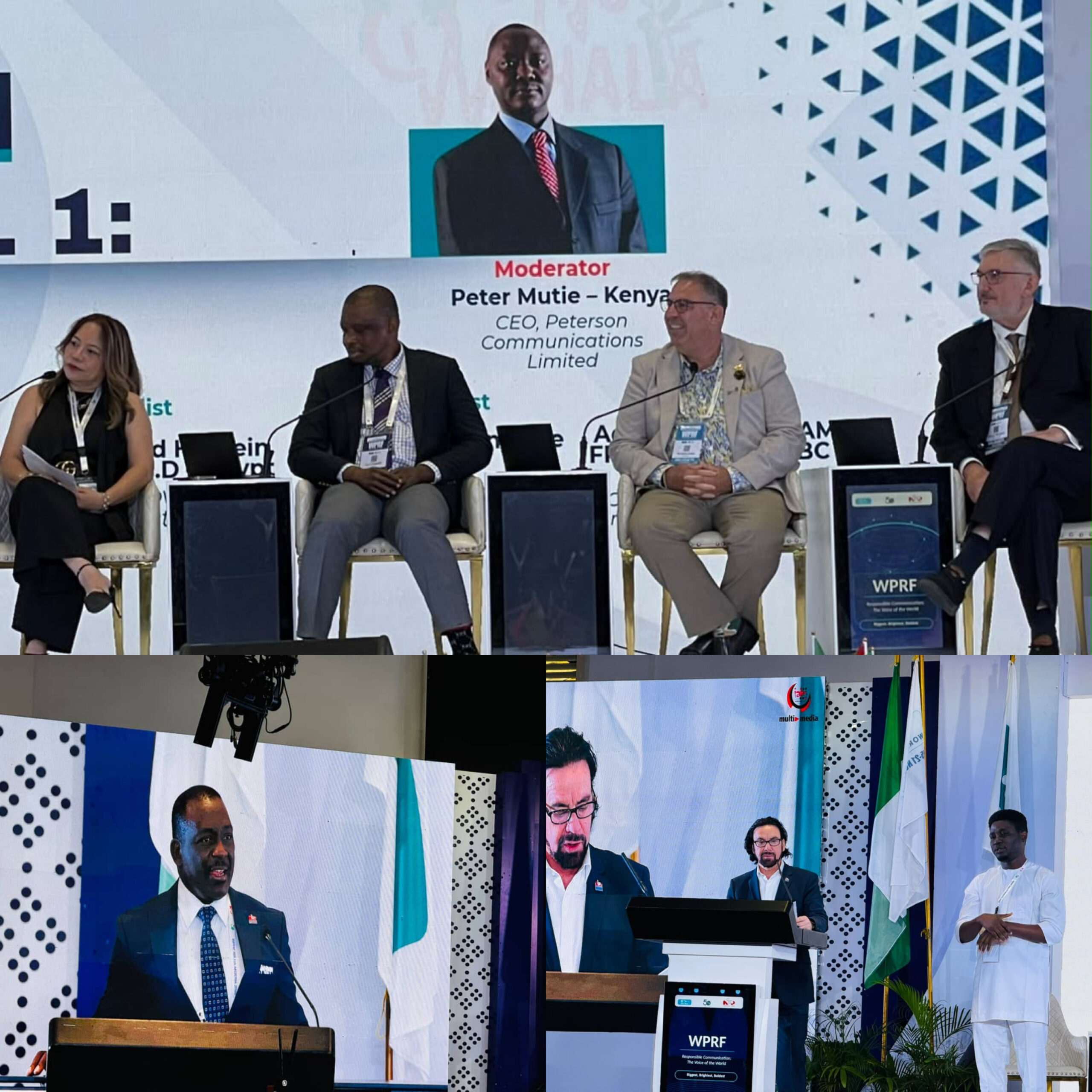



Public relations has long sold itself as the profession that builds trust. On the first day of the main programme of the 13th World Public Relations Forum (WPRF) in Abuja, some of its most senior voices asked whether the industry has earned the right to do so.
The Nigerian Institute of Public Relations (NIPR) opened the forum’s core activities on Monday with a Knowledge Conference and Parliamentary Relations day at the Transcorp Hilton Event Centre. Practitioners and international leaders met under the theme “Responsible Communication and Citizen Representation in a Digitised World” to weigh how the profession should act when information moves faster than verification.
Prof. Justin Green, President and CEO of the Global Alliance for Public Relations and Communication Management, mentioned that Africa, which once had no seat on the Alliance’s board, now holds six, the largest share of any continent. Green called this a milestone for the continent, invited the six African members to the stage and urged delegates to seek out board members during the week.
Transitioning to the profession’s duty to society, Green stressed that practitioners hold real influence and can press for accountability, equality and justice. In his words, the profession should serve not only organisations and governments but also people who might otherwise not be heard. On artificial intelligence, Green acknowledged its promise but urged that human understanding, emotional
The keynote speaker, Mr Alastair McCapra, Chief Executive Officer of the Chartered Institute of Public Relations (CIPR) in the United Kingdom, stressed that practitioners must confront their own credibility problem before they take on the task of restoring public trust in institutions.
McCapra mentioned that misinformation and disinformation were flagged in the 2026 Global Risks Report as threats the world is poorly prepared to handle, and that the UK government plans a national information defence centre to identify and counter AI-driven disinformation.
On the profession’s own standing, McCapra cited a study by the CIPR together with four other UK chartered bodies. According to him, 89 per cent of respondents thought recognised professional status matters, and 70 per cent said belonging to a professional body would raise their trust in a practitioner. He further noted that 59 per cent had checked a professional’s membership before hiring, compared with 48 per cent in 2019.
Addressing the less encouraging findings, McCapra said just 42 per cent of those surveyed saw professionals as trustworthy and 28 per cent as ethical, with many linking the field to corruption, bias and greed. In his view, professional bodies must do more to guarantee the integrity, competence and accountability of their members, because credibility is earned through conduct and not demanded through messaging.
On his part, McCapra announced that the CIPR is building an online knowledge hub, launching in January 2027 and continuing into 2028, to put learning resources in front of practitioners in different countries and languages.
McCapra also urged the audience not to take the loyalty of young people for granted. According to him, Generation Z in several countries has used digital platforms to organise, confront graft and press for accountability, frequently beyond traditional media and political structures. McCapra stressed that practitioners must listen to their concerns, engage through credible communication and show why the profession matters to their future.
Representing Nigeria, Prof. Emmanuel Dandaura, Vice President of NIPR, presented “Redefining Public Relations: Nigeria’s Gold Proposition for a Changing World”. Dandaura mentioned that misinformation, disinformation and malinformation, alongside rapid advances in AI, have made trust in public communication harder to build, and that machines’ growing ability to generate persuasive content means practitioners must offer more than messages.
“This matters particularly in an age when artificial intelligence makes deception cheaper, faster, and increasingly convincing,” Dandaura said.
In his words, the lasting value of the profession lies in a different set of skills. “Our competitive advantage must remain our ability not just to produce persuasive content, because machines can do that better, but most importantly, our enduring value must lie in judgment, accountability, moral courage and the ability to counsel institutions toward responsible conduct,” he said.
Dandaura argued that the challenge runs deeper than technology: the volume of communication keeps growing while public confidence falls. “We communicate so much, yet we struggle so profoundly to trust one another,” he observed, and he asked why trust has grown more fragile as platforms and algorithms multiply.



Comment
No comments found.