
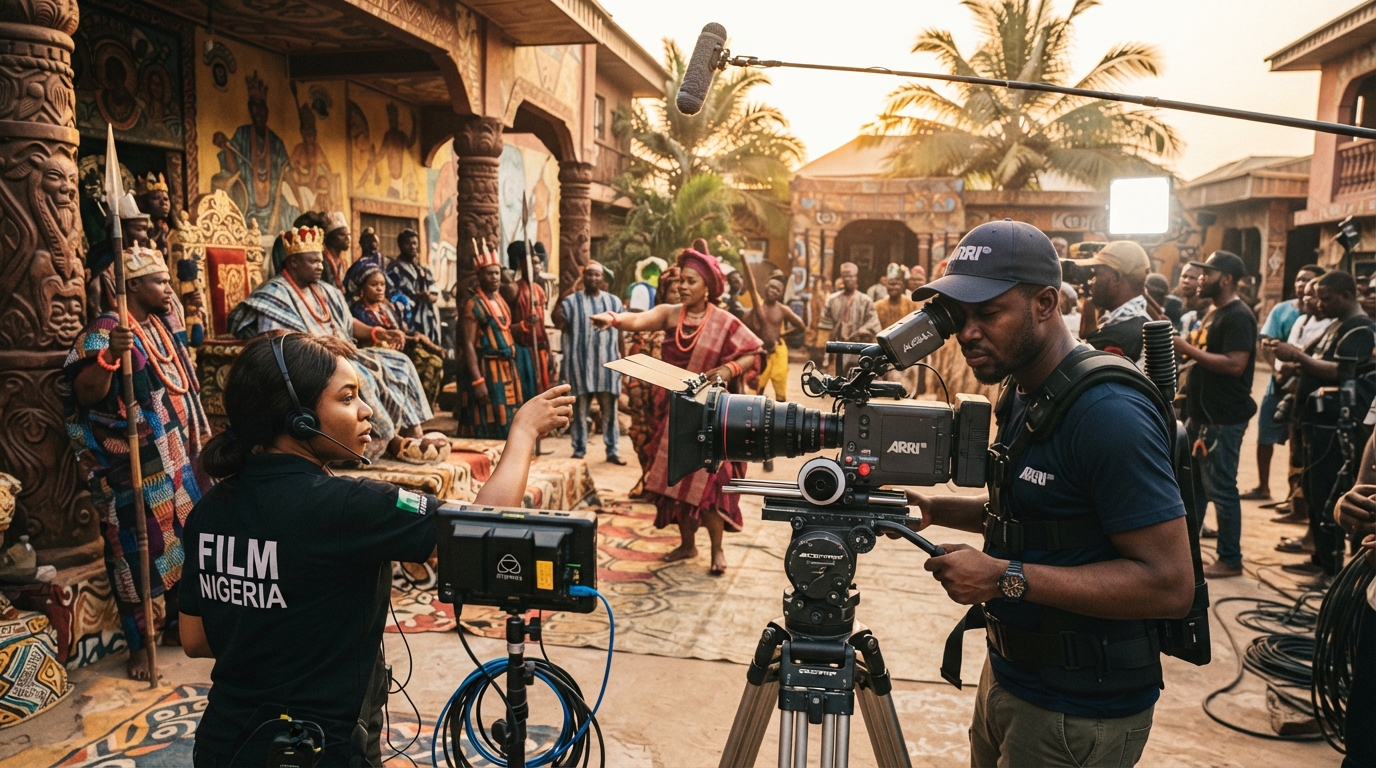



A Nigerian film does not need to explain its culture to become understood by the world. It needs to tell its story well enough for audiences beyond its borders to care about what happens next.
That distinction could shape the next phase of Nollywood’s international journey.
For years, the conversation around Nigerian cinema has centred on its ability to reach audiences outside the country. Streaming platforms have opened new distribution channels, Nigerian productions have attracted international attention, and filmmakers are increasingly exploring stories rooted in local history, mythology and social realities.
Yet, as the industry looks beyond its traditional markers, a question remains: must Nigerian films become less culturally specific to become more commercially successful internationally?
The answer may lie in understanding what makes a story travel.
The power of telling a Nigerian story
Nollywood’s international reach has demonstrated that audiences do not necessarily need a story to reflect their own culture before they can connect with it.
In 2023, Editi Effiong’s, The Black Book offered a striking example. The Nigerian-produced thriller attracted 5.6 million views within its first 48 hours on Netflix, reached the platform’s top 10 in 69 countries and remained among its global top 10 English-language titles for three weeks, according to the Associated Press.
The film’s story was firmly grounded in Nigerian realities, exploring corruption, police brutality and the pursuit of justice. Its international performance showed that a story emerging from a specific national experience could still find a substantial audience elsewhere.
The lesson is not that every Nigerian reality, exploring corruption, police brutality and the pursuit of justice. Its international performance showed that a story emerging from a specific national experience could still find a substantial audience elsewhere.
The lesson is not that every Nigerian film must become a thriller or reproduce the formula of an international streaming hit. It is that cultural specificity does not automatically limit audience appeal.
A story about a family navigating tradition, a community confronting injustice or a young person negotiating identity can resonate across borders because the emotional questions at its centre are widely understood.
What differs is the cultural world through which those questions are explored.
The difference should be preserved.
There is a distinction between making a film accessible and making it culturally neutral. Because accessibility involves the craft of storytelling: clear character motivations, compelling conflict, coherent narrative structure, strong performances, sound production, subtitles and visual storytelling that allows audiences to follow the action.
Cultural dilution, on the other hand, occurs when filmmakers remove or simplify the very details that give a story its meaning because they assume international audiences will not understand them.
A Yoruba proverb, an Igbo family custom or a Hausa cultural practice does not necessarily need to be replaced with a familiar Western equivalent. It may need to be presented within a story that gives viewers enough context to understand why it matters.
The audience does not have to know every cultural reference in advance. It needs to understand what is at stake for the characters.
This is where creative confidence becomes important. Nigerian filmmakers should not approach international audiences as though they are entering a market that requires them to abandon their own storytelling traditions.
The opportunity is to invite audiences into those traditions through compelling cinema.
For Nollywood, the next challenge is not simply getting films watched abroad. It is ensuring that international reach translates into sustainable commercial value.
The industry’s growing visibility has been accompanied by difficult questions about financing, distribution, ownership and the economics of streaming. A film can attract international attention without necessarily delivering substantial returns to its producers, particularly when the terms of distribution and intellectual property ownership are not favourable.
The Los Angeles Times reported in May 2026 that Nigerian filmmakers continue to face challenges around financing, industry infrastructure and access to international markets, despite the industry’s growing global profile.
This makes the business structure behind a film just as important as its creative ambition.
Who own the intellectual property? Who controls international distribution? How are revenues shared? Can a successful film generate value through sequels, remakes, licensing or other adaptations?
These questions determine whether global success becomes a lasting commercial asset or simply a moment of visibility.
Nollywood’s future international growth will require more than cultural authenticity alone. It will require investment in production, stronger distribution networks, effective marketing, professional development and business structures that allow filmmakers to retain value from their work.
UNESCO has identified underfunding and underdeveloped industry structures as significant challenges facing African film and audiovisual sectors, despite their substantial creative and economic potential.
But the creative foundation already exists; a wealth of stories, languages, histories, social experiences and imaginative worlds that cannot be replicated elsewhere.
The industry should not confuse international ambition with cultural imitation. Nigerian films can embrace global production standards, collaborate with international talent and reach new markets without surrendering their language, humour, traditions or worldview.
The world does not need another version of a story it already knows.
It needs to discover stories it has not heard before, told with the confidence and craftsmanship that make them impossible to ignore.
Nollywood’s global opportunity is not to become less Nigerian. It is to make the world more interested in what being Nigerian can mean.
ALSO WATCH: MARKETING EDGE ONTV




Comment
No comments found.