
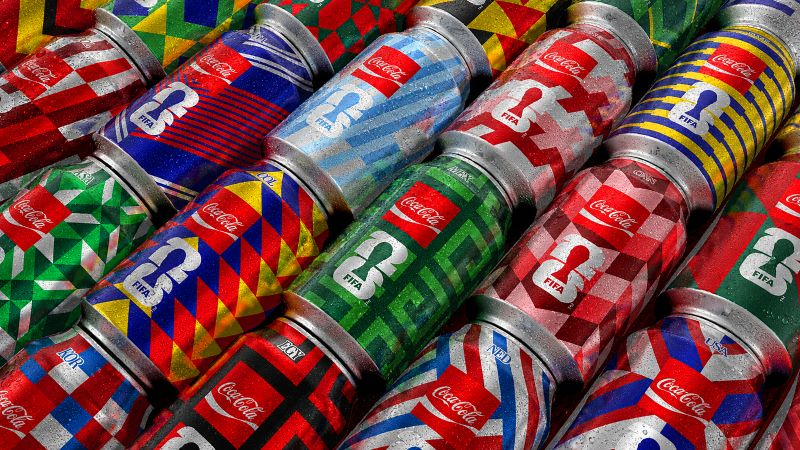


The question sits at the heart of every global brand’s World Cup dilemma: How do you represent 48 nations authentically while maintaining a single, coherent brand identity?
Most brands fail at this. They create one campaign, stamp it across the world, and hope the translation holds. Coca-Cola asked a different question: What if the shape itself could hold 48 nations?
The Problem
Sponsoring the FIFA World Cup gives you massive visibility. It also gives you a massive constraint. You have one brand. You have 48 nations with distinct colours, histories, and football identities. You cannot make each nation feel secondary to your brand. But you also cannot abandon your identity to serve theirs.
This is the representation problem in global sponsorship. How do you honour difference without fracturing unity?
The Asset
Coca-Cola’s answer was already sitting in their archive. The Arden Square. Introduced in 1969, it is one of the most enduring brand assets in history: a white dynamic wave beneath the Coca-Cola script, contained in a red frame. Simple geometry. Instantly recognisable. Fifty-five years of consistency.
But consistency in 1969 looked different from consistency in 2026. What if the shape stayed the same, but what it contained changed?
The Solution
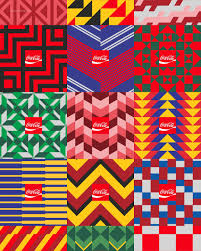
Studio GOLDEN took the Arden Square and transformed it into a modular design system. They created 18 distinct patterns, each one extracted directly from the colours and jersey designs of competing nations.
Argentina’s pattern draws from their light blue and white football heritage. Brazil reflects yellow and green. Spain, Germany, England, France, Mexico, Canada; each nation receives a unique geometric expression rooted in their actual football identity.
But here is the crucial part: they are all recognisable as Coca-Cola because they all use the same foundational shape. The Arden Square becomes a canvas. The square stays constant. The nations fill it differently.
Design Thinking, Not Campaign Thinking
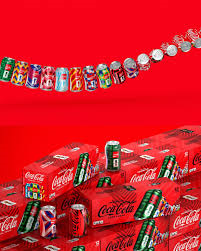
This is not a campaign that will air in January and disappear in July. This is a design system built to stretch across collectible packaging, retail spaces, digital experiences, live events, and more. Every touchpoint uses the same geometric language. Every touchpoint feels locally authentic.
Most brands approach sponsorship backwards: create a message, then apply it everywhere. Coca-Cola built this forward: create a structural principle, then let each culture express it through that principle.
The result is not domination. It is framework. The brand does not disappear into each nation. The brand becomes the skeleton that allows each nation to reveal itself.
Why This Matters
Heritage usually moves backwards. It anchors you to what came before. Coca-Cola moved the Arden Square forward. They took a 55-year-old asset and made it contemporary by making it spacious enough for 48 different cultures to inhabit it simultaneously.
This is cultural intelligence in 2026: understanding that true representation is not about erasing your identity. It is about creating a framework strong enough to hold difference without breaking.
The 2026 World Cup will reveal whether this design system actually moves people. Whether they see their nation reflected in the Arden Square, or whether they see Coca-Cola imposing itself on their football culture.
But the question has already been answered. You fit the world into a square by making the square big enough to hold it.
ALSO WATCH:MARKETING EDGE ONTV

Comment
No comments found.