
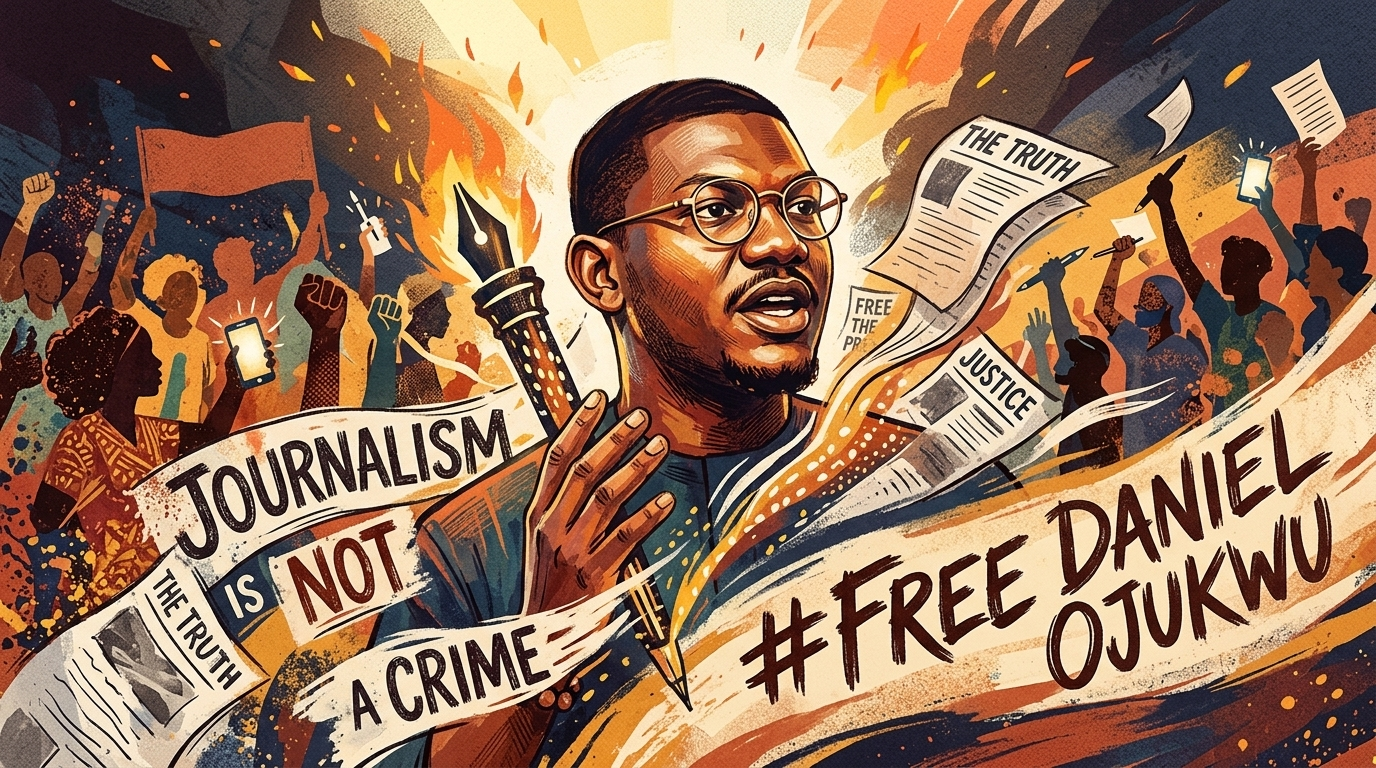



There is something deeply troubling about a society in which a journalist can find himself behind bars for reporting on matters involving public funds. More troubling is when it happens again.
For a journalist, that work often begins with a question. Where did the money go? Who authorised the payment? Were the promises made to citizens fulfilled? What happened to the public resources entrusted to those in power?
These are not unreasonable questions. They are the questions journalism is expected to ask. Yet, for Daniel Ojukwu, an investigative journalist with the Foundation for Investigative Journalism (FIJ), pursuing such questions has once again brought him face to face with the loss of his freedom.
On November 10, 2026, the Federal High Court in Abuja ordered Ojukwu to be remanded at the Kuje Correctional Centre until December 1, when his bail application is scheduled to be heard. He pleaded not guilty to 12 counts involving alleged cyberstalking and criminal defamation arising from investigation reports published by FIJ between November 2023 and January 2024.
Those reports examined alleged irregularities in public expenditure connected to Adejoke Orelope-Adefulire, a former Senior Special Assistant to the later President Muhammadu Buhari on Sustainable Development Goals. Among the issues investigated was an alleged payment of approximately ₦147 million relating to classroom construction and a skills acquisition centre in Lagos. These remain allegations raised in the reporting, not findings established by a court.
But there is a detail in this story that makes the latest development particularly difficult to ignore: this is not the first time Ojukwu has been detained over the same reporting.
In May 2024, he was arrested and detained for ten days. For those ten days, his whereabouts became a matter of concern before he was eventually located in police custody. His release followed public outcry and pressure from human rights organisations.
Now, more than two years later, he is back in custody.
Consider what this means for the person at the centre of this story. A journalist goes out to investigate, gather information, verify claims and publish findings. The work is done. The story reaches the public. But the consequences do not necessarily end when the article leaves the newsroom. They can follow the journalist into courtrooms, police stations and correctional facilities.
And that is where the pain of this case lies.
It is not simply about one journalist and the charges he faces. It is about the fear that such experiences can create across an entire profession. It is about the reporter who may hesitate before pursuing a sensitive investigation. The editor who must consider whether publishing a story could expose a colleague to prolonged legal trouble. The newsroom that begins to weigh the personal consequences of asking questions that the public has a right to have answered.
What happens to investigative journalism when the cost of reporting becomes too frightening to contemplate?
Let us be clear: journalism does not place anyone above the law. Reporters must uphold professional standards, verify their claims and take responsibility for what they publish. Anyone who believes they have been defamed must also have access to lawful remedies. Ojukwu is entitled to a fair hearing, and the allegations against him must be determined through due process.
But the existence of legal remedies does not erase the responsibility of the state to protect press freedom. Nor should the legal process become a source of intimidation that discourages legitimate public-interest reporting.
The Wole Soyinka Centre for Investigative Journalism has condemned Ojukwu’s remand, describing the subject of the reports as matters of public interest. The Committee to Protect Journalists has called for the charges against Ojukwu and FIJ founder Fisayo Soyombo to be dropped and for both journalists to be released unconditionally. Amnesty International has also expressed concern about the implications for freedom of expression.
These are not concerns that should be brushed aside.
Nigeria’s Constitution recognises the media’s responsibility to hold government accountable under Section 22, while Section 39 protects freedom of expression, including the freedom to receive and impart information. These protections matter because citizens cannot meaningfully hold public institutions accountable when the people investigating those institutions are made to fear the consequences of their work.
For the media industry, the implications are equally serious. A functioning press depends on journalists who are willing to pursue difficult stories, editors who can defend responsible reporting and institutions that protect editorial independence. When that environment is weakened, the damage extends beyond individual newsrooms. It affects public trust, democratic accountability and the quality of information available to citizens.
At Marketing Edge, we believe this is a moment that demands more than passing concern. It demands a clear defence of the right to investigate, question and report matters of public interest.
Because behind every journalist detained over their work is a larger question about the society we are building. What happens to the ordinary citizen when those who ask questions on their behalf begin to pay such a heavy price?
Daniel Ojukwu deserves due process. He deserves the opportunity to defend himself. And he deserves to have his freedom and fundamental rights treated with the seriousness they demand.
No journalist should have to wonder whether pursuing a story about public money could cost them their liberty. No newsroom should have to calculate the personal risk of telling the public what it needs to know.
The tragedy is not only that a journalist is back in custody. It is that every time this happens, the space for the rest of us to ask questions becomes a little more frightening.
And when the people who ask questions are made to suffer for asking them, we must all be concerned about the answers the public may never get.
ALSO WATCH: MARKETING EDGE ONTV

Comment
No comments found.