
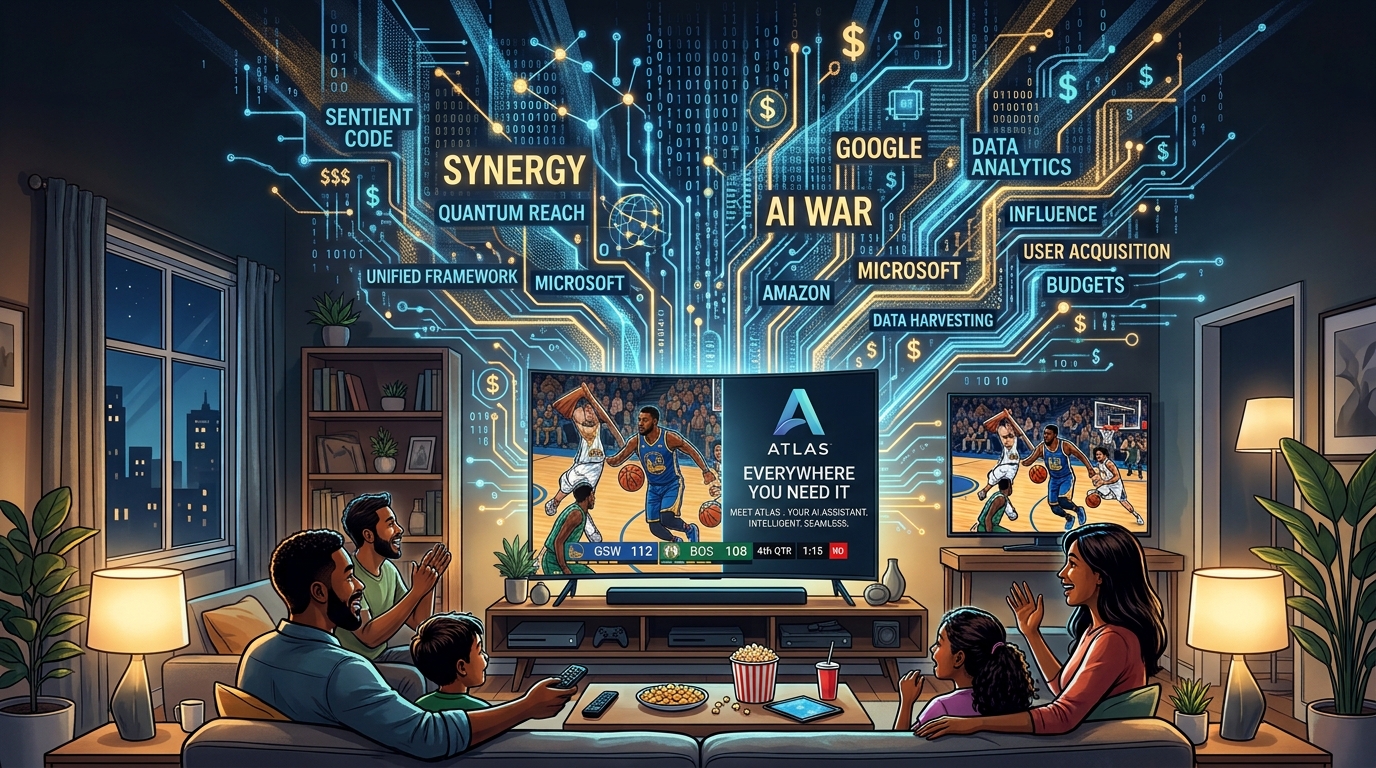





There is a new kind of arms race happening in advertising. And unlike most arms races, this one is playing out on your television screen, during your football match, inside your social media feed, and it is costing the companies involved hundreds of millions of dollars.
Anthropic, Google, Microsoft, OpenAI, and Perplexity spent a combined $333.6 million on US television advertising in 2025 alone, a 43 per cent increase from 2024. Digital spend reached $426 million, more than triple the year before. The AI companies are not just building intelligence. They are buying attention. And in 2026, that competition has intensified into something the advertising industry has not seen before, a full-blown consumer brand war between products that most people cannot see, touch, or easily explain.
The challenge every AI brand faces is the same, and it is significant. How do you sell something invisible? How do you build desire for a product that lives entirely inside a conversation? How do you make artificial intelligence feel human enough to trust, without making it feel so human that it becomes unsettling?
Those answers reveal exactly where these companies have landed in terms of consumer psychology right now.
Google has leaned into utility and everyday integration. Its Gemini campaigns show real people using AI to solve real problems; planning trips, writing emails, understanding medical results, positioning the product not as a marvel of technology but as a practical companion for daily life. The emotional register in warmth and reassurance. Google is not selling the future. It is selling on Tuesday morning.
Microsoft has taken a similar approach with Copilot, embedding the product so deeply into its existing Office 365 ecosystem that the campaign barely needs to explain what AI is. The message is simply: the tools you already use are now smarter. It is perhaps the least creative AI campaign of the major players, and possibly the most effective, because it asks the least of the consumer.
OpenAI’s approach has been the most ambitious and the most revealing. Anthropic spent approximately $16.5 million on US television ads in 2025, running campaigns during NFL, NBA, and college sports events, the same cultural spaces where beer brands, car manufacturers, and fast food chains have historically fought for mass consumer attention. The decision to advertise Claude during a basketball game is not accidental. It is a statement: AI is no longer a technology product. It is a consumer brand competing for the same emotional real estate as every other brand in the room.
What unites all these campaigns underneath their different creative strategies is a single underlying anxiety, the Pew Research finding that half of US adults are more concerned than excited about artificial intelligence, with only 10 per cent saying their excitement outweighs their worry. Every AI brand campaign in 2026 is, at its core, a trust campaign. The product features are secondary. The emotional reassurance is the primary brief.
For Nigerian marketing professionals watching this battle unfold, the lesson is not about AI specifically. It is about what happens when an entire category of products faces a consumer trust deficit simultaneously and how the brands that invest earliest and most honestly in building emotional credibility will be the ones that win when the market matures.
The AI wars are in full swing. And the most important weapon is not the model. It is the story.
ALSO WATCH: MARKETING EDGE ONTV




Comment
No comments found.