


The 2026 FIFA World Cup is reviving football’s oldest argument — who is the true GOAT?
But for marketers, a far bigger question looms behind that debate: what happens when the two biggest individual brands in sports history step off the global stage?
Cristiano Ronaldo has already confirmed it. He told CNN in November 2025 that this World Cup will definitely be his last because, at 41, his body has limits. Messi’s plans are murkier. He has made no retirement announcement and has said plainly that he intends to keep playing “until I can’t anymore.” Even so, 2026 is widely expected to be his final World Cup appearance, even without a formal statement.
Whichever way it plays out, one thing is certain: brands that have leaned on these two names for two decades are staring down a structural problem that nobody else can fully solve.
To understand the scale of this shift, it helps to stop thinking of Ronaldo and Messi as athletes and start thinking of them as standalone media companies.
Ronaldo became the first person in history to surpass one billion followers across his combined social media platforms. Messi trails with roughly 626 million combined followers, still a number larger than the populations of most countries, yet a clear step behind his rival.
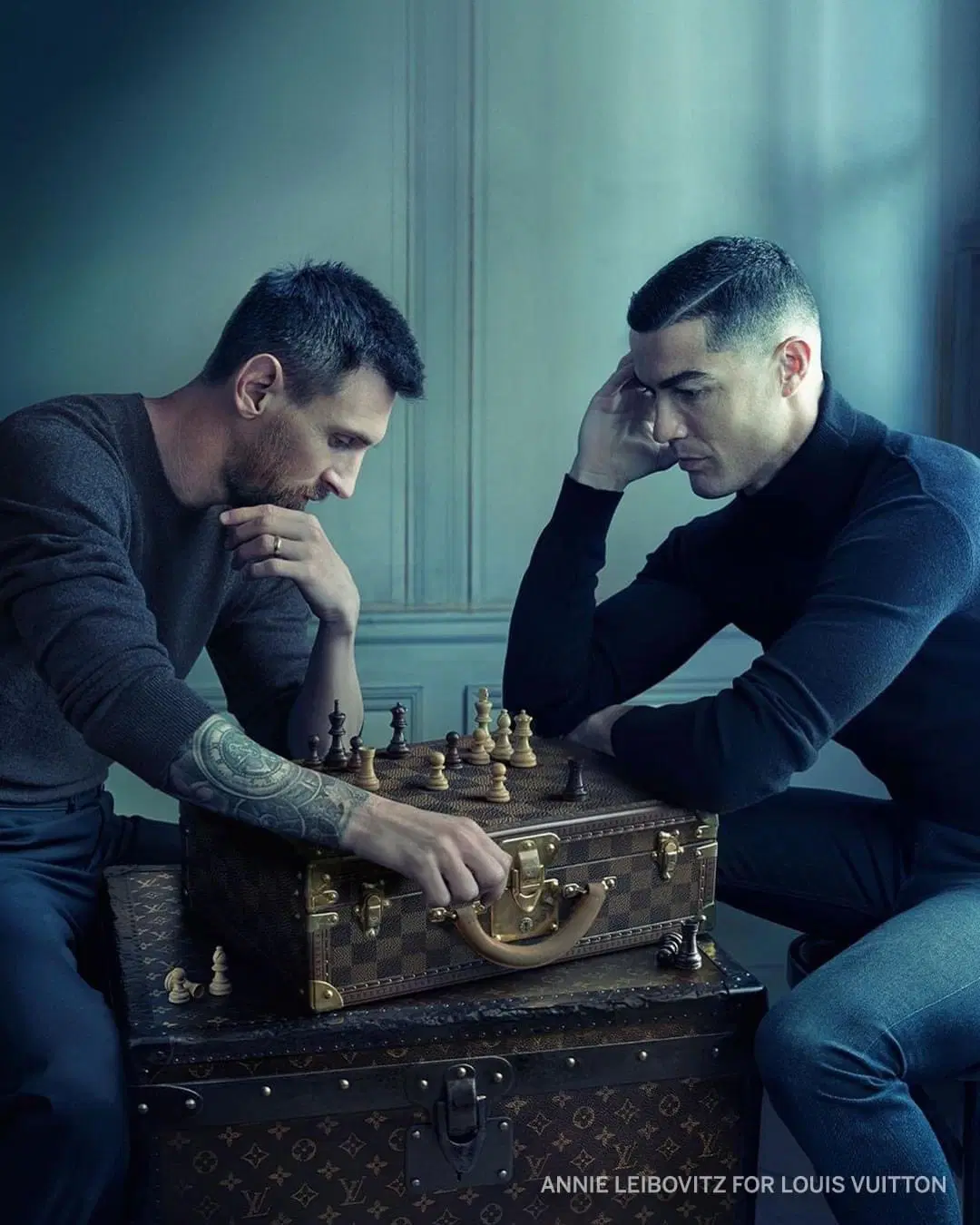
The clearest evidence of their commercial gravity remains the 2022 Louis Vuitton chess campaign, shot by Annie Leibovitz ahead of the Qatar World Cup. The campaign harnessed both players’ star power to generate the most Instagram likes ever recorded for a brand post while sidestepping the tournament’s political controversies entirely. The image, showing the two rivals playing chess on a Louis Vuitton trunk, amassed a combined 72 million likes: 38 million on Ronaldo’s account and 29 million on Messi’s.
The financial return was just as striking. Ronaldo’s post alone generated $2.8 million in media impact value within 48 hours, while Messi’s generated $2.6 million, according to measurement firm Launchmetrics. Few brand activations in any industry, anywhere, generate that level of value in just two days.
Why can no single heir replace them?
This is precisely where the marketing problem begins.
The current generation of rising stars, Kylian Mbappé, Erling Haaland and Vinícius Júnior, are extraordinary players. But none of them commands anything close to a billion combined followers, or even half that number.
That gap matters more than it might first appear. For two decades, brands operated on a simple principle: sign Messi, sign Ronaldo, or sign both, and instantly reach a meaningful share of the world’s population. That principle is now broken. There is no single athlete capable of inheriting that audience on a like-for-like basis.
This does not mean sponsorship budgets will shrink. It means they will fragment. Brands chasing Messi- or Ronaldo-level reach will increasingly need to build portfolios of talent, combining football stars with athletes from other sports, gaming creators and lifestyle influencers, all stitched together into a single, coherent campaign narrative rather than relying on one face to do the work alone.
What this means for Nigeria
This global shift carries direct relevance for Nigeria’s marketing industry, and not in a small way. Nigeria is one of the world’s most football-obsessed and digitally engaged markets.
The country also already has internationally relevant football talent that domestic brands are underutilising.
Victor Osimhen and Ademola Lookman, for instance, command significant visibility in European football. Yet local brand activity around Nigerian footballers often stops at billboards or basic sponsored posts, rarely evolving into the kind of sustained, integrated storytelling that built lasting brand equity through campaigns such as Louis Vuitton’s collaboration with two ageing global icons.
The pattern is even more pronounced in women’s football. The Super Falcons and Nigeria’s domestic women’s leagues possess genuine commercial potential, with loyal and engaged fan bases at a time when global investment in women’s sports sponsorship continues to grow. In Nigeria, however, that opportunity remains largely untapped.
The way forward
This World Cup will likely be remembered as a farewell tour for two of football’s greatest commercial icons, regardless of how either man’s career unfolds afterwards. For marketers, that farewell also serves as a deadline.
The era of building global campaigns around one irreplaceable face is ending, not because reach no longer matters, but because no single athlete can deliver it alone anymore. What comes next will reward brands and agencies, in Lagos as much as in London or New York, that can weave multiple voices into one believable, compelling brand story.
For Nigerian marketers specifically, the task is clear. Stop waiting to borrow the spotlight of the next global icon. Start building integrated, locally rooted campaigns around the football talent, both men’s and women’s, that Nigeria already has.




Comment
No comments found.