
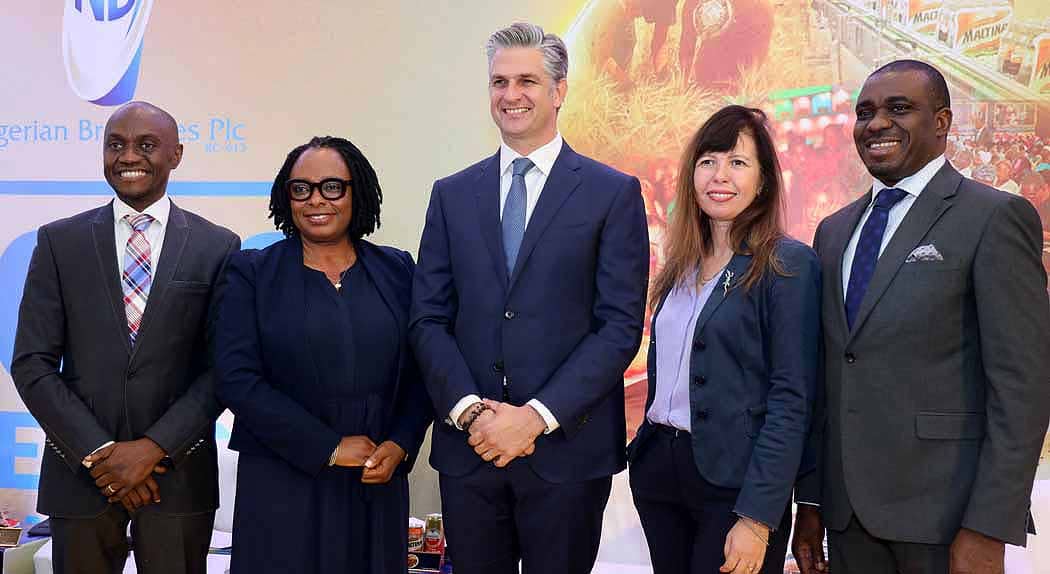


After two consecutive years of heavy losses that tested the resilience of one of Nigeria’s oldest and most iconic companies, Nigerian Breweries Plc has staged a remarkable financial comeback, posting record group revenue of N1.46 trillion in 2025 and returning to profitability for the first time in years.
The results were presented at the company’s 80th Pre-Annual General Meeting media briefing held at the Sheraton Hotel, Ikeja, Lagos, where management offered a candid assessment of the company’s performance, the challenges ahead and the strategic foundations it is building for long-term growth.
Thibaut Boidin,Managing Director and Chief Executive Officer, expressed confidence in the company’s performance.
“I am very proud of these results. On all key metrics, we outperformed expectations. Revenue grew by 35% and we tripled our operating profit. For the first time in about 10 years, we delivered this level of net profit. It shows that the company has come out of the crisis and is now much stronger,” he said.
Group revenue rose by 35% from N1.08 trillion in 2024 to N1.46 trillion. Operating profit increased by 194 percent from N69.9 billion to N205.2 billion.
Finance Director Maria Karaseva described the year as one built on disciplined execution and cost control. Gross profit grew by 77% to N565 billion, while profit before tax stood at N161 billion. The company recorded a net profit of N99 billion, reversing the N145 billion net loss reported in 2024.
Karaseva said both variable and fixed costs grew more slowly than revenue during the year, reflecting tighter financial management.
One of the most significant changes in the company’s financial structure was the elimination of foreign exchange denominated debt. According to Karaseva, Nigerian Breweries currently has no foreign currency liabilities linked to borrowings or investment needs. This marks a shift from previous years when currency volatility significantly impacted performance.
The company also completed a rights issue that reduced total borrowings from over N200 billion at the end of 2024 to N59 billion. Cash flow moved from negative territory to positive, strengthening the balance sheet.
Karaseva attributed the recovery partly to improved currency stability, strong brand performance and a focus on premium products.
Board Chairman Juliet Anammah placed the company’s performance within the wider brewing industry context, noting that 2025 marked a return to profitability for major players in the sector.
“After consecutive years of net losses, the published results of all players showed that 2025 marked a return to profitability for the sector and our company was a big example of this rebound,” she said.
The recovery came despite a single digit decline in industry volumes, as inflation, cautious consumer spending and competition weighed on demand. The second half of the year was weaker than the first.
Anammah said Nigerian Breweries maintained market leadership through disciplined pricing, premium portfolio management, strengthened route to market systems and sustained engagement with trade partners.
Boidin highlighted the company’s nationwide footprint as a key competitive advantage. Nigerian Breweries operates nine breweries, one malting plant and 21 depots across the country.
“We have a footprint that is quite unique in Nigeria. None of our competitors has this kind of presence across the country,” he said.
The company also reorganised its sales structure into three regional divisions covering North, West and East to improve operational efficiency and customer proximity.
Despite the strong results, shareholders will not receive dividends for the year. Karaseva explained that accumulated retained earnings remain negative due to losses recorded in 2023 and 2024.
“As long as your retained earnings are negative, the law does not allow you to pay dividends,” she said, adding that dividend payments will resume once the company fully exits its recovery phase and strengthens its balance sheet.
Management also underscored the strategic importance of its majority shareholder, Heineken. Boidin described the relationship as a source of financial and operational strength.
“Our majority shareholder is Heineken, and that gives us strong financial power. We are able to leverage the strength of the Heineken Group across the world, and this is very important for our future,” he said.
Karaseva added that Nigerian Breweries benefits from Heineken’s global supply chain network, which helps manage disruptions linked to geopolitical tensions, including developments in the Middle East.
Looking ahead to 2026, the company identified three key risks. The first is supply chain sustainability in light of global uncertainty. Karaseva said the company continues to monitor supply channels closely and does not foresee major disruptions affecting operations in Nigeria.
The second risk is currency stability. While she noted that the naira has remained stable in recent months, she stressed that sustained currency stability is essential for economic planning and business confidence. The company is using financial hedging instruments to manage potential volatility.
The third concern is food inflation and its impact on consumer affordability. Karaseva said the company is mindful of pricing decisions in a challenging economic environment.
“We feel a responsibility as leaders of this category. We are conscious of affordability and we are doing all that we can,” she said, noting that the company is applying revenue management strategies to limit the direct impact of cost pressures on consumers.
On the regulatory front, Boidin welcomed the Federal Government’s introduction of a three year excise framework, describing it as an improvement that enhances planning and investment predictability.
“We are happy that we now have a three year excise plan. It gives us more predictability, which is important for our investment decisions,” he said.
However, Anammah raised concerns about a proposed tax stamp regime for excise verification and product tracking, cautioning that additional compliance costs could weaken productivity and affect the sector’s recent recovery.
During the year, Nigerian Breweries completed the integration of the Distell Wines and Spirits portfolio, expanding its presence beyond beer into wines and spirits. Management described the immediate financial contribution as modest but said the acquisition supports long term diversification into a broader beverages business.
The company also continued implementing its Brew a Better World sustainability agenda, focusing on environmental responsibility, social impact and responsible consumption in line with the United Nations Sustainable Development Goals.
As Nigerian Breweries prepares to mark 80 years of operations in 2026, Anammah reflected on the milestone.
“Nigerian Breweries Plc is proud to be one of a select group of companies that has not only withstood the ups and downs of an ever changing and challenging business environment but has remained one of Nigeria’s topmost companies over the last eight decades,” she said.
After a period marked by foreign exchange shocks, rising costs and balance sheet pressure, the company’s latest results signal a return to stability. Management maintains that disciplined execution, stronger financial structure and strategic alignment with its global parent position Nigerian Breweries for more sustainable performance in the year ahead.




Comment
No comments found.