
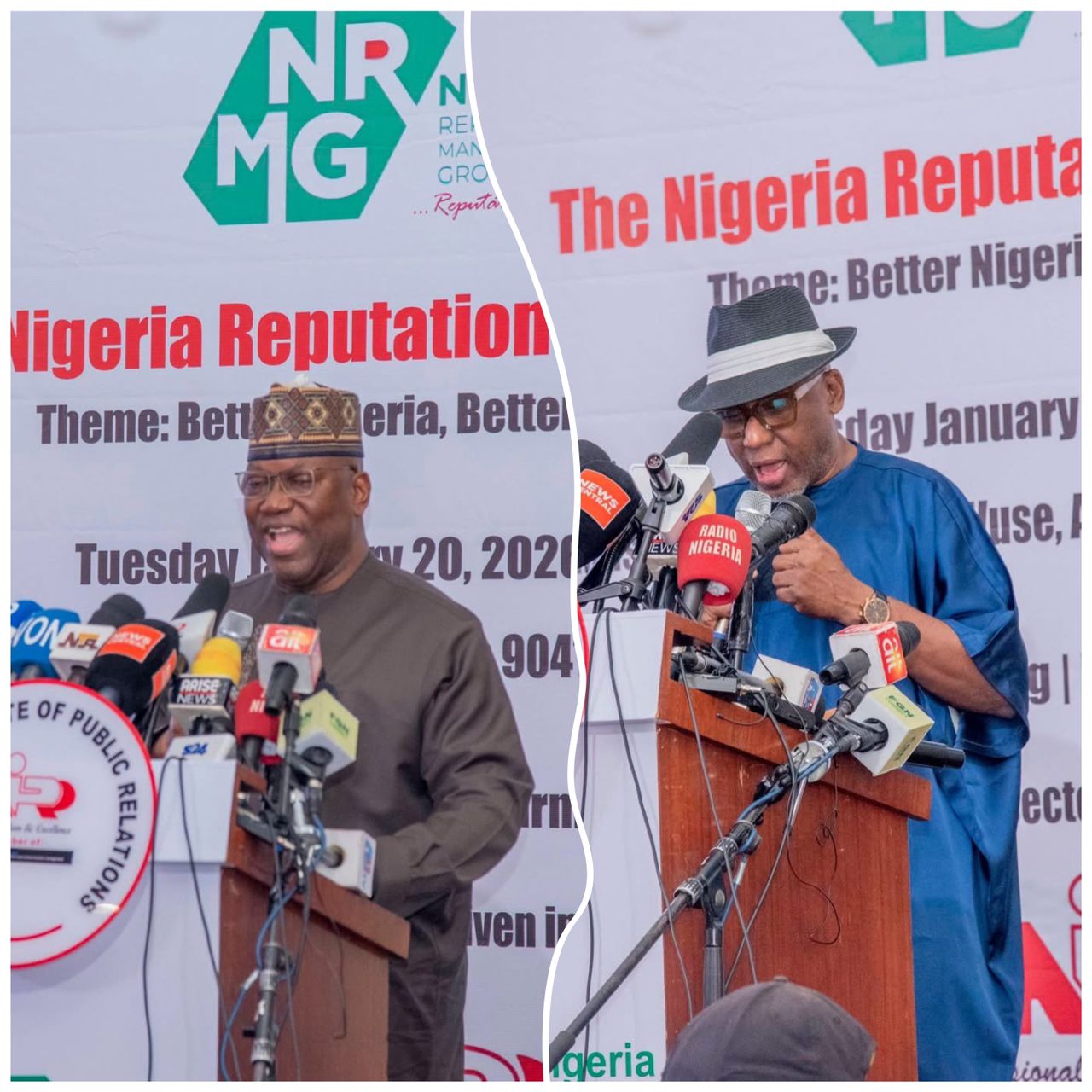





Leaders from across Nigeria’s public and private sectors gathered in Abuja recently to confront a challenge that has long shaped perceptions of Africa’s most populous nation: the disconnect between its achievements and its reputation.
Stakeholders at the inaugural Nigeria Reputation Summit, held at the Shehu Musa Yar’Adua Centre, were told that Nigeria’s reputation has been shaped more by fragmented narratives than by coordinated strategy, and more by reaction than intention.
Call for a Coordinated National Strategy
Speaking at the summit, Yomi Badejo Okusanya, Chairman of the Nigeria Reputation Management Group and Founder of CMC Connect LLP, said the time had come for a deliberate and coordinated approach to managing the country’s reputation across government, business, media and society.
Addressing a gathering of business leaders, government officials, traditional rulers and communications professionals, Okusanya stressed that reputation has evolved beyond perception management.
Reputation as a Strategic National Asset
“Reputation is no longer a soft issue. It is not cosmetic and is certainly not optional,” Badejo Okusanya said. “In today’s hyper-connected, digitally amplified world, reputation has become a strategic national asset.”
He outlined how reputation influences investment flows, citizens’ trust, diplomatic standing, consumer confidence and even national security. According to him, reputation is not what people merely believe about a nation, but what leadership consistently proves through action.
He warned that any nation that fails to manage its reputation leaves its story to chance and to others.
“Not through propaganda, but through credibility, consistency, transparency and performance,” he said.
Private Sector Engagement and Shared Responsibility
Speaking on the need for private sector support, Badejo Okusanya appealed to corporate Nigeria to partner with the initiative, emphasising that responsibility for national reputation must be shared.
“The change we are looking for in Nigeria’s reputation is not just in Abuja. It’s not just with the leaders, it’s for each and everyone of us,” he said.
He noted that Nigeria’s story is still being written and urged stakeholders to ensure it is written with truth, responsibility and strategic intent.
“Let us move forward from reputation repair to reputation leadership. If we fix what we do, then the world will see us differently,” he added.
Nigeria’s Achievements Take Centre Stage
Reinforcing this message, John Momoh, Chairman of Channels Media Group, highlighted Nigeria’s recent achievements across multiple sectors, pointing to evidence that the country’s global impact often outweighs its global image.
He noted that Nigerian music artists continue to dominate global streaming charts in 2025, with Grammy winner Burna Boy securing placement on global impact lists and recording billions of streams across platforms.
“Nigeria is a powerhouse,” Momoh said. “We’re about 200 million and counting. We are the creative and digital economy helping to redefine global culture. But too often our stories of excellence are overshadowed by headlines that do not reflect who we actually are.”
Education, Innovation and Global Recognition
Momoh also pointed to academic excellence, noting that 99 Nigerian students were recognised in the 2025 Cambridge Outstanding Learner Awards, including multiple best-in-the-world distinctions.
He referenced a recent global tech competition in which two Nigerian girls defeated teams from Japan, Canada and Spain with an AI safety application, placing Nigeria firmly on the global innovation map.
Beyond innovation, he highlighted Nigeria’s ranking as first in the 2025 World Giving Report for generosity, describing it as evidence that Nigerians lead not just with voice but with compassion and action.
He added that the national team continues to inspire unity and pride, with recent victories strengthening cultural diplomacy and national cohesion.
Reputation in a Fast-Moving Digital World
“For every headline of genius, there’s sometimes a competing headline of frustration, but attention itself tells us something powerful,” Momoh said. “Nigerian reputation is dynamic. It’s not fixed, and it is shaped not just by what we say but by what we do and how consistently we do it.”
Drawing from over four decades of experience as a broadcast journalist and founder of Channels Television, Momoh emphasised that reputation now travels faster than facts in the digital age.
“Reputation today moves faster than policy cycles,” he said. “One viral image can travel the world before a committee is convened to study it. Investors now price trust alongside interest rates when deciding where to commit capital.”


Comment
No comments found.