


There is a version of Children’s Day that Nigeria knows well. Bright colours. Cheerful children. Brands posting balloons and birthday cake graphics with their logos dropped in the corner. Captions that say “celebrate the future.” Posts that perform joy without examining whether joy is actually available to every child this country is supposed to be protecting.
This year, a handful of creative agencies in Nigeria looked at that version and quietly refused it.
What they produce instead may not win a Cannes Lion. It may not generate the kind of engagement metrics that get screenshotted in Monday morning campaign reviews. But it is the most important creative produced in this country in 2026, because it told the truth when almost everyone else was still celebrating.
The Numbers Nobody Wanted to See
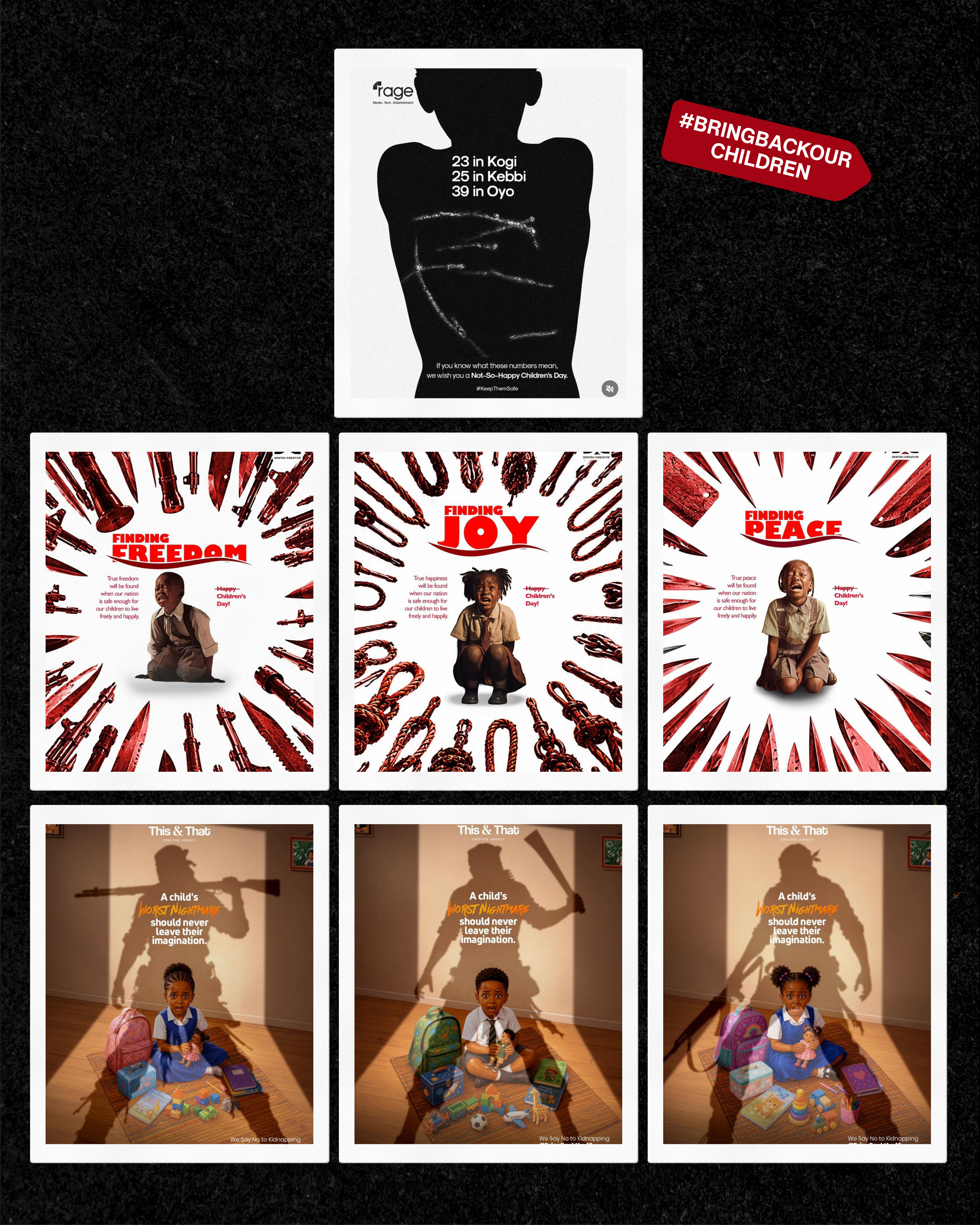
Rage Media opened with a creative that should stop every marketing professional cold. A child’s silhouette, back turned to the viewer. Across that back, rendered as scars carved into skin: 23 in Kogi. 25 in Kebbi. 39 in Oyo. “If you know what these numbers mean, we wish you a Not-So-Happy Children’s Day.” #KeepThemSafe.
Those numbers are not statistics. They are children. Taken from classrooms, from homes, from the only futures they had. The scars on those children’s back are not design choice. They are an accusation, directed at every institution, every government, and every brand that chose to post a celebration graphic on the same day those numbers existed.
The creative does not explain itself. It does not need to. If you know what those numbers mean, you already feel the weight of them. If you do not, the image teaches you in the time it takes to read three lines.
Finding What Should Never Need to be Found
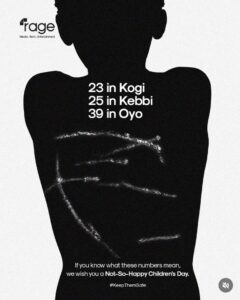
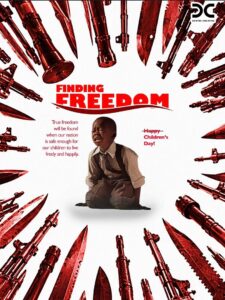
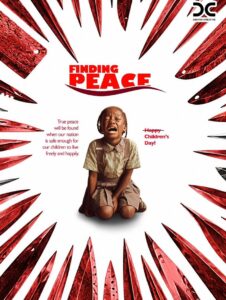
Dentsu Creative produced three executions under a single devastating creative platform. Finding Freedom. Finding Joy. Finding Peace. Each one: a Nigerian child in school uniform, crouching, crying, terrified, surrounded by a circle of weapons. Guns pointing inward in Fining Freedom. Chains closing in from every direction in Finding Joy. Blades converging in Finding Peace.
In the corner of each image, the word “Happy” is struck through in red. “Children’s Day!” remains, exposed and hollow beneath it. That strikethrough is the most honest editorial decision in Nigeria advertising this year. It does not pretend. It does not soften. It simply removes the word that no longer applies and leaves the rest standing, uncomfortable, unresolved, exactly as it should be.
The copy is equally precise: “True freedom will be found when our nation is safe enough for our children to live freely and happily.” Not a campaign slogan. A verdict.
The Shadow in the Room
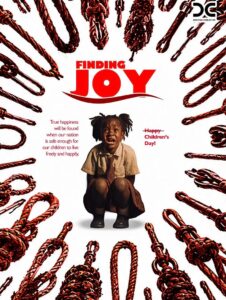
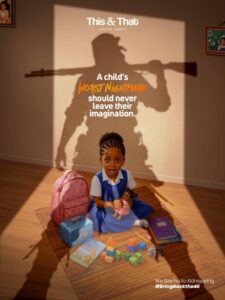
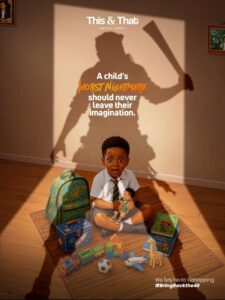
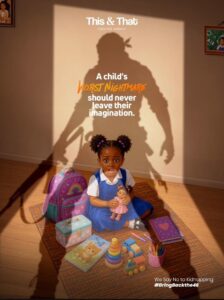
This&That Creative Agency produced what may be the most quietly devastating work of the three. Three separate executions. Three different children, a girl in a blue school uniform, a boy in grey and green, a younger girl surrounded by crayons and picture books, each sitting on a floor with the full architecture of childhood arranged around them. Schoolings. Toys. Lunchboxes. The small, sacred objects that belong to a life that has not yet been interrupted.
But cast on the wall behind each child is a shadow. Enormous. Armed. The silhouette of a kidnapper, already in the room, already reaching.
“A child’s worst nightmare should never leave their imagination.” #BringBackthe46.
The creative understands something that makes it more disturbing than any explicit imagery could be: the shadow is not coming. It is already there. It is already in the room with the child, already touching the edges of the world where they the toys are, where the books are, where the future was supposed to be safe. The children in the images are not yet take. But they are not safe. And that gap, between not yet and already, is exactly where the 46 children from Oyo State, the 23 from Kogi, the 25 from Kebbi, and every other stolen child currently lives.
What the Industry Must Reckon With
These creatives were not produced by brands. They were produced by agencies, creative businesses whose entire existence is built around the power of communications to move people, shift behaviour, and change the conversation.
That distinction matters enormously.
On Children’s Day 2026, while brands across Nigeria posted colourful graphics celebrating childhood, three creative agencies made a different calculation. They decided that the most powerful thing they could do with their skills on that particular day was not to sell anything, not to generate engagement, not to demonstrate their creative range for prospective clients, but to bear witness. To refuse the comfort of celebration when 46 children in Oyo State were not celebrating. When children in Kogi and Kebbi were not celebrating. When mothers and fathers across this country woke up on Children’s Day with empathy spaces where their children used to be.
That decision, to use creative skill in service of conscience rather than commerce, is what the Nigerian marketing and advertising industry needs to examine seriously. Not once a year. Not only when a kidnapping makes headlines. But as an ongoing question about what this industry is actually for, and what it owes to the society it operated within.
The Challenge to Every Brand
The agencies spoke. The brands, by and larger, did not.
That silence is its own statement. When creative agencies are willing to trade their Children’s Day content calendars for a call to action, and the brands funding those calendars are not, something is out of alignment. The industry cannot simultaneously claim to understand Nigerian consumers, to know their fears, their values, their deepest concerns, and then look away from the thing that is consuming Nigerian parents with dread every morning their child leaves for school.
This is not a call for brands to turn every campaign into social commentary. It is a call for something simper and more demanding: awareness. The awareness that there are moments when a “Happy Children’s Day” post is not neutral. When it is, in fact, a choice. And choices carry consequences, to reputation, to trust, and to the relationship a brand claims to have with the people it asks to buy from it.
The children in Oyo are still missing. The children in Kogi are still missing. The children in Kebbi are still missing. Their parents do not need balloon graphics. They need every voice that has the power to be heard to use that power, loudly, consistently, and without apology, until those children come home.
The Bottom Line
On Children’s Day 2026, Nigeria’s creative agencies looked at a blank canvas and chose truth over celebration. They produced work that will outlast any campaign brief, any metrics dashboard, and any end-of-year award submission.
They chose the children.
The question now is whether the brands, with their larger platforms, their bigger budgets, and their millions of followers, will find the courage to do the same.
#BringBackOurChildren. #KeepThemSafe
ALSO WATCH:MARKETING EDGE ONTV


Comment
No comments found.