
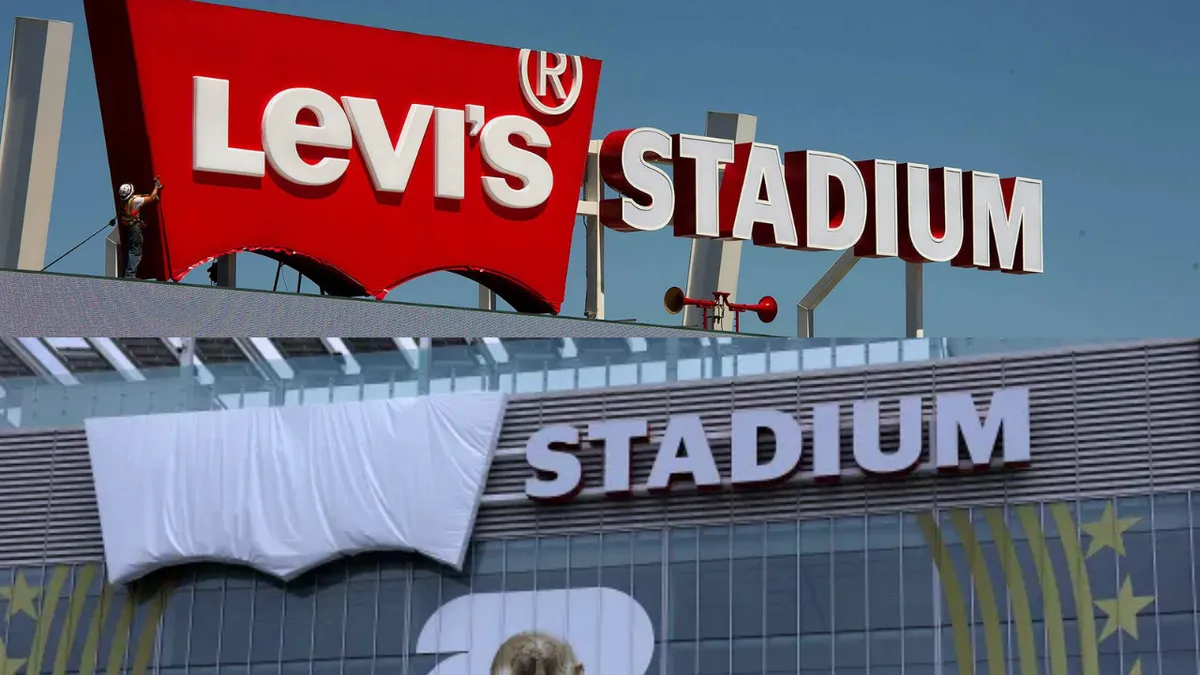



FIFA tried to make Levi’s invisible. It did the opposite.
On June 13, 2026, the 2026 FIFA World Cup played its match at a stadium in Santa Clara, California. The venue, which has hosted Super Bowls, NFL playoffs, and some of the biggest sporting events in American history, was not called by its name that day. It was not called Levi’s Stadium. For the duration of the World Cup, it had been temporarily renamed the San Francisco Bay Area Stadium, a generic, geography-based placeholder that exists solely to satisfy one of football’s most commercially aggressive rules.
As part of FIFA’s strict “clean stadium” policy, all venues hosting tournament matches must remove or cover branding from companies that are not official tournament sponsors. That means sponsored venue names disappear, partner logos get hidden, and stadium signage is scrubbed clean to make room for FIFA’s commercial ecosystem.
Levi’s, which is not an official World Cup sponsor, was one of the casualties. Or so FIFA thought.
The challenge for Levi Strauss was straightforward: hide the company’s name from one of the tournament’s most visible venues. The solution, however, drew worldwide attention. Rather than completely obscuring its famous red batwing logo shape, the company covered only the wordmark while preserving the distinctive silhouette that consumers instantly recognise.
The tarp went up. The name disappeared. And then something happened that no compliance brief could have predicted, the internet noticed.
Videos and images of the stadium with the covered Levi’s batwing logo went viral, drawing attention both to FIFA’s strict clean venue rule and to the strength of Levi’s brand recognition. Arguably, the batwing’s distinctive shape became even more noticeable once covered with a white tarp, attracting more attention than it might have if the logo had been left uncovered.
A brand that was supposed to disappear had just become one of the most talked-about names at the tournament.
What Levi’s did next
A lesser brand would have issued a polite statement acknowledging the situation and moved on. Levi’s did something far smarter, it leaned in.
Rather than treating the situation as an inconvenience, Levi’s embraced it publicly. The company changed its Instagram profile picture to feature the covered logo and published a playful video referencing the viral “Nobody’s Gonna Know” trend. The accompanying caption read: “Welcoming the world to the beautiful [redacted] stadium!” The post quickly generated engagement from fans, many of whom praised the brand’s sense of humour.
The video amassed around 35.7 million views, sparking a wave of online applause.
Think about what just happened there. Levi’s spent $170 million on a ten-year stadium naming rights deal. FIFA voided that deal for the duration of the World Cup without compensation. And Levi’s turned that loss into 35.7 million views, global press coverage, and a social media moment that brands with full official sponsorship packages could not buy.
That is not luck. That is brand intelligence.
Why this works as a marketing lesson
The Levi’s moment is not just a funny story about a tarp. It is a case study in three of the most important principles in modern brand strategy.
The first is distinctive asset strength. A Sage Journal study examining nearly 600 assets found that visual identifiers such as logos, colours, and shapes play a critical role in brand recognition. The batwing shape alone was enough for fans to identify Levi’s, a shape can carry a brand without a single word. Most brands cannot say that. Most brands need their name, their colour, their font, and their tagline all working together before a consumer knows who they are looking at. Levi’s needed none of that. The silhouette was enough. That level of brand equity is built over decades, and the World Cup just put it on a global stage in the most dramatic way possible.
The second is cultural awareness. Levi’s willingness to joke about the FIFA rule earned organic engagement because audiences reward marketing that is culturally aware. The brand did not get defensive. It did not send a press release. It posted a meme. And in doing so it communicated something about its personality, self-aware, confident, unbothered, that no paid campaign could have delivered as efficiently.
The third is reactive agility. The window between the tarp going up and the internet moving on was short. Levi’s had to see the moment, make a creative decision, and publish, fast. Brands that are still waiting for three rounds of approval before posting on Instagram do not get to play in these moments. Levi’s did.
The FIFA angle nobody is saying
Here is the uncomfortable truth sitting underneath this story. Sponsorship is expected to generate roughly $2.8 billion in revenue for the 2026 World Cup, making it one of the tournament’s largest commercial pillars. FIFA’s clean stadium policy exists to protect the exclusivity that official sponsors have paid billions to secure. The logic is sound, if you pay to be the official soft drink of the World Cup, you do not want a competitor’s logo visible in the stadium.
But the Levi’s incident exposes the limits of that logic in a social media age. FIFA can control what is on the stadium wall. It cannot control what goes viral on Instagram. The attempt to erase Levi’s from its own building created more Levi’s coverage than most official sponsors generated with full campaign budgets. The brands inside the clean zone paid for exclusivity. The brand outside it got the conversation.
For Nigerian marketing and advertising professionals watching this tournament, the lesson is not that you should find loopholes in sponsorship agreements. The lesson is that brand strength, real, distinctive, deeply embedded brand strength, cannot be covered with a tarp. And that the most powerful marketing moments at a tournament this size are not always the ones that cost the most.
Sometimes they are the ones that cost nothing. Sometimes all you need is a silhouette, a caption, and the confidence to laugh at yourself in front of six billion people.
Levi’s did not sponsor the World Cup. The World Cup sponsored Levi’s.
ALSO WATCH: MARKETING EDGE ONTV




Comment