
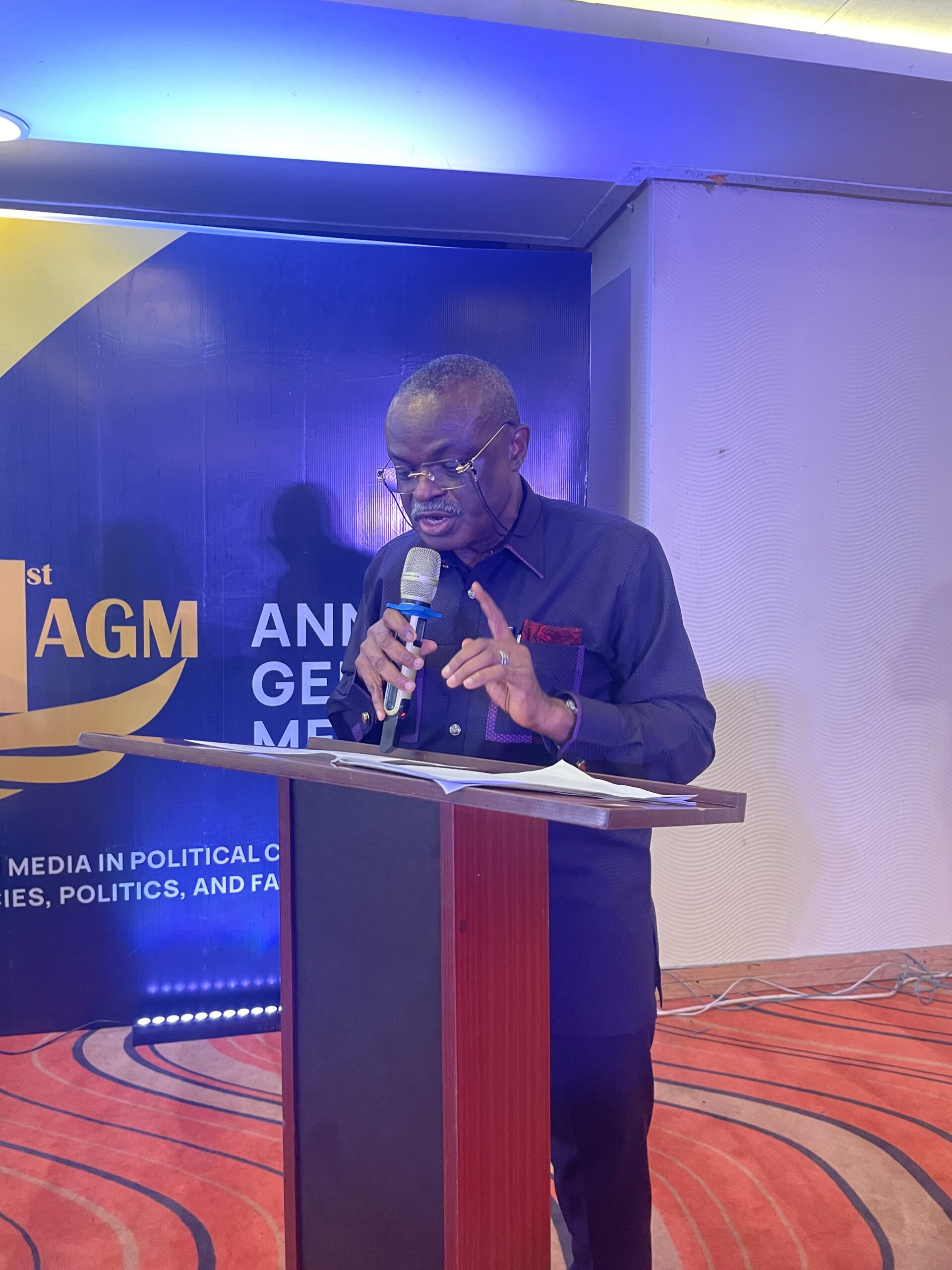


As Nigeria edges closer to another election cycle, the out-of-home advertising industry finds itself once again at what one of its most respected voices described as “the intersection of business, politics, regulation, public communication, and democratic accountability.”
It was on this note that Dr. Theodore Ekechi, chairman Marketing Media Group limited, delivered the keynote paper at the 41st Annual General Meeting of the Out-of-Home Advertising Association of Nigeria (OAAN) held in Abeokuta, Ogun State.
His paper, titled “Out-of-Home Advertising Association of Nigeria in Political Campaign Season: Policies, Politics, and Fair Practice,” was a methodical, frank and at times uncomfortable examination of the forces shaping outdoor advertising practice during political seasons and what OAAN must do to preserve its integrity in the face of those forces.
Dr. Ekechi opened by reframing a debate that has lingered within the industry for years. Drawing on a study conducted during the 2019 general elections, he cited findings that “Exposure to Outdoor Advertisements by the electorate in some states of Nigeria was up to 94 %,” before making his position unequivocal.
“Given the peculiar circumstances of developing countries, OOH cannot be classified as a support medium. It is not one of, but the leading medium of communication particularly in a chaotic political communication environment that is not deeply intellectual, historically analytic nor ideologically centred.”
He traced the origin of political outdoor advertising in Nigeria to 1963, noting that “Chief Obafemi Awolowo and the Action Group pioneered modern political outdoor advertising by using skywriting during rallies ahead of the 1964 elections,” a tradition that has since grown into one of the most consequential communication channels in Nigerian democracy.
Dr. Ekechi gave considerable attention to the legal and regulatory framework governing the industry, pointing to what he described as “a complex mix of federal standards, state and local controls.”
He noted that while Advertising Regulatory Council of Nigeria (ARCON) exercises federal powers over advertising regulation, the Constitution’s Fourth Schedule vests “the control and regulation of outdoor advertising and hoardings exclusively in Local Government Councils,” a tension that has led some constitutionalists to argue that Section 54 of the ARCON Act is “inconsistent with the Constitution and consequently null and void.”
Rather than dwelling on the legal conflict, his broader point was that “there are indeed a myriad of laws, rules and legal instruments, whether overlapping or underlapping, enough to regulate advertising, and particularly, out-of-home practice in the country without the meddlesomeness of States.” The problem, he argued consistently, is not the absence of regulation but its application. “The challenge is often not the absence of policy but wrongful, selective and inconsistent implementations.”
The most pointed section of Dr. Ekechi’s paper catalogued the specific challenges OAAN members face when political seasons arrive. On permit fees, he observed that “State signage agencies now impose unprecedented, prohibitive, non-negotiable outdoor campaign permit fees and levies specifically for political advertisement,” adding that while the fees are presented as applying to all parties, “the ruling party are self-accounting and often perfected their peculiar ways of paying and receipting from themselves to themselves.”
On post-election debt, he described outdoor agencies as “usually hapless to seek redress or enforce their credit rights because of fear of regulatory victimisation” a situation where the very parties that patronise the industry leave it financially wounded with no viable recourse.
On the monopolisation of prime advertising space, he noted that “prime digital and static billboard locations sell out or are heavily monopolised early even during the ‘no campaign’ period by the governments in power, leaving smaller or opposition parties tottering for visibility when eventually the ban is lifted.”
On vandalism, he acknowledged that while there may not be an official policy behind the destruction of campaign materials, “lack of prosecution by the state and relevant security agencies encourages impunity and perpetuation. Even then, it is common knowledge that politicians tacitly nudged them on.”
On the commercial consequence of all these pressures, Dr. Ekechi was measured but direct, observing that “the traditional dominance of political outdoor advertising pre-, pro- and during election seasons is beginning to fade to the detriment of the industry reputation, industry growth and profitability, and indeed the foundation of democracy.”
One of the more pointed observations in his paper was Dr. Ekechi’s reference to “allegations of preferential treatments by regulators who sometimes indulge in direct practice” a conflict of interest that he positioned as one of the industry’s most corrosive challenges. He noted that these challenges “arise from political pressures attributable to government(s) in power with very negative impacts on professionalism and industry growth.”
At the heart of his paper was a democratic argument about fair access. “Access to advertising inventory should be guided by transparent commercial principles rather than political affiliation,” he stated.
“Every qualified political party and candidate should have equal opportunity to purchase available advertising space, subject to existing laws and industry regulations. If one candidate is denied advertising space because of regulatory restrictions, those same restrictions must apply equally to every other candidate. Selective enforcement undermines both public confidence and the credibility of the industry.”
He reinforced this with a point about the economic logic of predictable regulation. “Fair practice requires consistency. Predictable regulation encourages investment. Because predictability engenders planning and projections. No investment regime thrives without planning and projections.”
Dr. Ekechi was candid about the limits of OAAN’s current institutional position. “Only an OAAN Charter will equip the organisation to realistically resist and fight the impunity in the regulation of out-of-home business,” he stated. Until that is secured, he urged the association to “rely on ARCON and its Advertising Codes of Practice to press for compliance.”
He also called on OAAN to strengthen its internal governance, advocating for “self-regulatory codes designed to prevent unfair advantages, curb visual clutter or environmental pollution, stop inflammatory messaging, uphold transparency in pricing, allocation and acquisition of advertising space, contract administration and equal access to advertising inventory for all political contenders.”
On the vulnerability of OAAN executives to regulatory pressure, he renewed an earlier call that “OAAN staff should be entrusted with executive powers so that they can indeed speak truth to power without fear of reprisal or victimising axe from regulators,” adding that “I have always doubted the extent an OAAN Chief executive or any other executive can engage a regulatory agency within the region of his company practice without prostrating for the fear of the obvious repercussion.”
On the question of political neutrality, Dr. Ekechi was unambiguous. “Political neutrality is perhaps the greatest asset of any professional association. Individual members are entitled to personal political beliefs, however, the Association itself must remain an impartial professional institution whose commitment is first and foremost to ethical standards, professional excellence, and national development. The moment an industry association is perceived as favouring one political interest over another, it risks losing the confidence of stakeholders across the socio-political economic spectrum.”
His prescription for engagement was equally direct. “We must be realistic to our status limitations. If we can’t bite, we should not just bark, we should engage.”
Dr. Ekechi closed his paper with a charge that lifted the conversation beyond the industry into the realm of national responsibility. “A credible advertising industry contributes directly to credible elections and, ultimately, to a stronger Nigerian democracy. History will not only judge the politicians who contest elections; history will also judge the institutions that provide the platforms through which democracy speaks or is muted.”
He his conclusion was a practical and philosophical warmt, reminding the association that in its pursuit of the Charter, “the very stakeholders you may be engaging are the ones to deny or affirm your Charter. Wisdom should prevail.”
For an industry that has spent 41 years building institutional relevance, Ekechi’s paper was both a celebration of that journey and a sobering reminder that the road ahead demands more than commercial instinct. It demands courage, consistency and an unshakeable commitment to the principles that make outdoor advertising not just a business but, as he argued, a democratic institution.



Comment
No comments found.