
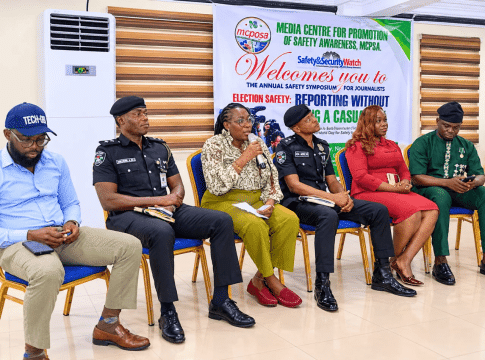


The Media Centre for Promotion of Safety Awareness (MCPoSA), in collaboration with the Nigeria Union of Journalists (NUJ), has called for stronger measures to end impunity for crimes against journalists and guarantee the safety of media professionals. The call was made at a symposium held in Lagos to mark the 2026 International Day to End Impunity for Crimes against Journalists
Meanwhile, the call was made at a one-day symposium organised by the Media Centre for Promotion of Safety Awareness (MCPoSA), in collaboration with the Nigeria Union of Journalists (NUJ), to commemorate the 2026 International Day to End Impunity for Crimes against Journalists, observed on November 2.
Also, the symposium, themed “Election Safety: Reporting Without Being a Casualty,” held at the Lagos Chamber of Commerce and Industry (LCCI), Alausa, Ikeja, with support from UNESCO, the Federal Airports Authority of Nigeria (FAAN) and Fidelity Bank. It examined the dangers confronting journalists and measures required to protect them during elections and other high-risk assignments.
Under this year’s global theme, “Threats Evolve. Impunity Endures,” the commemoration highlighted persistent attacks on journalists and the need for stronger protection mechanisms.
WATCH ALSO:MARKETINGNEDGE ONTV HOSTS AYODEJI TOBUN
Welcoming participants, Dr. Chinyere Amaechi, Executive Director of MCPoSA, reaffirmed the organisation’s commitment to health, safety, security and environmental awareness through advocacy, training, workshops and public engagement. She stressed that protecting journalists requires deliberate preparation and shared responsibility, particularly ahead of the elections.
Representing the police, ASP Adeola Mohammed, Public Relations Officer, Airport Command, described journalists and security agencies as partners in sustaining democracy. He disclosed that the Nigerian Police Force, in partnership with the Nigerian Police Trust Fund, commenced a five-day election-security training programme on October 22, 2026, involving 10,000 officers nationwide.
He said the programme covered accountability, transparency and election security, with participants expected to transfer the knowledge to their respective commands. Mohammed urged media organisations to train reporters, familiarise them with assigned locations and encourage neutrality, situational awareness and timely withdrawal from dangerous situations.
On personal and digital safety, Dr. Ugo Onuoha advised journalists to monitor their health, recognise burnout and maintain emergency contacts beyond their employers. He recommended encrypted communication, secure devices, backing up essential files and removing sensitive information before high-risk assignments. He also urged reporters to avoid travelling alone to volatile locations, share their itineraries and identify escape routes, while calling on media organisations to provide adequate training and resources.
ALSO WATCH:MARKETING EDGE ONTV HOSTS GEORGE ISITUA-ONUKWU
Similarly, Waliu Adegoke, Managing Director of Qodar Safety Consults, called for greater attention to water safety and emergency response. Citing his experience training Sterling Bank employees who travelled through riverine communities, he urged media houses to provide life jackets and water-safety instruction for reporters covering waterways. He also advocated basic first-aid and cardiopulmonary resuscitation (CPR) training.
From an occupational safety perspective, Diseye Oba, Head of Health, Safety, Environment and Sustainability at Dangote, said risk management begins with identifying hazards, determining who could be affected and establishing preventive controls. She identified violence, crowd disturbances, communication failures and delayed emergency response as potential election risks, stressing that government, employers, regulators and individuals all have responsibilities for safety.
Adding the NUJ’s perspective, Adeola Ekine, Special Adviser to the National President and former Chairperson of the Nigeria Association of Women Journalists (NAWOJ), Lagos, insisted that providing protective equipment is an employer’s responsibility, not a favour. She urged media organisations to equip reporters according to their assignments and advised journalists to wear appropriate clothing, identify exits and remain security-conscious. She warned against risking one’s life for exclusive footage, maintaining that only a living journalist can tell the story.
Delivering the UNESCO Director-General’s message, Yachat Nuhu, representing the Country Representative and Head of Office in Abuja, Dr. Isaías Barreto da Rosa, disclosed that more than 189 journalists were killed in violent attacks worldwide in 2024 and 2025, with 67 per cent of the deaths occurring in conflict zones. Six out of every seven killings remained unpunished.
The message also highlighted emerging threats, including drone attacks, which claimed 50 lives during the period, and gender-based online violence, particularly against women journalists. It noted that impunity for journalist killings in countries not affected by conflict had declined by 17 percentage points since 2012. UNESCO had also supported more than 70 national protection mechanisms and trained 53,000 judicial and law-enforcement officials across 160 countries.
ALSO WATCH:MARKETING EDGE ONTV HOSTS DEMILADE
Nuhu further highlighted UNESCO’s work with Nigerian journalists on capacity development, media and information literacy and digital safety, stressing the importance of ethical conduct in the use of artificial intelligence and digital platforms.
Addressing the relationship between journalists and security agencies, ASP Olufemi Adeoye, Deputy Police Public Relations Officer, Lagos State Command, emphasised the need for professional boundaries, lawful conduct and mutual respect during election coverage.
He explained that the police are responsible for protecting voters, journalists, electoral materials and polling environments, while journalists must concentrate on observing and accurately reporting events without interfering with security operations.
Recalling an off-cycle election assignment in which political supporters disrupted a polling unit and seized electoral materials, Adeoye explained that he relied on observation, discretion and evidence gathering rather than reckless confrontation. He warned that journalists who openly expose their intention to record individuals involved in unlawful activities could provoke dangerous reactions.
He also cautioned against partisan expressions, provocative language and sensational reporting, noting that such conduct could heighten tensions and endanger reporters. He urged journalists to separate personal political interests from professional responsibilities and respect lawful security procedures, while reminding security personnel to operate within the law.
The symposium concluded with a shared call for media organisations to invest in journalist training and protective equipment, security agencies to facilitate safe reporting, and journalists to exercise professional judgement and prioritise their lives.
Through the commemoration, MCPoSA and the NUJ reinforced the importance of translating the global campaign against impunity into practical protection for Nigerian journalists, particularly as preparations for the 2027 elections gather momentum.




Comment
No comments found.