
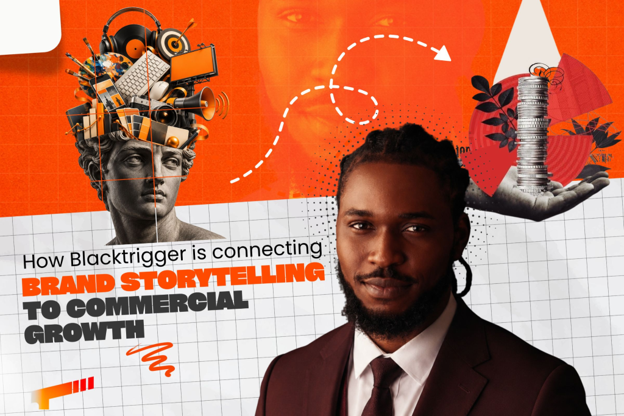



By Caleb Nnamani, Chief Storyteller, Blacktrigger
Marketing has never had more ways to reach people. Brands can buy attention, target increasingly specific audiences, automate campaigns, recruit creators, publish endlessly and measure almost every click.
Yet an uncomfortable question remains: how much of that activity actually changes what people think about a brand, whether they trust it, or why they should choose it over another?
The industry has become exceptionally good at generating attention. It has not become equally good at turning attention into lasting preference, authority and commercial growth.
That is the problem Blacktrigger is building its model around.
The Lagos-headquartered storytelling company is advancing an integrated approach that connects brand strategy, public relations and thought leadership, video production, digital marketing, creator partnerships and distribution around a common commercial objective: helping businesses become more understood, more trusted and more difficult to overlook.
The thinking is simple, but its implications for the marketing industry are significant. Storytelling should not be the decorative layer of a campaign. It should inform the way a business presents itself to the market.
Attention is rented. Preference is earned.
There is a reason some advertising campaigns remain culturally recognisable decades after their release.
In 1971, Coca-Cola’s Hilltop campaign did not simply advertise a soft drink. It associated the product with togetherness and a shared human ideal.
Guinness took a similarly expansive approach in Nigeria with Made of Black in 2014, attaching the brand to a generation of African creativity, confidence and self-expression.
More recently, Coca-Cola’s Nigerian Achalugo and Odogwu campaign used romantic chemistry, cultural references and everyday Nigerian experiences to make a product promotion feel like a story people wanted to follow.
Coca-Cola’s Odogwu and Achalugo campaign was culturally fluent and brand resonant
The formats changed. The underlying principle did not.
A brand becomes more valuable when people associate it with something beyond the transaction.
This is not an argument against performance marketing, paid media or conversion optimisation. Those disciplines matter. But the evidence increasingly challenges the idea that short-term response is enough.
The Institute of Practitioners in Advertising’s 2026 analysis of 812 campaigns found that 93% of for-profit campaigns reporting very large increases in brand trust also reported at least one very large business effect, such as growth in sales, market share or profit. Across all for-profit campaigns, the figure was 66%.
Trust is not a soft metric sitting outside business performance. It can be one of the conditions that makes business performance stronger.
The Nigerian market makes the argument even sharper
Consider the Nigerian consumer.
According to NielsenIQ’s 2025 Consumer Outlook findings, reported by BusinessDay, almost six in ten Nigerian shoppers switched brands in the preceding year because of price increases. Yet 99% said trust in the brand they buy is very or somewhat important.
This is the tension businesses must understand. Consumers are watching their spending, comparing alternatives and demanding value. Brand familiarity alone may not be enough to keep them.
A brand cannot storytelling its way out of poor product quality, inconsistent service or an uncompetitive offer. But when the fundamentals are right, a clear and credible story can give customers a stronger reason to notice, understand and choose it.
In a market as culturally diverse and commercially complex as Nigeria, that story has to sound like it belongs here. It must understand how people speak, what they aspire to, what they distrust, the communities they identify with and the realities shaping their decisions. Cultural fluency is not sprinkling local slang into an advert.
From making campaigns to building a connected story
This is where Blacktrigger’s model departs from the conventional agency transaction.
A business might commission a video from one provider, hire another for public relations, engage creators separately, run digital campaigns elsewhere and eventually wonder why all these activities seem to be telling slightly different stories.
The problem is not necessarily the quality of the individual work. It is the absence of a shared strategic direction.
Blacktrigger starts with the business: what it does, what makes it different, what the market misunderstands, which audiences matter and what needs to change commercially. From there, it develops the narrative and connects the work across channels.
A brand film can introduce the story. Public relations can establish credibility around it. Founder thought leadership can give the market a human voice to trust. Creator partnerships can bring the story into relevant communities. Original research can give the company an original contribution to the industry conversation. Digital distribution and AI visibility can help the narrative travel further.
Each activity has a role. None should exist simply to fill a content calendar.
This connected approach also changes the economics of agency relationships. Clients should not have to pay for disconnected activity, coordinate multiple providers or mistake a long list of deliverables for progress. Work should be scoped around the actual business objective, delivered with clear accountability and measured against agreed outcomes. Media spend should be transparent, not buried inside vague campaign costs.
The point is not to do everything for every business. It is to bring the right capabilities together, at a commercially sensible scope, under one strategic direction.
What this looks like when the story has to deliver
The strongest argument for a model is what happens when it meets a real business problem.
For YC-backed fintech company Bujeti, the challenge was not simply to announce another product. It was to make a complex finance platform more relevant to the businesses it served.
Blacktrigger connected positioning, product storytelling, launch films, earned media, founder thought leadership and original research. The work helped drive a 64% increase in Payroll adoption, 45% more new customers against baseline and over 30% growth in organic inbound.
With Condia’s flagship #TheBorderlessExperience, the challenge was to turn an upcoming event into something people had a reason to anticipate. Rather than treating speaker announcements as routine updates, Blacktrigger turned confirmed speakers and sponsors into individual storytelling opportunities through invitation films and coordinated amplification.
The campaign generated more than one million impressions and ticket sales 100% above expectations.
For Bitnob, the challenge was one of market perception: moving beyond being understood as an African crypto app to being recognised as global crypto infrastructure. Blacktrigger developed the narrative and coordinated a launch across six regions and four languages. The campaign generated more than 500 publications, over 200 million cumulative reader reach and more than a dozen PR-driven B2B inbounds, with over 480 earned placements.
These are different businesses, different audiences and different commercial objectives. What connects the work is the same discipline: identify the story the market needs to understand, then build the creative and distribution system capable of carrying it.
The next agency advantage will be integration
The agency industry is already debating its next evolution. Marketing Edge’s coverage of Insight Publicis’ digital-first repositioning and AIKIDO Agency’s launch reflects a wider conversation about the relationship between creative work, technology, strategic relevance and measurable business results.
The effectiveness debate is not new. Les Binet and Peter Field’s influential The Long and the Short of It made the case for balancing long-term brand building with short-term sales activation. The challenge today is connecting those objectives across an increasingly fragmented media environment.
Artificial intelligence will accelerate that pressure. Content production is becoming easier and cheaper. More brands will be able to publish more material, more frequently. But an abundance of content does not automatically create distinction, trust or demand.
The advantage will belong to businesses that know what they stand for, communicate it consistently and give people compelling reasons to care.
Blacktrigger’s position is that storytelling is the connective discipline capable of bringing those activities together. Not storytelling instead of marketing, and certainly not storytelling instead of a good product. Storytelling as the strategic system that helps the product, the people, the reputation and the distribution reinforce one another.
The industry does not need more content for content’s sake. Businesses need marketing that makes them matter.
And the story should be judged by what it moves.




Comment
No comments found.