
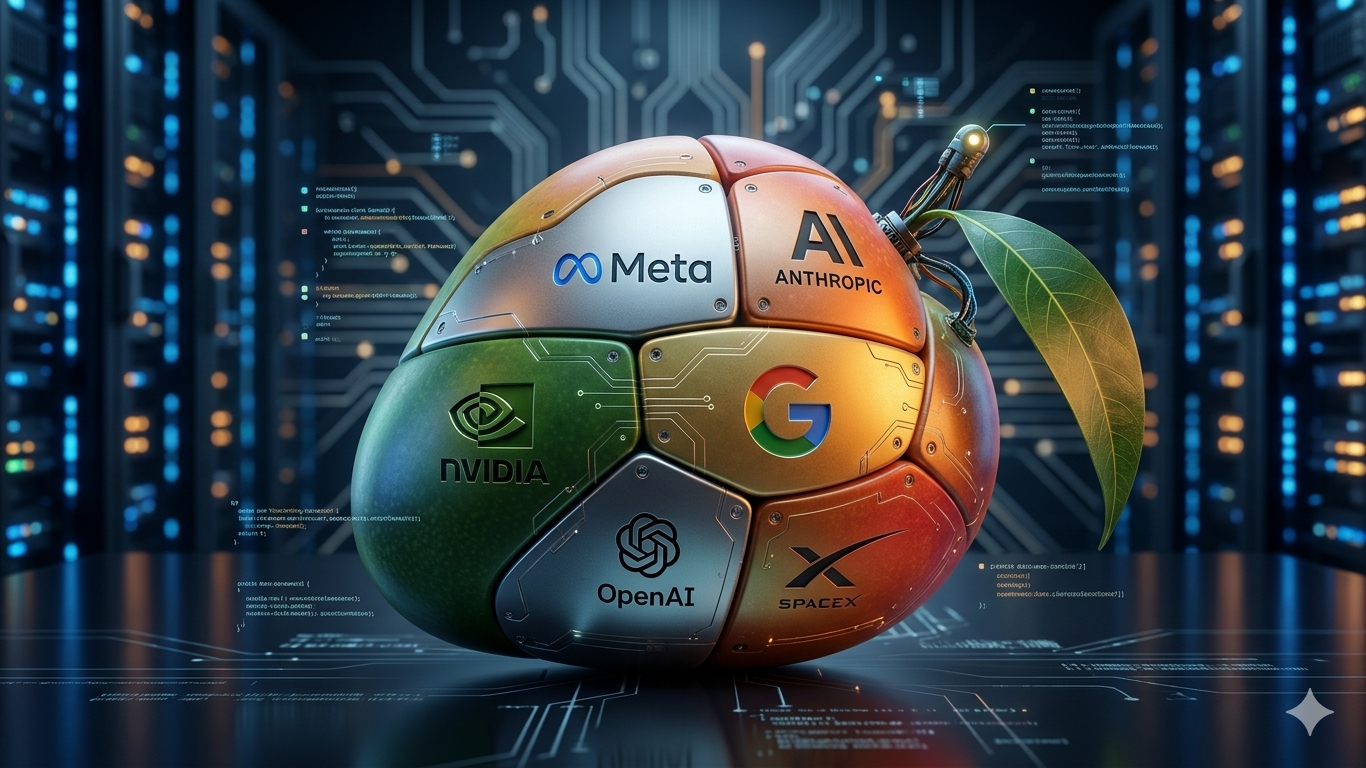


There is a new acronym in town. And if you work in marketing, advertising, brand strategy, or tech, it is not just a Wall Street story, it is your story too.
For most of the past decade, five letters defined the technology industry. FAANG; Facebook, Apple, Amazon, Netflix, and Google, represented the companies that built the internet as we know it, shaped consumer behaviour on a global scale, and in doing so, became the most powerful advertising platforms in history. Every brand strategy, every media plan, every digital campaign was written with at least one of those five companies somewhere in the equation.
Now, FAANG is being replaced. The new acronym is MANGOS; Meta, Anthropic, Nvidia, Google, OpenAI, and SpaceX, and it signals a dramatic shift in how the world’s most powerful technology is being built, owned, and deployed.
The name started not in a boardroom but online. On June 8, 2026, a graphic posted by full-stack AI engineer Krishna B. on X drew more than 20,000 likes in a single day, while TechCrunch credited developers posting as @krishdotdev and @lilscoot with pushing the MANGOS version into wide circulation. Within days, the term had moved from social media shorthand into mainstream financial and technology commentary. The timing was not accidental.
SpaceX had begun trading in what could be the largest IPO ever, valued at nearly $75 billion. Anthropic had filed for an IPO on June 1. OpenAI was expected to follow. Three of the most closely watched private companies in the world were preparing to go public at the same moment, and investors needed a framework for what they were looking at. MANGOS gave them one.
What changed, and why it matters
To understand what MANGOS represents, you have to understand what FAANG was actually selling.
FAANG was about owning consumer attention. Facebook owns social. Apple-owned devices. Amazon-owned commerce. Netflix owns entertainment. Google-owned search. Together, they built the infrastructure of the consumer internet, and brands paid to reach people through it. The entire modern advertising industry, programmatic buying, social media marketing, influencer culture, and performance marketing, was constructed on top of the platforms FAANG built.
MANGOS is different. The shift is from owning consumer attention to owning the intelligence layer itself, the models, the chips, the computing infrastructure, and the orbital systems that will define how the next era of technology functions.
Look at who is in the group and what each one controls. Meta and Google survived the transition from FAANG, but they are no longer in MANGOS because of social media or search. They are there because of their AI capabilities and the sheer scale of their computing infrastructure. NVIDIA sits at the centre of the AI trade because of its chips, the hardware without which none of the AI models being built by Anthropic, OpenAI, or anyone else could function at scale. Anthropic and OpenAI are building models already used by millions of people and businesses worldwide to create content, make decisions, and run operations. SpaceX brings something different entirely, the orbital infrastructure that will power next-generation connectivity, data transmission, and computing at a planetary level.
When MANGOS is fully public, it will represent over $10 trillion in combined market value, more than FAANG at its peak, achieved in roughly half the time.
The marketing implication nobody is saying out loud
Here is what the MANGOS conversation almost always misses when it stays inside financial media: this is not only an investment story. It is a brand and marketing story.
FAANG built the platforms. Brands built their entire growth strategies around those platforms. When Facebook changed its algorithm, marketing budgets shifted overnight. When Apple introduced privacy changes in iOS, the performance marketing industry had to restructure itself in real time. When Amazon became a search engine for products, entire brand positioning strategies had to be rethought. The platforms held the power, and the brands played by their rules.
MANGOS is building something more foundational than platforms. It is building the intelligence that will run inside every platform, every tool, every channel that brands use to communicate with consumers. Anthropic and OpenAI are not just chatbot companies, they are building the reasoning engines that will power creative tools, customer service systems, media buying algorithms, and content production workflows across the entire marketing industry. NVIDIA’s chips are not just for data centres, they are the hardware that makes real-time personalisation, generative creative, and AI-powered campaign optimisation possible at scale. Meta and Google are not resting on their platforms, they are racing to embed AI into every product they own, which means every advertising surface they sell.
For Nigerian marketing and brand professionals, this is not a distant conversation.
Search interest for “how to use AI” in Nigeria doubled between June 2024 and July 2025, reflecting a growing awareness that AI is no longer optional infrastructure, it is a competitive advantage. A 2024 survey found that 42 per cent of African marketing professionals had already increased their use of AI-powered tools, with momentum continuing to build. Nigerian brands are already using tools built on the models and infrastructure that MANGOS companies own, for content creation, customer targeting, campaign optimisation, and real-time marketing activation.
The question is not whether MANGOS will affect Nigerian marketing. It already has. The question is whether Nigerian brand custodians and marketing leaders understand who is actually building the tools they rely on, and what the concentration of that power in six companies means for how marketing gets done, priced, and controlled in the years ahead.
The era ahead
Some market participants are already proposing an alternative version called TANGOS, which would swap in Tesla, reflecting ongoing debate over which companies truly define the next era of market leadership. The acronym may still be settling. But the underlying shift it represents is not.
FAANG gave marketers their platforms. MANGOS is building its operating system. The brands that understand the difference, and start thinking strategically about how the intelligence layer shapes their creative, their media, and their consumer relationships, will be the ones best positioned for what comes next.
The new acronym is MANGOS. Learn it. Because the companies behind it are already learning you.
ALSO WATCH: MARKETING EDGE ONTV


Comment
No comments found.