
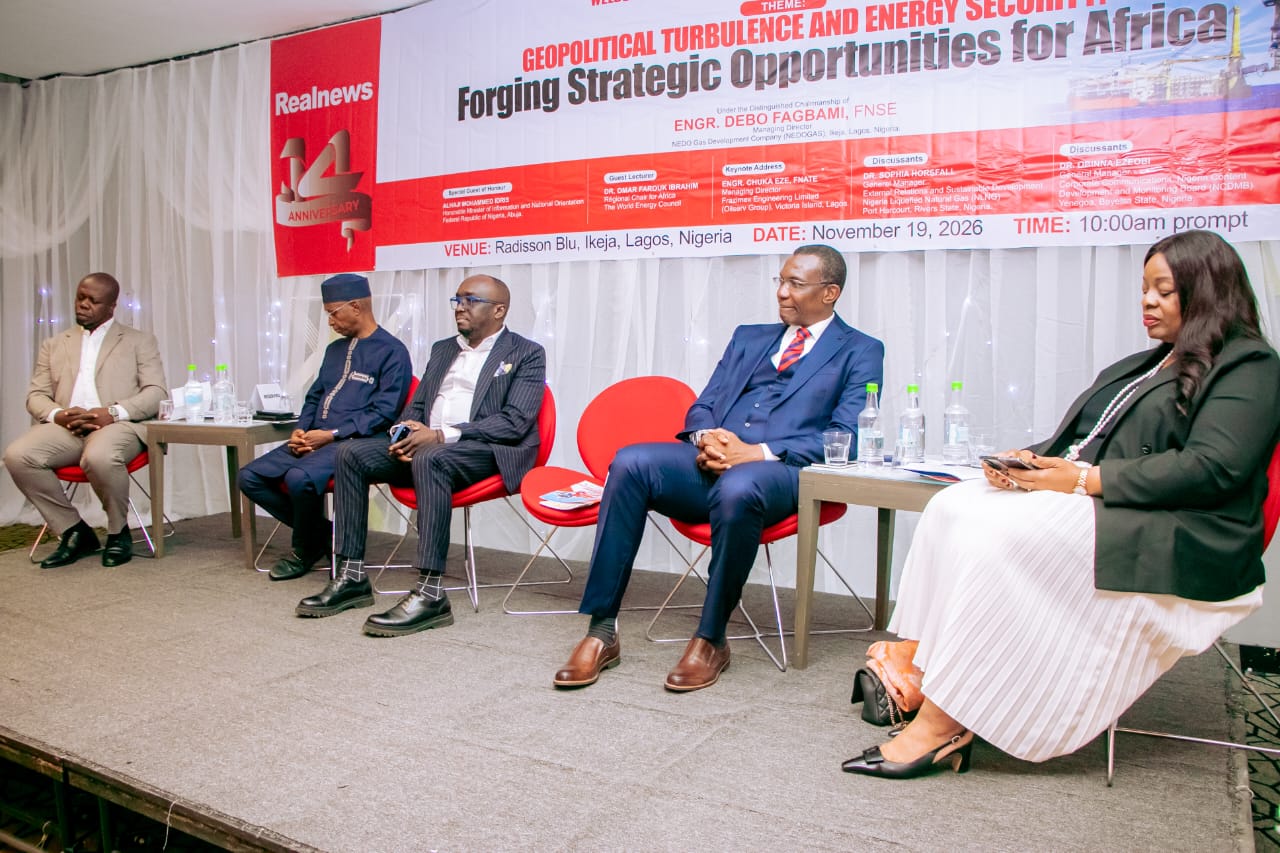



SOME Industry experts at the 14th anniversary of Realnews Magazine have called on African countries to strengthen regional cooperation, attract investment, develop local capacity and improve energy infrastructure to take advantage of the opportunities created by geopolitical disruptions in the global energy market.
They said the continent should move beyond its dependence on exporting raw energy resources and develop the financial, technological and industrial capacity required to secure its energy future.
The experts spoke during a panel session following the keynote address by Omar Farouk Ibrahim on the theme, Geopolitical Turbulence and Energy Security: Forging Strategic Opportunities for Africa.
The panel was moderated by Debo Fagbami, Managing Director of NEDO Gas Development Company, with contributions from Sophia Horsfall of Nigeria LNG Limited (NLNG), Obinna Ezeobi of the Nigerian Content Development and Monitoring Board (NCDMB), and Dr Ibrahim.
Speaking on how African countries could position themselves to benefit from the current global energy disruptions, Fagbami identified investment attraction, policy stability, infrastructure development and human capacity building as essential requirements.
He said geopolitical tensions, particularly the conflict involving the United States and Iran and the resulting disruptions to shipping through the Strait of Hormuz, had affected the global energy industry beyond crude oil and gas prices.
According to him, the disruptions had implications for investment decisions, transportation costs and energy policies.
He said the developments presented both opportunities and challenges for African countries.
While higher energy prices could increase national revenues for oil-producing countries, he noted that they could also increase domestic fuel prices, transportation costs, food prices and inflation.
Fagbemi said African countries must therefore develop strategies to benefit from increased revenues while protecting their economies from the negative consequences of global price movements.
He maintained that Africa had the potential to shape its energy future if governments created the right conditions for investment and developed the necessary infrastructure and human resources.
NCDMB advocates regional collaboration, local capacity
Ezeobi identified collaboration among African countries, promotion of local content, development of supply chains and access to financing as important measures for strengthening the continent’s energy security.
He said the NCDMB was advocating greater cooperation among African countries through the African Petroleum Producers’ Organisation (APPO) and the platform of African oil and gas regulators.
According to him, the board was promoting the development of indigenous capacities across the continent to reduce dependence on foreign technology and expertise.
He noted that Africa’s substantial oil and gas resources would not translate into meaningful economic benefits without the technology and industrial capacity required to exploit them.
Ezeobi also identified supply chain deficiencies as a major challenge facing African oil and gas producers.
He disclosed that the NCDMB had commissioned a study that identified seven key products that could be manufactured in Nigeria to address supply chain gaps in the oil and gas industry.
He said developing local manufacturing capacity would reduce dependence on imported materials and strengthen indigenous participation in the sector.
On financing, Ezeobi cited the Nigerian Content Fund established by the NCDMB as an example of how African countries could develop indigenous funding mechanisms to support their oil and gas industries.
He also referred to efforts to establish the African Energy Fund as part of the continent’s response to financing challenges.
The NCDMB official disclosed that about 12 African countries had approached the board to learn from Nigeria’s local content framework, with Ghana, Senegal, Namibia, Uganda and Mozambique among the countries it had mentored.
He said African countries must share experiences and replicate successful initiatives to build a stronger continental energy industry.
Addressing the impact of US President Donald Trump’s ‘drill, baby, drill’ policy, Ezeobi said the renewed emphasis on fossil fuel production had helped restore investor interest in the oil and gas industry.
He argued that the policy shift had encouraged companies to reconsider investments that had slowed amid concerns about the global energy transition.
He, however, advocated an energy mix that accommodates crude oil, natural gas and other fossil fuels alongside renewable energy sources.
NLNG calls for responsible management of oil windfalls
Horsfall, in her contribution, warned that higher international oil prices did not automatically translate into improved economic conditions for oil-producing countries.
She said Nigeria should increase production by addressing insecurity and operational disruptions. while removing investment constraints that prevent producers from taking advantage of higher prices.
According to her, countries must have the capacity to produce and deliver their commodities to international markets before they can benefit fully from favourable price movements.
She also called for responsible management of additional revenues, urging government to invest windfall gains in education, healthcare, power generation and infrastructure.
Citing NLNG’s contribution to education, Horsfall disclosed that the company had recently endowed six universities across the country’s six geopolitical zones with professorial chairs valued at $9 million.
She said the initiative demonstrated the importance of returning value generated from the oil and gas industry to the wider economy.
Horsfall also stressed the need for value addition across the energy supply chain, including improvements in refining, gas processing, petrochemicals and fertiliser production.
She stated that the government has the responsibility to provide an investment-friendly environment and policy certainty, while private sector operators must invest in local capacity development, operational efficiency and initiatives that attract further investments.
She maintained that Nigeria needed to be deliberate in converting temporary gains from higher energy prices into sustainable economic development.
Farouk identifies finance, technology and infrastructure as key challenges
Omar Farouk Ibrahim, who delivered the keynote address before joining the panel, identified financing, technology and market infrastructure as three major challenges confronting Africa’s energy industry.
He said the continent would struggle to achieve meaningful progress if it continued to address these challenges independently rather than through cooperation and collaboration.
Responding to a question on the single most important policy action and industry initiative required to strengthen Africa’s energy security and competitiveness over the next decade, Ibrahim said it was difficult to prioritise one challenge over the others.
He explained that access to finance alone would not guarantee progress without the technology required to develop energy resources.
Similarly, he said Africa could have the necessary financial resources and technological expertise, but would still struggle to move energy products from one location to another without adequate infrastructure.
He therefore identified cooperation and collaboration as the foundation for addressing the continent’s interconnected energy challenges.
Ibrahim said African countries could not overcome their existing limitations if they continued to operate in silos.
He argued that regional cooperation would help address gaps in financing, technology and market infrastructure.
His position reinforced the calls by other panelists for stronger continental partnerships and the development of indigenous capacities.
The discussions also highlighted the need for African countries to balance the opportunities presented by higher energy prices with the risks of inflation, rising domestic energy costs and disruptions to international supply chains.
The panelists agreed on the importance of attracting investment, developing infrastructure, strengthening local content and building the capacity required to make Africa a more competitive participant in the global energy market.




Comment
No comments found.