
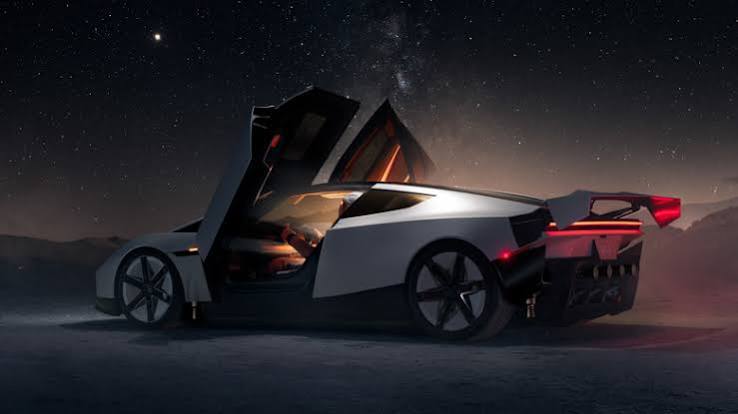


Elon Musk has unveiled a new Tesla Roadster prototype designed to perform airborne manoeuvres using technology developed with SpaceX, presenting a sports car that he says can “basically fly like a rocket.”
Demonstrated at SpaceX’s rocket development and testing facility in McGregor, Texas, the vehicle combines an electric powertrain, a fan-powered suction system and compressed-air thrusters. Tesla’s presentation showed the Roadster travelling up a curved ramp, turning upside down and performing airborne flips before landing.
“Flying cars are real,” Musk said during the event.
The demonstration also featured the vehicle leaping over a line of Tesla models, showcasing capabilities that go beyond the conventional performance claims associated with electric sports cars.
SpaceX Technology Meets Tesla Engineering
Tesla’s engineers explained that the Roadster uses a suction system beneath the car to generate downforce, helping it maintain grip even when travelling upside down.
Its airborne manoeuvres rely on technology borrowed from SpaceX, with compressed air stored in high-pressure tanks and released through multiple nozzles. According to the presentation, the system can recharge its air supply without requiring a separate specialised propellant.
Describing the vehicle’s capabilities, Musk said: “So it can basically fly like a rocket.”
He added that it could perform rolls and other aerial manoeuvres, while acknowledging that the prototype prioritises extreme performance over conventional safety considerations.
The demonstration was conducted without a human driver, with Musk saying the arrangement was intended “to make sure we don’t kill anyone.”
Sub-One-Second Acceleration Claim
Alongside the aerial display, Tesla demonstrated an acceleration run and announced a 0–60mph time of 0.81 seconds. Musk said the production version could improve on that result.
The figure was presented by Tesla during the event and was not independently verified in the material reviewed.
The company also presented the redesigned Roadster as a two-seater, with seats moulded into the chassis and electronically controlled steering, braking and acceleration. Its aerodynamic systems are intended to adjust downforce according to driving conditions.
Musk said Tesla intends to begin production in 2028, although the demonstration left questions about regulatory approval and where the vehicle’s more unusual capabilities could legally be used.
“I’m not sure it’s necessarily legal in all jurisdictions,” he said.
For now, the Roadster remains a demonstration of Tesla and SpaceX’s combined engineering ambitions rather than proof of an approved, commercially available flying car. The next challenge will be translating its dramatic prototype performance into a production vehicle that meets the requirements of its intended markets.



Comment
No comments found.