
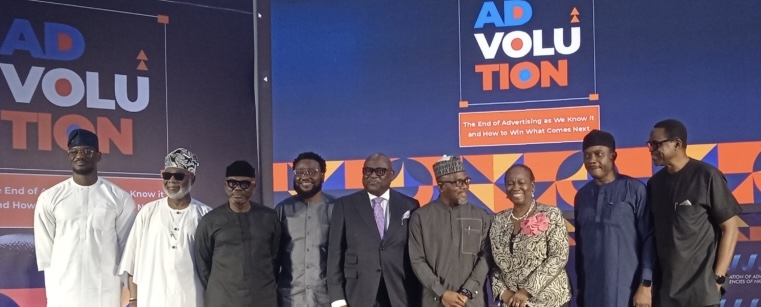


The Nigerian advertising industry was handed a blunt message at the weekend: adapt to the disruption sweeping through the profession, or watch the disruption redefine the profession without you.
That was the dominant thread running through the 53rd Annual General Meeting of the Association of Advertising Agencies of Nigeria (AAAN), held in Lagos and attended by stakeholders drawn from across the advertising ecosystem, including the media.
The gathering’s theme, “Advolution: The End of Advertising as We Know It… and How to Win What Comes Next,” set the tone for a day of candid reflection on how artificial intelligence, shifting consumer behaviour and the rise of the creator economy are forcing the industry to confront questions it has never had to ask before.
Delivering the welcome address, AAAN President Lanre Adisa framed the moment as a departure from the industry’s familiar worries. Losing a pitch, holding on to a client, staying a step ahead of a rival agency these, he said, used to be the biggest sources of anxiety in the business. That has changed.
“In a world where artificial intelligence is transforming creativity, where consumers are changing faster than brands can adapt, where creators are becoming media companies, and where technology is reshaping every aspect of communication, the greatest threat is not that another agency wins the business. It is that the business itself changes and we fail to change with it.”
Adisa noted that older concerns have not gone away; they have simply been joined by a far more fundamental one. He described the conference theme not as a catchy title but as a deliberate provocation.
“Advolution: The End of Advertising as We Know It… and How to Win What Comes Next,” he said, “is not merely a conference title. It is a call to action.”
He went on to sketch the scale of what the industry is up against:
“Across the globe, advertising is undergoing perhaps the greatest transformation in its history. Artificial intelligence is redefining how ideas are conceived, developed and executed. Data is reshaping strategy. Technology is disrupting every touchpoint of the consumer journey. The creator economy has fundamentally altered the way influence is built. And consumers are demanding participation instead of interruption, authenticity instead of spin, and experiences instead of messages. The rules we mastered are evolving. The models that built many successful agencies are being challenged. The future is no longer approaching. The future has arrived. The question before us is simple. Will we merely adapt to change, or will we lead it?”
Yet Adisa’s outlook was not one of despair. He argued that advertising, at its core, has never really been about the campaigns it produces.
“At its very best, our profession has always been about solving business problems through powerful human insight and transformative ideas. That has not changed. What has changed are the tools available to us. Technology is becoming more powerful by the day. Artificial intelligence will undoubtedly reshape how we work. But technology, on its own, does not create meaning. Algorithms can optimise. Machines can generate. But only people can imagine. Only people understand culture. Only people can feel emotion, appreciate nuance and create ideas capable of moving hearts, shifting behaviour and building enduring brands.”
He closed his address with a definition of where he believes the industry’s future lies:
“The future will therefore belong not to those who fear technology, nor to those who rely on it blindly. It will belong to those who combine technology with imagination, data with empathy, and innovation with timeless human creativity.”
The day’s keynote fell to Dr. Meksley Nwagboh, chief marketing officer, Fidelity Bank Plc, who took the audience further into the theme, arguing that the “end” of advertising as an industry has long known it should be read as an opportunity rather than a loss.
For Dr. Nwagboh, the old go-to-market playbook has run its course, and the agencies that will still matter to clients regardless of their size are the ones capable of genuinely solving client problems rather than simply producing marketing output.
“If your client’s problem is in promotion, then yes, it’s about ads, it’s about designing marketing, it’s about getting the messaging right. But sometimes the problem is in the product, and sometimes the work and the value that you can add to your client is to help them understand what it is that the audience sees.”
He predicted that the brands that come out ahead will not necessarily be the ones with the biggest budgets, but those able to create moments that people genuinely want to talk about. To illustrate the point, he turned to an episode from the recently concluded 2026 FIFA World Cup involving a light-hearted wager between two airlines.
“During the FIFA World Cup, the Norwegian Air challenged the British Air to a friendly wager on social media. The rules were very simple: whichever country’s team lost would replace its Instagram logo with that of the winning team for at least 24 hours. And so, British Airways accepted. Unfortunately, England beat Norway. The Norwegian Air, following the defeat, temporarily changed its profile to the British Airways look and congratulated them. Simple transaction. But what’s remarkable was what followed; the millions of people that watched, commented, shared, celebrated the exchange. Other airlines even joined the conversation. Global media picked up the story. Neither of these airlines were official World Cup sponsors, yet they became part of tournaments most talked about marketing moments. In the future, we will look back at the 2026 World Cup. We’ll remember it for its highs, for the beautiful game, but we’ll also remember it for what Norwegian Air did with British Airways, without even buying expensive ad slots or sponsorship rights or launching a traditional advertising campaign. Yet they were able to reach millions.”
The lesson, he suggested, is that the exchange itself was the advertisement — without a traditional media buy behind it.
“That to me is absolution. The advertisement wasn’t the labor force. The advertisement wasn’t the conversation. The media buy wasn’t television or billboards. The media was the audience itself.”
Building on that idea, Dr. Nwagboh observed that creativity is no longer confined to the thirty-second commercial slot; it now plays out in real time, with consumers acting as participants, storytellers and distributors, and a single clever idea capable of capturing culture and outperforming a campaign backed by a multi-million-dollar budget.
He also addressed the growing role of artificial intelligence, noting that it has moved well past the experimental stage and is now embedded in the day-to-day practice of marketing and communication worldwide. Trust, he stressed, remains one of the most important currencies in the marketing communications space, and he outlined a set of priorities agencies must embrace to stay competitive: investing in capabilities, redesigning talent, measuring what truly matters, protecting originality, becoming genuine experience partners to clients, and building AI literacy across their organisations.
Rounding off the presentations, Tomiwa Aladekomo, chief executive officer, Big Media Cabal, offered a similarly unsentimental assessment: advertising, as the industry has always known it, is genuinely coming to an end. In his view, the agencies that thrive going forward will not be the ones that dress up old habits in new vocabulary, but those that grasp that the next era of communication has to be more intelligent, more integrated, more predictive, more participatory and, above all, more accountable.
Taken together, the addresses at this year’s AGM painted a picture of an industry at an inflection point one where the tools of the trade are changing faster than the trade itself, and where the agencies willing to rebuild around insight, trust and genuine audience participation are the ones best placed to define what comes next.


Comment
No comments found.