
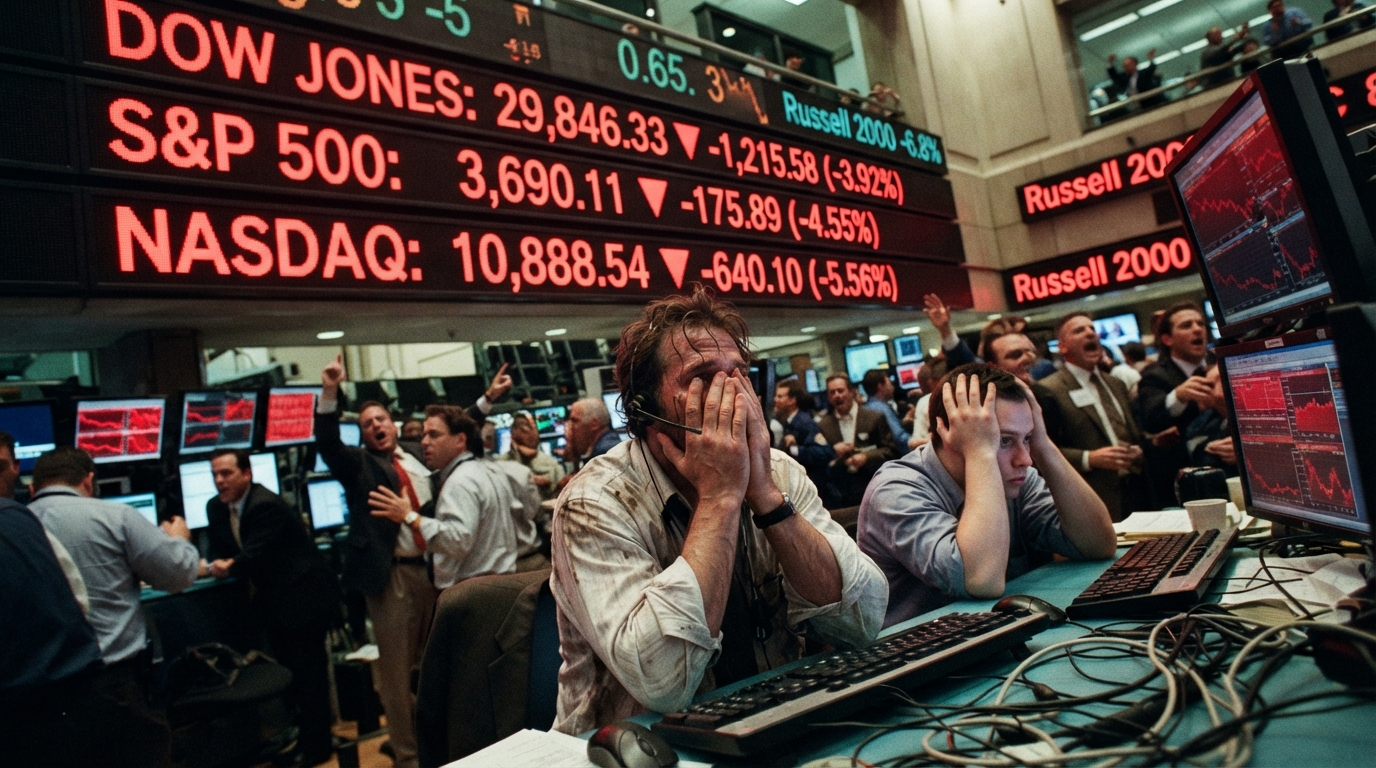


The artificial intelligence investment boom is confronting a difficult question: how much longer can technology companies sustain enormous spending on infrastructure before investors begin demanding stronger evidence of returns? Wall Street’s latest sell-off has brought that question sharply into focus, exposing the growing tension between the promise of artificial intelligence and the financial expectations surrounding it.
On Thursday, 5 November 2026, United States stock markets suffered a significant retreat, led by technology and semiconductor companies. The S&P 500 fell 4.4 per cent, while the Nasdaq Composite declined 5.5 per cent, entering correction territory after dropping more than 10 per cent from its October record. The Dow Jones Industrial Average also fell 3.4 per cent, shedding more than 1,800 points.
The scale of the losses was striking. According to Dow Jones Market Data estimates reported by financial news outlets, companies in the S&P 500 lost approximately $2.9 trillion in market value, while Nasdaq-listed companies shed about $2.5 trillion. Both figures represented record one-day market-value losses for their respective indexes.
Yet the sell-off was about more than a sudden change in market sentiment. It reflected growing unease over the financial commitments underpinning the artificial intelligence revolution.
The cost of building the AI economy
For the past two years, artificial intelligence has become a major driver of investment in the technology sector. Alphabet, Microsoft, Amazon and Meta have committed substantial resources to data centres, advanced processors, computing capacity and other infrastructure required to develop and operate artificial intelligence systems.
The scale of that investment has helped drive demand for semiconductor manufacturers and technology infrastructure providers. However, investors are increasingly questioning how quickly these commitments will translate into profitable business operations.
The latest earnings from major technology companies have done little to settle those concerns. Meanwhile, several infrastructure companies have turned to debt markets to finance their expansion, increasing scrutiny of the relationship between capital expenditure, borrowing costs and future returns.
The semiconductor sector bore a particularly heavy share of Thursday’s losses. The Philadelphia Semiconductor Index fell approximately 12.2 per cent, its steepest single-day decline since April 2025. Qualcomm’s weaker-than-expected earnings also contributed to pressure on technology stocks, reinforcing concerns about the sector’s near-term prospects.
Politics enters the investment equation
The market reaction was also influenced by developments in United States politics. Democratic victories in the midterm elections, including control of both chambers of Congress, raised concerns among investors that greater scrutiny of artificial intelligence infrastructure could slow data-centre expansion.
The issue has become increasingly contentious as communities debate the environmental, electricity and infrastructure demands associated with larger data centres. Local opposition and proposals to restrict new developments could complicate expansion plans for companies that have already committed significant capital to the sector.
For investors, this introduces another layer of uncertainty into an industry already facing questions about financing, profitability and the pace of adoption.
Beyond the market correction
The latest decline does not necessarily signal the end of the artificial intelligence investment cycle. Rather it suggests that the market is becoming more selective about which companies can translate technological ambition into sustainable commercial value.
For the wider technology industry, the implications could be significant. Semiconductor manufacturers, data-centre operators, cloud computing providers and emerging artificial intelligence businesses may face greater pressure to demonstrate viable business models and clearer paths to profitability.
For businesses investing in artificial intelligence, the message is equally important: technological advancement alone does not guarantee commercial success. Investment must ultimately be supported by measurable productivity gains, stronger customer propositions sustainable revenue opportunities.
The artificial intelligence race is far from over. But Wall Street is beginning to ask a more demanding question of its participants: beyond building the future, can they make it pay?
ALSO WATCH: MARKETING EDGE ONTV



Comment
No comments found.