
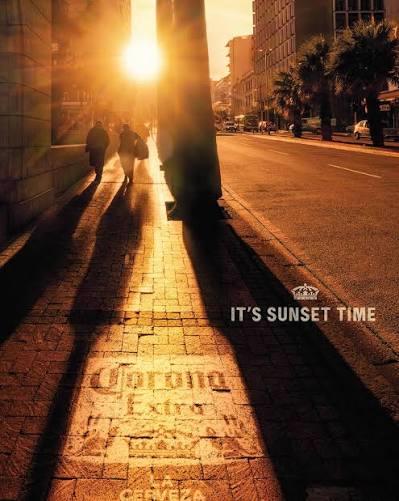




No screens. No pixels. No CGI. Just chalk, shadows, and a window of a few fleeting minutes each evening.
In June 2026, Corona and its South Africa agency Boundless created something the advertising industry has almost forgotten how to make; a campaign that cannot be faked, manufactured on demand, or experienced from a screen. Titled Sun Shadows, the work uses the long shadows cast across Cape Town’s streets at sunset to form the silhouette of a Corona bottle for a matter of minutes each evening, before the sun moves and the image disappears entirely.
The execution depends on precise timing. As the sun approaches the horizon, shadows stretch across the pavement and briefly form the recognizable outline of a Corona bottle pointing toward the sunset. A simple white chalk drawing completes the label, turning the fleeting arrangement of light and shadow into a piece of street advertising. Furthermore, the team confirmed that no CGI or digital manipulation was used. Production relied entirely on careful planning and precise timing; predicting where shadows would fall and choreographing the environment to receive them.
The result exists for only several minutes. Before and after that window, the shadows no longer match the outline. Consequently, the billboard disappears as reliably as it appears; governed entirely by the movement of the earth around the sun.
Why this matters beyond the campaign itself
Sun Shadows would be a remarkable piece of work in any era. However, it lands with particular force in this specific moment in the advertising industry’s history.
The current creative landscape is defined by abundance. AI-generated imagery has made it possible to produce photorealistic visuals in seconds. Digital out-of-home screens light up city centres with dynamic, data-driven content that changes by the hour. Hyper realistic CGI spectacles, giant cats walking through cities, enormous products appearing on real streets through augmented reality, have become the default language of viral brand creativity. Moreover, social media has created a powerful incentive to make advertising that is designed primarily to be shared rather than experienced.
Nevertheless, something has been quietly lost in that abundance. When everything is extraordinary, nothing is. The campaign arrives at a time when brands are increasingly experimenting with AI-generated images, hyper realistic CGI and digital outdoor spectacles designed primarily to travel across social media. Against that backdrop, Corona’s decision to use sunlight as the campaign’s central creative element is not nostalgic. It is radical.
Additionally, Sun Shadows is not the first time Corona has drawn on the sun as a creative instrument. The brand previously created a sun-powered billboard in Brighton and a lime wedge timed to the moon. Therefore, what is emerging is a coherent creative philosophy, one built around the idea that a brand synonymous with the outdoors, sunsets, and natural moments should produce advertising that lives inside those moments rather than beside them.
Rather than treating the street as an empty space waiting to hold a poster, Sun Shadows uses the environment, the time of day, and the behaviour of natural light as part of the idea.
The creative argument the industry needs to hear
There is a version of this story that is simply about a clever outdoor execution. However, the more interesting version is about what Corona’s Sun Shadows campaign says to an industry currently in the grip of a specific kind of creative anxiety.
As AI tools make production faster and cheaper, the pressure to produce more content more frequently has intensified. Briefing cycles have shortened. Campaign windows have narrowed. The instinct, understandable but ultimately self-defeating, is to use new tools to make more of what already exists rather than to imagine what only those tools, or in Corona’s case only the sun, can uniquely create.
Sun Shadows is a corrective to that instinct. It required months of planning to execute something that lasts minutes. It demanded precision, patience, and deep understanding of how the physical environment behaves at a specific time of day in a specific season. Furthermore, it produced something that cannot be replicated, not by a competitor, not by an algorithm, not by a bigger budget. The sun sets at the same angle in Cape Town every winter evening. However, no other brand has built a chalk outline on that pavement. That specificity is the creative advantage.
For Nigerian and African creative professionals watching this work circulate globally, the lesson is not that technology is the enemy of great advertising. Rather, it is that the most memorable creative work has always been defined not by what it uses but by what it understands. Corona understands its brand world, sunsets, nature, the outdoors, the unhurried pleasure of a cold beer at the end of a long day; well, enough to let that world do the creative work itself.
The brief was not “make a billboard.” The brief was “become the sunset.” And for a few minutes each evening in Cape Town, Corona did exactly that.
ALSO WATCH: MARKETING EDGE ONTV




Comment
No comments found.