


Thirty-nine per cent of marketers say lead quality matters most to their business in 2026. Thirty-one per cent prioritise ROI. Twenty-nine per cent still track lead generation volume. The gap between those priorities reveals fundamental confusion about what metrics actually connect to revenue versus what metrics make dashboards look busy.
The measurement crisis is not a lack of data. Global data creation grows to 180 zettabytes whilst marketing departments struggle to transform that abundance into actionable insights. The problem is the overwhelming complexity of choosing which numbers matter when every platform offers thirty ways to measure engagement and zero ways to measure whether engagement predicts purchase.
Traditional metrics, impressions, clicks, and basic conversion rates no longer provide granular insights needed to navigate multi-channel customer journeys where consumers interact with brands across seven to eleven touchpoints before converting. Marketing leaders need a sophisticated approach to performance measurement, but most organisations are stuck optimising metrics that predict everything except business outcomes.
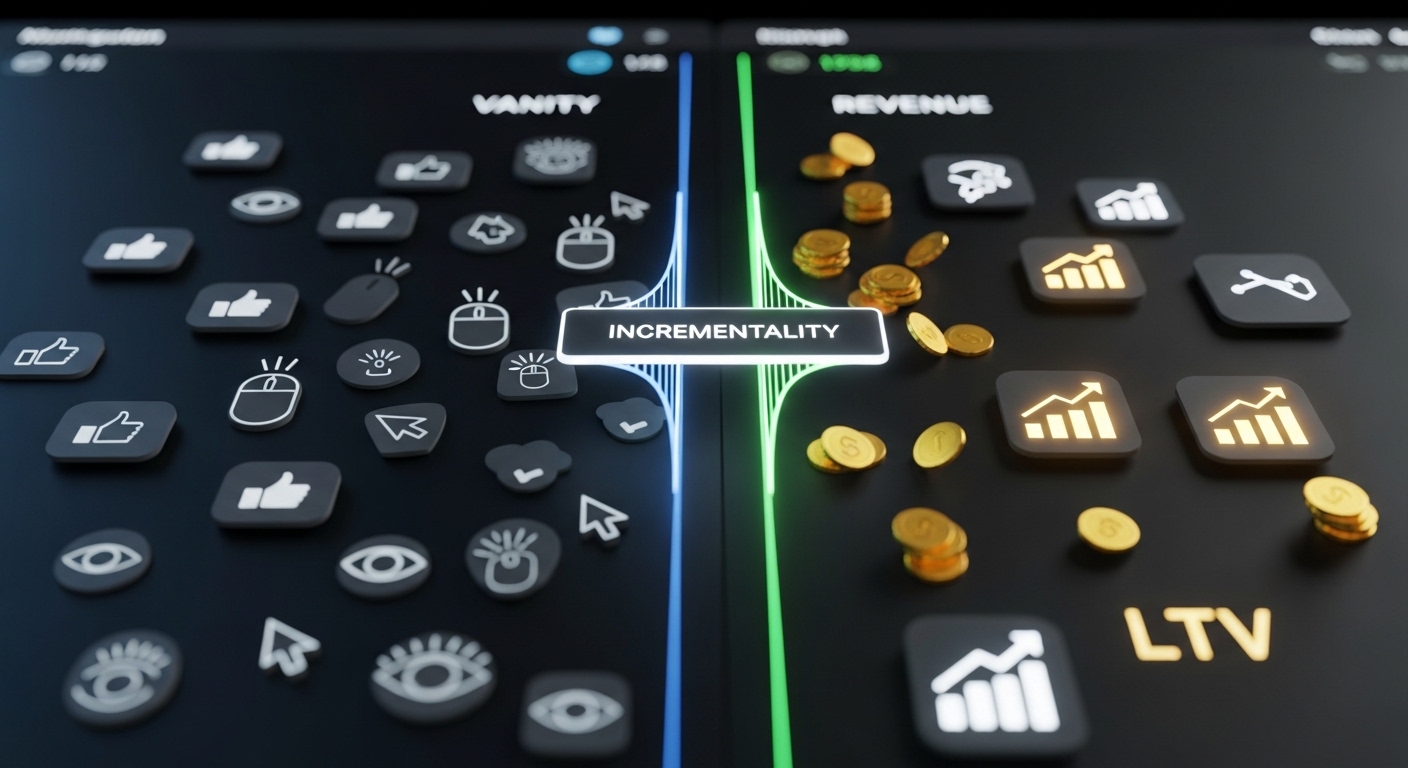
The shift from vanity to value requires understanding the distinction between metrics that signal activity and metrics that predict revenue. Click-through rate measures motion, not intent. Time on page captures presence, not engagement. Follower count demonstrates reach, not influence. These numbers create a false sense of achievement that divorces marketing performance from business results.
David von Hilchen at StackAdapt notes that incrementality is often overlooked “because it’s hard to measure,” but it’s essential for understanding whether spend drives real revenue or simply captures customers who were already going to convert. Sarah Mansfield, former VP of Global Media at Unilever, reinforces the value: “You need to know what that advert truly drove in terms of revenue returns. Would the consumer already have bought that product without you buying that impression?”
That question exposes the measurement gap. Most attribution models credit campaigns for conversions that would have happened anyway. Last-touch attribution gives all credit to the final interaction, whilst ignoring upper-funnel and mid-funnel activity that built awareness and consideration. Multi-touch attribution provides a more complete picture of which channels influence deals and which ones actually close them, but implementation requires infrastructure most Nigerian marketing departments haven’t built.
For Nigerian brands navigating this complexity, the implications are strategic. First, the temptation to copy Western measurement frameworks wholesale should be resisted. Those frameworks assume data infrastructure, attribution capabilities, and cross-platform tracking that many Nigerian businesses lack. Better to measure fewer things accurately than measure everything poorly. Second, the shift from lead volume to lead quality changes how marketing departments justify budgets to finance teams. CFOs don’t care that the campaign generated 10,000 leads. They care whether those leads convert to customers at an acceptable acquisition cost and acceptable lifetime value. The metric that matters is customer acquisition cost relative to customer lifetime value, and most marketing dashboards don’t show that relationship clearly.
Third, cultural metrics capture whether brands matter in conversations shaping the category. Amar Vyas at M+C Saatchi Fluency explains: “Everyone’s measuring awareness and consideration, so you’re not finding any differentiation or strategic advantage.” Cultural relevance, whether a brand participates in moments that audiences care about, predicts sustained attention better than awareness scores.
The measurement sophistication gap creates a competitive advantage for brands willing to build proper infrastructure. Marketing Efficiency Ratio looks across all channels, comparing total revenue to total marketing spend. It exposes waste faster than platform-specific metrics and rewards integrated planning whilst revealing the true cost of customer acquisition across the entire marketing mix.
Trust has become a measurable asset. AI tools that once tracked keywords now detect tone and emotion. WARC’s 2024 study found that brands with rising trust indices outperform market peers by more than double over five years. In a world where consumers fact-check everything, credibility has replaced persuasion. The trust metric closes the loop between emotion, attention, and loyalty.
Time to insights measures how quickly raw data becomes something marketers can actually act on. Vincent Spruyt at KINESSO describes it as the “speed at which your data is converted into actionable knowledge,” adding that “what actually matters is how quickly we can leverage that data to personalise and customise strategy and execution.”
Faster insight loops mean faster optimisation, more personalised experiences, and a competitive edge when every brand has access to similar data and technology. Dashboards can highlight underperformance, but they rarely explain why it’s happening or what to do next, creating friction between insight and execution.
The metrics that actually matter in 2026 share a common characteristic: they connect marketing activity to business outcomes that finance teams care about. Lead-to-customer conversion rate matters more than lead volume. Customer acquisition cost matters more than impressions. Marketing-influenced pipeline as a percentage of total sales pipeline matters more than engagement rate.
But the measurement revolution requires organisational change beyond choosing better metrics. Nearly 20 per cent of marketers say adopting a data-driven marketing strategy is the biggest challenge they face in 2026, whilst 13 per cent have difficulty sharing data across the organisation. The infrastructure problem compounds the measurement problem.
Marketing leaders succeeding in 2026 implement a strategic measurement framework focused on multi-touch attribution, customer acquisition optimisation, and predictive analytics that demonstrate clear business value whilst continuously improving campaign performance. Success requires discipline in KPI selection, sophistication in measurement methodology, and commitment to data-driven decision making.
The future belongs to marketing leaders who navigate the balance between comprehensive measurement and focused action, using advanced analytics to drive business growth without drowning in data that doesn’t predict revenue. The organisations that master these metrics gain a significant competitive advantage through more efficient resource allocation, better customer targeting, and stronger ROI performance.
For Nigerian markers, the path forward isn’t measuring more. It’s measuring what matters. That starts with asking uncomfortable questions that most dashboards avoid: which of these forty-seven metrics actually predicted last quarter’s revenue, and which ones just made us feel busy?
The answer determines whether the marketing budget is an investment or an expense.
ALSO WATCH:MARKETING EDGE ONTV




Comment
No comments found.