



Nigeria’s events industry is steadily emerging as one of the country’s fastest expanding creative economy segments, with new market intelligence projecting the sector to surpass US$27.5 billion (₦37.54 trillion) by 2034 as businesses, entertainment brands and technology continue to redefine how experiences are created, marketed and consumed.
Nigeria’s events economy set for US$27.5 billion (₦37.54 trillion) boom
The projection comes at a time when the global meetings and events industry is witnessing unprecedented expansion, creating fresh opportunities for Nigeria to strengthen its position as Africa’s leading destination for conferences, concerts, exhibitions, sporting events, festivals and corporate gatherings.
According to the latest report by 360 Research Reports, the global meetings and events market, currently valued at approximately US$1.62 trillion (₦2.21 quadrillion) in 2026, is expected to rise to about US$1.77 trillion (₦2.42 quadrillion) in 2027 before almost doubling to an estimated US$3.60 trillion (₦4.92 quadrillion) by 2035, underscoring the increasing economic value of experience driven engagements worldwide.
ALSO WATCH:MARKETING EDGE ON TV HOSTS NKECHI ALI-BALOGUN
While developed markets continue to dominate global revenues, Nigeria is rapidly building momentum as stronger corporate spending, booming entertainment, digital innovation and a youthful population combine to accelerate the country’s events ecosystem.
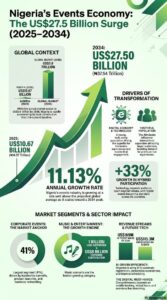
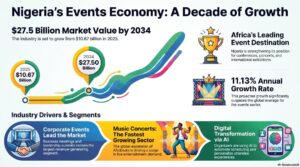
Supporting this outlook, Deep Market Insights forecasts that Nigeria’s events industry will grow from US$10.67 billion (₦14.57 trillion) in 2025 to approximately US$27.5 billion (₦37.54 trillion) by 2034, representing an annual growth rate of 11.13 percent, well above the projected global average.
ALSO WATCH: MARKETING EDGE 3 CROWNS MILK MUM OF THE YEAR AWARD WINNERS
The report identifies Corporate Events and Meetings as Nigeria’s largest market segment, reflecting rising investments in leadership summits, product launches, conferences, exhibitions, employee engagement programmes and business networking platforms.
At the same time, music concerts are projected to become the fastest growing category as Afrobeats continues to expand its international influence and attract larger audiences at home and abroad.
Although Nigeria presently contributes just 0.64 percent of the global events industry, analysts believe the country’s enormous growth potential lies in its expanding digital economy, globally recognised entertainment sector, growing tourism appeal and increasing appetite for immersive consumer experiences.
Across the world, demand for live and hybrid events continues to gather pace. The 360 Research Reports study shows that nearly 1.9 million professional events took place globally in 2024, attracting more than 142 million international travellers. Corporate meetings accounted for 41 percent of all events, while entertainment represented 27 percent and sports contributed 18 percent.
Furthermore, hybrid participation expanded by 33 percent across 92 countries, demonstrating how technology is reshaping audience engagement beyond physical venues.
ALSO WATCH:MARKETING EDGE ONTV HOSTS KELECHI NWOSU
The report further reveals that more than 1.2 billion people participated in physical or virtual events during 2024, while organisations increasingly embraced artificial intelligence to simplify registrations, automate scheduling, personalise attendee experiences and improve operational efficiency.
Corporate investment also continued to strengthen the market, with 62 percent of companies increasing event budgets to support employee engagement, networking, product marketing and executive development. Business travel equally recovered, rising by 19 percent, while conference attendance and international exhibitions continued to rebound strongly.
Regionally, Asia Pacific leads global activity with 34 percent market share, ahead of Europe at 29 percent and North America at 27 percent, reflecting the growing competitiveness of the global events economy.
Industry stakeholders believe Nigeria is well positioned to benefit from these global shifts.
Commenting on the outlook on LinkedIn, Monday Binshak, Managing Director of Sparkling Event Planners Limited, Information Management Expert, Events Strategist and Startup Advisor, said the country stands at a critical turning point as global demand for premium event experiences continues to expand.
ALSO WATCH:MARKETING EDGE ONTV HOSTS KINGSLEY JAMES
According to him, the international events industry is projected to increase from approximately US$1.23 trillion (₦1.68 quadrillion) in 2024 to about US$1.93 trillion (₦2.64 quadrillion) by 2029, creating significant opportunities for innovative Nigerian event professionals.
Binshak noted that Nigeria’s entertainment industry has already expanded from roughly US$4 billion (₦5.46 trillion) in 2013 to about US$14.82 billion (₦20.23 trillion) in 2025, while event ticket sales are projected to generate approximately US$169 million (₦230.7 billion) by 2028. He added that sporting events alone could contribute about US$115.3 million (₦157.4 billion), further highlighting the sector’s commercial potential.
He also observed that Nigeria’s music industry, which supports nearly one million jobs and contributes about US$8 billion (₦10.92 trillion) to the economy, provides a strong platform for the country’s broader events market to flourish.
However, Binshak stressed that future competitiveness will depend on technology adoption. He urged event organisers to embrace artificial intelligence, data analytics, hybrid event platforms, mobile booking systems, virtual venue tours and live streaming technologies, arguing that consumers increasingly demand seamless digital experiences alongside memorable physical engagements.
He further encouraged operators to leverage Lagos’ growing reputation as Africa’s entertainment capital while partnering with Nollywood stars, Afrobeats artistes and tourism stakeholders to develop globally competitive events capable of attracting international visitors.
Analysts also believe Nigeria’s expanding corporate sector, flourishing creative industry and growing investments in destination tourism are creating sustained demand for conferences, exhibitions, executive retreats, trade fairs, sporting competitions and cultural festivals.
Although rising logistics costs, inflation, venue pricing and regulatory challenges remain major concerns for organisers, experts maintain that innovation, collaboration and digital transformation will continue driving the industry’s next phase of growth.
As governments, investors and private sector operators increasingly recognise the economic value of business events and live experiences, Nigeria appears to be positioning itself as one of Africa’s fastest growing event destinations.
If current forecasts hold, the country’s events industry will not only generate trillions of naira in economic activity but will also strengthen tourism, create thousands of jobs, stimulate investment across hospitality, aviation and technology, and reinforce Nigeria’s standing as Africa’s foremost hub for business, entertainment and cultural experiences in an increasingly competitive global marketplace.



Comment
No comments found.