
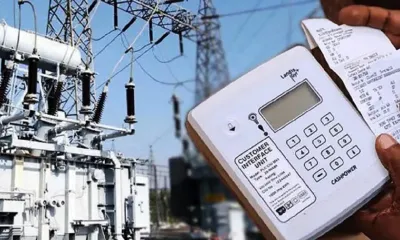


The Lagos State Government has taken one of its boldest steps yet in reshaping how electricity reaches homes and businesses. recent move, approving 14 licences and permits for independent electricity operators across the state.
The Lagos State Electricity Regulatory Commission (LASERC) issued the approvals at its maiden stakeholder engagement earlier this week.  The licences span five categories: off-grid generation, embedded generation, independent distribution, metering services, and interconnected mini-grid operations.
The intent behind this move is structural; it’s one that tells businesses, investors, and everyday Lagosians that the state is serious about breaking its dependence on the national grid.
The approved operators cut across some of Lagos’ most active industrial corridors. Axxela Limited received approval for a 5.8MW off-grid generation project at Cadbury Nigeria Plc in Agidingbi. Daybreak Power Solutions Limited secured multiple off-grid licences across facilities including Seven-Up, Nigerian Breweries, NBC, Crown Flour Mill, Nigerdock, and Promasidor. Isolo Power Gen Limited received approval for a 9MW embedded generation project along the Apapa-Oshodi Expressway. 
Additionally, Isolo Power Supply Limited was licensed as an Independent Electricity Distribution Network operator, alongside approvals for New Hampshire Capital, GossLink Engineering, and Enaro Energy Mini-Grid Limited in metering and mini-grid operations. 
Notably, several of the approved projects sit inside or adjacent to major manufacturing and FMCG facilities. That is deliberate. Industrial clusters are where power unreliability hurts most, and where stable, independent supply creates the most immediate economic value.
However, these approvals are not isolated occurrences. They are part of a much larger restructuring of Lagos’ electricity market, one that has been building steadily since the Federal Government’s 2023 decision to allow states to generate and distribute power independently.
Governor Babajide Sanwo-Olu signed the Lagos Electricity Bill into law and approved the constitution of LASERC in 2024, replacing the Lagos State Power Sector Reform Law of 2018. In March 2026, he inaugurated the LASERC board, marking the start of full operational leadership. 
Furthermore, in April 2026, Lagos signed Power Purchase Agreements and concession deals with three independent power producers, targeting a scale-up of generation capacity from below 60MW to between 200MW and 400MW in the coming years. 
Taken together, the trajectory is clear. Lagos is not waiting for Abuja to fix the national grid. It is building around it.
LASERC has set an ambitious timeline for the months ahead. The Commission plans to roll out two to three 24/7 electricity franchise zones by October 2026 as pilot districts for round-the-clock supply. A 100% metering initiative begins in July 2026, and consumer complaint centres will open in phases starting August 2026 in Amuwo Odofin, followed by Ikorodu and Epe in September. 
Perhaps most striking is the technology play embedded in these reforms. The Electric Eye of Lagos (EEL) Programme — an AI-enabled metering system — will be finalised by August 2026 with pilot deployment in October 2026.  That positions Lagos as one of the first Nigerian state governments deploying artificial intelligence directly into utility infrastructure.
By 2030, LASERC is targeting 97.5% electricity availability across Lagos and aims to reduce market losses below 10%. Those are ambitious numbers. But the regulatory architecture now being built: licences, market rules, sandbox guidelines for innovation, suggests this is not aspirational talk. It is a working plan.
For brands and businesses operating in Lagos, particularly those in manufacturing, retail, and hospitality, this development carries real commercial implications. Reliable, independently supplied power reduces generator dependency, which remains one of the heaviest operational cost burdens for Nigerian businesses. A manufacturer running 18 hours on diesel generators daily and six hours on grid power does not have a power problem alone, it has a cost competitiveness problem. Independent electricity operators, particularly those licensed within industrial clusters, directly address that.
Moreover, as more operators enter the market and competition grows, businesses may eventually gain pricing leverage they have never had with the national grid monopoly. That outcome is still years away. But the foundation is being laid now.
For Lagos, Africa’s largest city by some estimates, and Nigeria’s undisputed commercial engine, a functioning, competitive electricity market is not a luxury. It is the precondition for everything else the state wants to become.


Comment
No comments found.