
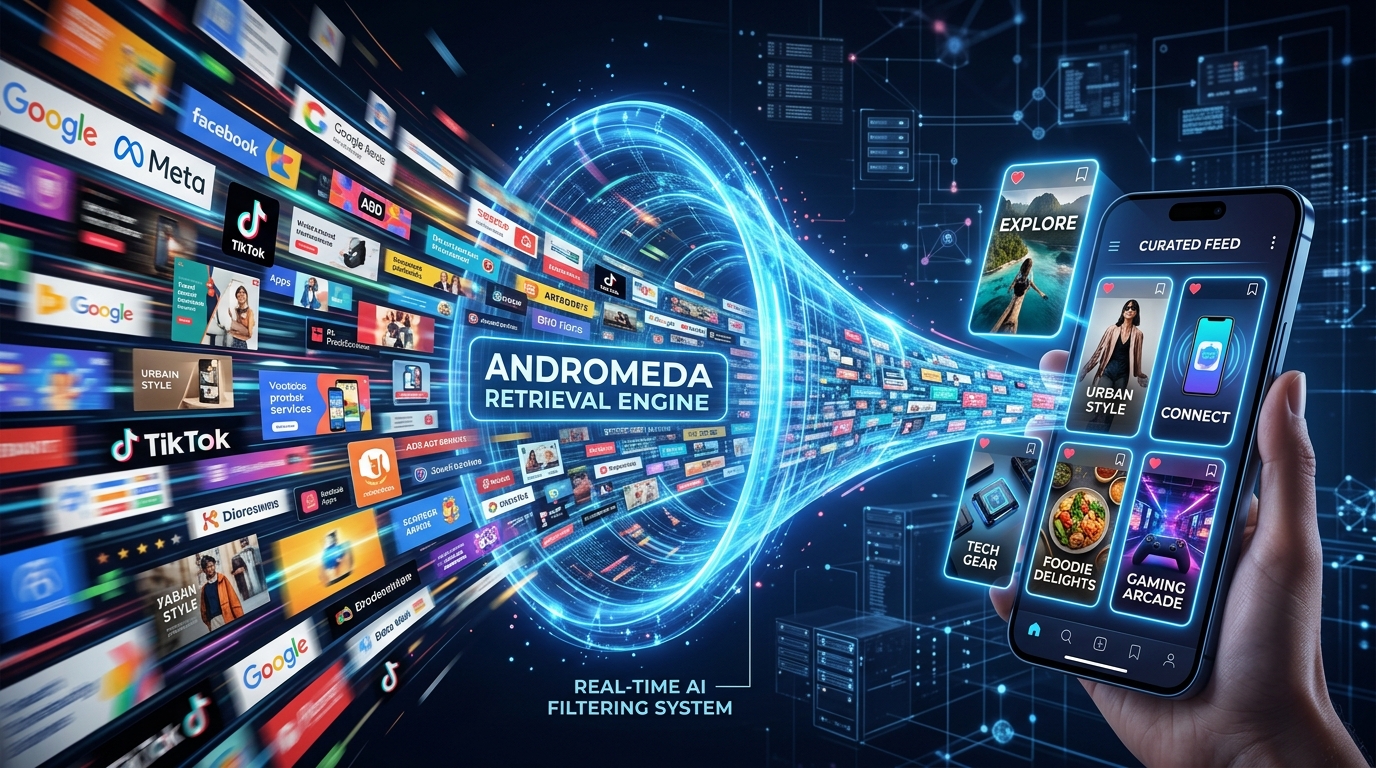


Meta transformed its advertising business from a manual targeting platform into an AI-driven automation engine, helping drive forecast 2026 revenue to $240 billion, representing 22.3 per cent growth from 2025’s $196 billion. The shift came through a fundamental restructuring of how advertisers reach audiences across Facebook, Instagram, Messenger, and Threads.
The evolution centres on the introduction of the Andromeda algorithm in late 2024, which fundamentally changed Meta’s value proposition. Previously, advertisers controlled targeting through manual audience selection based on interests and behaviours. Andromeda shifted that control to Meta’s systems, using advertiser creative as the primary targeting signal rather than demographic selections.
The algorithm applies deep learning and sequence learning to match creative content with user intent and position within the buyer journey, effectively making targeting an automatic consequence of creative quality rather than manual strategic configuration.
Apple’s iOS 14.5 App Tracking Transparency framework fragmented attribution systems, forcing Meta to accelerate machine-learning optimisation to compensate for reduced tracking visibility. Detailed interest targeting weakened following privacy regulation changes, pushing greater emphasis toward broad targeting combined with stronger creative execution instead of narrow audience segmentation.
The transition proved commercially successful despite early advertiser resistance. Advantage+, Meta’s flagship AI-driven campaign product, delivers 41 per cent higher blended return on ad spend and 17 per cent lower new customer acquisition costs compared with manual campaigns, reinforcing automation’s performance advantage over human-led optimisation.
UGC-style video emerged as the dominant format in 2026, with lower-production content consistently outperforming polished brand assets in conversion. Real people demonstrating products in vertical, full-screen formats optimised for Reels and Stories increasingly dominate inventory distribution.
Brands producing fresh creative every one to two weeks maintain stronger ROAS performance, while those updating monthly often experience creative fatigue within 60 days as audience responsiveness declines.
The first one to three seconds of any Meta ad now carry disproportionate influence on campaign performance, reflecting shorter attention spans and algorithmic prioritisation of immediate engagement signals over delayed conversion tracking weakened by privacy changes.
In 2026, Meta also introduced stricter advertising compliance requirements. Global policies now require companies to declare campaign data sources, particularly for remarketing and cross-platform tracking. Enhanced advertiser identity verification aims to reduce disinformation and opaque messaging.
Professional services, financial products, political content, and healthcare advertising now require Business Manager validation, with non-compliance carrying suspension risk.
Compliance has shifted from an optional consideration to a mandatory campaign component, increasing operational overhead while improving ecosystem quality and reducing fraud.
Partnership Ads, which combine creator content with paid amplification, emerged as a major growth format. The model enables brands to distribute creator content at scale whilst preserving the authenticity audiences trust. Meta reports that 71 per cent of consumers purchase within days of viewing creator content across its platforms.
Meta is also developing its Generative Ad Model (GEM), allowing advertisers to provide only a product URL, budget, and prompt while AI generates campaign assets including images, copy, headlines, and animations.
As automation advances, competitive advantage increasingly shifts away from campaign management expertise toward post-click optimisation. Landing pages, offers, and customer journey design become stronger performance drivers when AI handles targeting and creative production.
Meta’s transformation reflects a broader industry shift: platforms increasingly consolidate optimisation through superior data and computational infrastructure whilst advertisers trade manual control for performance gains they struggle to achieve independently.
With 2.11 billion daily active users across Meta properties and more than 10 million active advertisers, automation has become essential for managing advertising complexity at scale.
For Nigerian advertisers, Meta’s AI-driven ecosystem lowers the barrier to sophisticated campaign execution. However, creative quality, offering strength, and customer experience increasingly determine performance when technical optimisation becomes commoditised through automation.
ALSO WATCH:MARKETING EDGE ONTV




Comment
No comments found.