
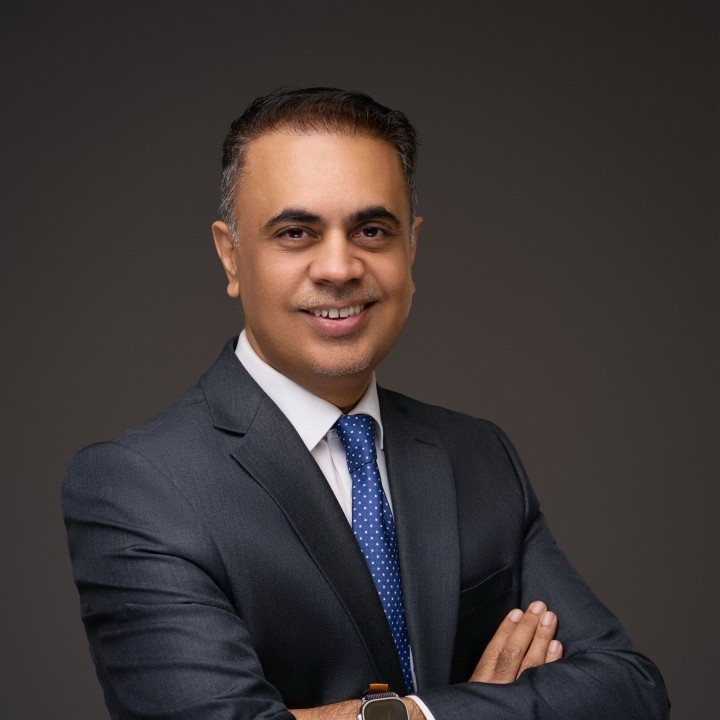


Akbar Ali Shah has moved into a new chapter of his FMCG career at Flour Mills of Nigeria (FMN) Group, where he has assumed the position of Managing Director of a strategic business vertical, bringing more than 25 years of experience across consumer goods, emerging markets and multinational business operations to the Nigerian food and agro-allied company.
Shah announced his appointment in his LinkedIn, expressing appreciation to the Chairman and Board of FMN for the opportunity and signalling his intention to work with the Group’s team as it pursues its next phase of expansion.
“I am excited to share that I have joined The FMN Group as Managing Director, leading the Group’s strategic new vertical,” Shah said in announcing the move.
The appointment brings to FMN an executive whose career has taken him through several African markets and complex commercial environments, particularly during his years with Reckitt, where he occupied senior leadership positions across the company’s operations in Africa, the Middle East and Pakistan.
Before making the move to FMN, Shah served as Regional Director and Vice President for Reckitt’s Sub-Saharan Africa cluster, with responsibility spanning 42 countries and multiple business operations. He also served as Chief Executive Officer of Reckitt Nigeria and held a position on the Executive Board of Reckitt Kenya.
His leadership responsibilities further placed him within Reckitt’s Africa, Middle East and Pakistan leadership team, giving him exposure to markets with differing consumer dynamics, economic conditions and business structures.
Across those assignments, Shah developed experience managing both emerging operations and large-scale businesses, while also leading turnaround efforts in markets where economic and operational conditions presented significant challenges.
That experience now takes him into an organisation with a deeply rooted presence in Nigeria’s food and agricultural economy. Importantly, Shah’s own assessment of FMN reveals why the Group’s structure represents a significant shift in his career.
Rather than operating around a narrow product portfolio, FMN has developed a broad agribusiness platform that connects different stages of the food production and distribution chain.
Founded in 1960 by George S. Coumantaros and headquartered in Lagos, FMN has grown from a single commodity company into a diversified agribusiness conglomerate spanning Food, Sugar, Agro-allied and Feed Milling.
The Group’s operations are further supported by Port Operations, Logistics, Packaging and Real Estate infrastructure, all connected to what Shah described as a vertically integrated supply chain.
At the centre of that model is an integrated farm-to-market approach. FMN participates in production and subsequently moves products towards consumers through its logistics and distribution network, giving the company a presence across several stages of the value chain.
Today, FMN describes itself as Nigeria’s largest FMCG business, employing more than 12,000 people and pursuing an ambition to become the largest FMCG player across Africa.
The Group also operates the largest feed mill in Sub-Saharan Africa, according to Shah, while maintaining a significant position in the global flour milling industry.
For Shah, that combination of heritage, scale and ambition makes his new assignment an opportunity to operate at a broader level. He described FMN’s scale and business model as providing an opportunity to “build and deliver at a whole new level”, while expressing enthusiasm about working with the Group’s team and contributing to its continued growth.
Against this industrial backdrop, Shah steps into his new assignment at a time when Nigeria’s food and FMCG sectors face a combination of supply, affordability and production pressures.
Manufacturers and food businesses continue to navigate higher operating costs, supply-chain constraints, shifting consumer purchasing patterns and the wider challenge of expanding local production. Consequently, companies operating across the food value chain increasingly require business models that can connect production efficiency with market realities.
Shah’s background in consumer goods gives him experience across precisely such commercial environments. During his career, he has worked with diverse teams, managed businesses across different markets and developed strategies for navigating challenging operating conditions.
His more than 25 years of experience across the Africa, Middle East and Pakistan region have also exposed him to businesses ranging from start-up models to complex, large-scale operations.
Beyond commercial performance, he has placed considerable emphasis on leadership development and talent management. His professional profile describes an approach centred on building high-performing teams, developing executives and creating leadership capacity within organisations. He has also identified technology, strategic partnerships, sustainability, workplace inclusion and digital transformation among areas of professional interest.
His work in African markets has included initiatives focused on health and hygiene, alongside efforts connected with inclusion and sustainability.
More recently, Shah has also used his professional platform to examine the changing dynamics of FMCG competition in developing economies.
In a recent publication, he explored what he described as a “margin mismatch” between multinational businesses and local competitors, arguing that difficult economic conditions can create opportunities for more agile domestic players to serve consumers whose needs may be overlooked when traditional pricing and margin assumptions dominate business decisions.
His analysis focused particularly on affordability and the ability of local businesses to identify segments of the market that larger competitors may struggle to serve efficiently.
That perspective adds another dimension to his move into FMN, whose business model is closely tied to Nigeria’s domestic food market and agricultural supply chains.
Shah’s observations on the evolving FMCG environment are particularly relevant to an organisation whose operations extend from agricultural inputs and food processing to logistics and distribution.
Rather than entering a company focused on a single product category, Shah joins a diversified organisation with operations extending across several interconnected stages of the food economy.
His mandate within the strategic vertical will therefore place his consumer goods experience alongside FMN’s established manufacturing, agricultural and distribution capabilities.
Furthermore, the move gives him a platform to bring his experience of managing multinational businesses across different African markets into an indigenous Nigerian organisation with ambitions that extend beyond the domestic market.
Shah described FMN’s heritage, scale and ambition as factors that make the new assignment particularly significant, while expressing enthusiasm about working with what he described as a talented team.
“My sincere thanks to the Chairman and the Board for this opportunity,” he said, adding that he looked forward to contributing to the Group’s continued growth story.
The move consequently marks a shift from multinational FMCG leadership to a major Nigerian food and agro-allied platform, giving Shah an opportunity to apply his experience in a business whose operations are closely connected to local production, processing and consumption.
At the same time, his arrival comes with experience gathered across multiple markets, business models and leadership environments, creating a new intersection between international FMCG management and FMN’s vertically integrated Nigerian food and agricultural operations.
As FMN continues to expand its presence across the food and agricultural value chain, Shah’s appointment adds another layer of international FMCG experience to the Group’s leadership structure and places his extensive African market exposure within a business pursuing broader growth across the continent.




Comment
No comments found.