
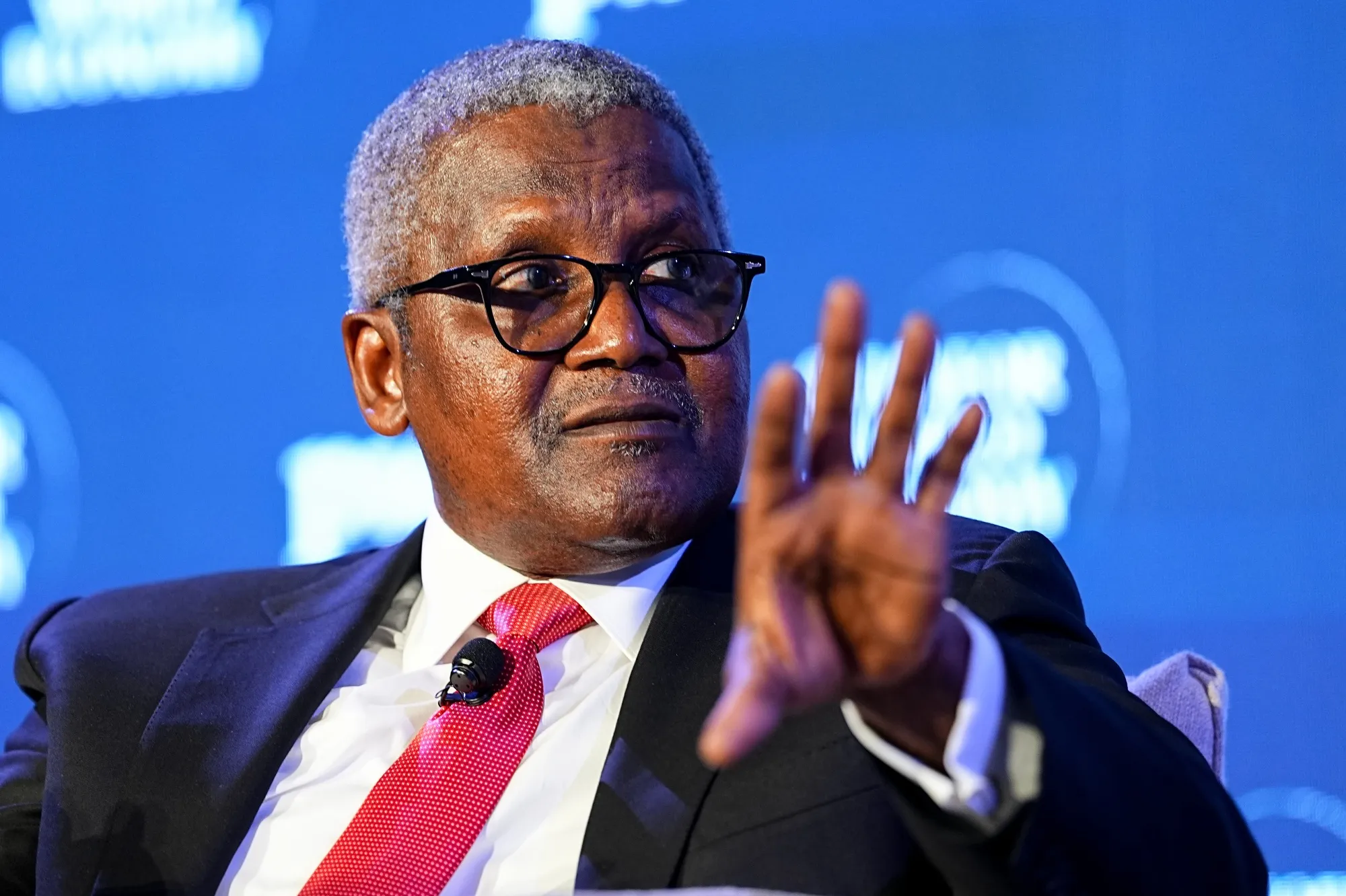


Africa’s richest industrialist, Aliko Dangote, has unveiled plans to invest in a 20,000-megawatt power generation project, a move that, if realised, would become the single largest private-sector energy intervention in Nigeria’s history.
Dangote disclosed the plan during an interview at the International Finance Corporation headquarters in Washington with IFC Managing Director Makhtar Diop. The discussion offered the clearest public indication yet of how cash flows from the Lagos refinery could fund the group’s next phase of expansion.
“We are now going into power, 20,000 megawatts. We are building the biggest deep-sea port, and we are doing LNG. Why? Because we are looking at the needs of Africa and making them a reality,” Dangote said.
See Also: MARKETING EDGE Hosts Yomi Badejo-Okusanya, Chairman – Organizing Committee, NPRW 2026
A Nation Starved of Power
The announcement comes amid Nigeria’s persistent electricity crisis. Recently resigned Power Minister Adebayo Adelabu repeatedly missed targets to stabilise the national grid at 6,000MW, with actual generation often hovering around 3,331MW, barely enough to sustain a single major city in a country of more than 200 million people.
The result is widespread dependence on diesel generators across homes and businesses. According to World Bank estimates, unreliable electricity costs Nigeria roughly $29 billion annually, equivalent to about 10 per cent of GDP.
Nigeria’s installed generation capacity currently stands at around 13,000MW, though only a fraction is consistently available to the grid. A 20,000MW private-sector addition would fundamentally reshape the country’s electricity landscape.
Riding on Refinery Momentum
Dangote’s power ambitions appear tied directly to the growing success of the Dangote Refinery. He revealed that the refinery recently operated at 661,000 barrels per day, above its 650,000-barrel nameplate capacity, and had maintained stable operations for two consecutive months.
“We are now actually free of assets, and we can actually raise more money. Our cash flow now is very strong,” he said.
The proposed power project forms part of a broader investment push that also includes fertiliser expansion, LNG infrastructure, and a deep-sea port. Dangote explained that the planned generation capacity would complement the group’s existing industrial assets, creating an integrated ecosystem designed to strengthen Africa’s self-sufficiency.
The Challenges Ahead
Despite the scale of the ambition, analysts remain cautious. Delivering a 20,000MW project would require sweeping reforms across Nigeria’s power sector and unprecedented coordination between regulators, gas suppliers, transmission operators, and private investors.
The sector remains trapped in a liquidity crisis. Distribution companies struggle to recover revenue, creating mounting debts owed to generation companies and gas suppliers. Industry estimates suggest nearly 70 per cent of Nigeria’s thermal plants face gas shortages because of unpaid invoices.
Dangote also provided no details regarding the project’s location, financing structure, implementation timeline, or generation mix, leaving critical questions unanswered.
An African Vision
Dangote framed the power project within a broader vision for African industrialisation. He highlighted visa restrictions, weak transport systems, and high logistics costs as barriers limiting intra-African trade and investment.
He also disclosed plans to list some of the group’s major assets, including the refinery, on stock exchanges to allow African investors participate directly in the businesses. According to him, the company intends paying dividends in hard currency to attract continental investors.
Whether the 20,000MW ambition materialises remains uncertain. But if the refinery project proved anything, it is that Dangote is willing to pursue projects many consider too large, risky, or complex to attempt.


Comment
No comments found.