
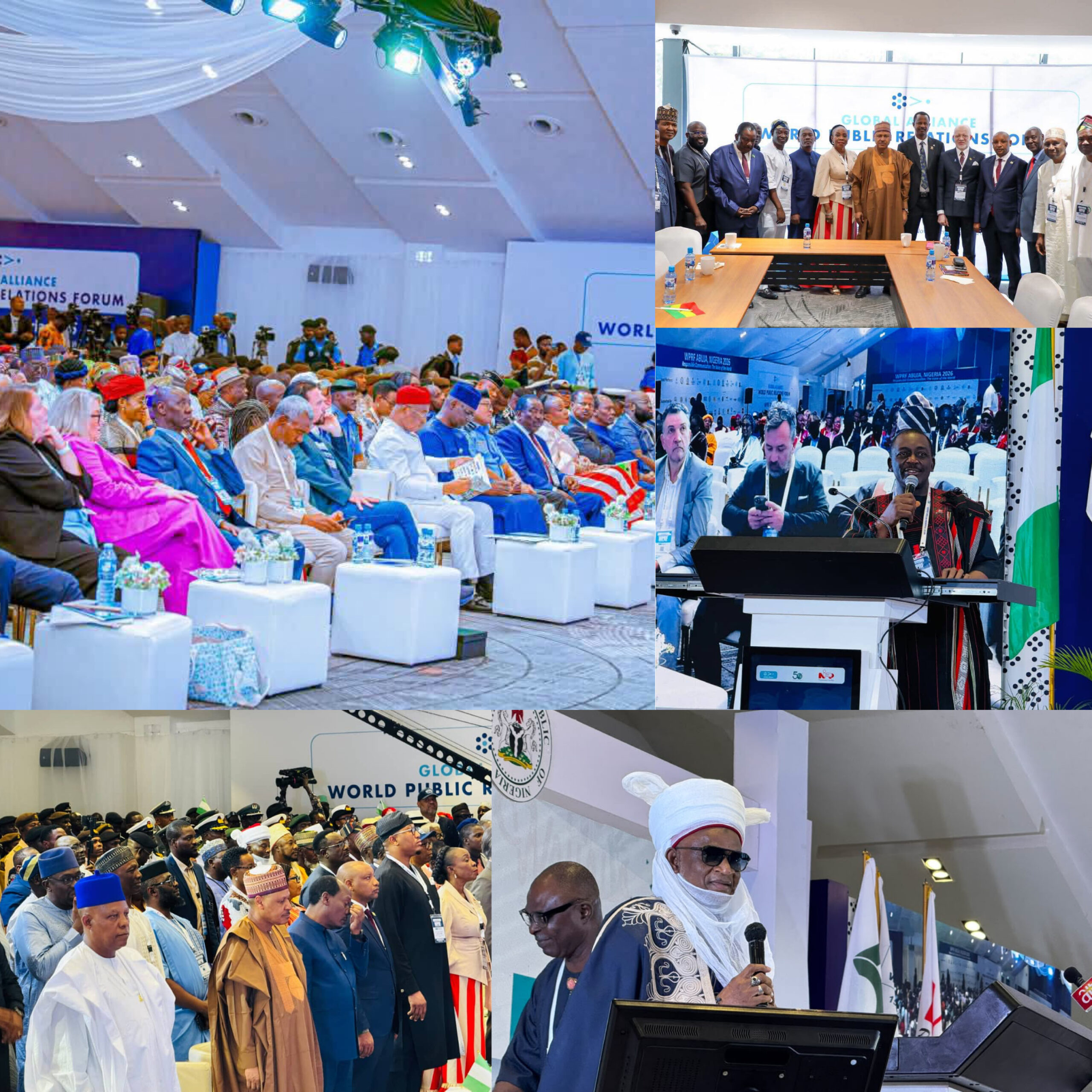



A false story can now travel round the world before anyone has checked it. With machines able to write, speak and imitate faster than any newsroom can verify, the people who communicate for governments, companies and institutions are being asked a simple question: can they still be believed?
That question ran through the 2026 World Public Relations Forum (WPRF) in Abuja, held under the theme “Responsible Communication: The Voice of the World.” The call was made by President Bola Ahmed Tinubu, and ministers, scholars and heads of professional bodies echoed it in different words. Communication carries power, and it must be used with honesty, accountability and care.
The President sets the tone
At the Forum, President Tinubu urged public relations and communication practitioners to uphold the highest standards of ethics, professionalism and responsibility. He charged them to hold on to truth, accuracy, transparency and professional integrity.
“In this environment, public relations and communication professionals have responsibilities that go beyond managing images and reputations,” the President said. “They must promote truth, accountability, transparency, mutual understanding and constructive engagement between governments, institutions and citizens.”
“Our government recognises the strategic importance of communication to national development, democratic governance, economic growth and international cooperation,” he added.
“We therefore encourage communication professionals to uphold the highest standards of ethics, professionalism, and responsibility in discharging their duties.”
President Tinubu also asked participants to look beyond the discussions and discover what Nigeria offers. “Explore our investment potential, vibrant entrepreneurial ecosystem, creative industries, rich cultural heritage, tourism assets, and the ingenuity of our people,” he said.
“Nigeria is a country of enormous possibilities,” he said, adding that the nation boasts “of diverse cultures, talents and ideas, with a youthful population, a dynamic private sector and a strong determination to build a more prosperous future.”
He urged participants to share experiences, exchange ideas and develop practical solutions that would strengthen the profession across continents.
“Let this Forum be remembered not merely as another international conference but as a turning point in the advancement of responsible communication, professional excellence and global cooperation,” he stated.
Government and the cost of falsehood
Alhaji Mohammed Idris, Minister of Information and National Orientation, warned against the growing threats of misinformation, disinformation, hate speech and deepfakes.
He urged communication professionals to promote responsible freedom of expression, peaceful coexistence and fair representation of Africa in global narratives. “Communication has an immense power to unite the world but when abused can also threaten unity,” Idris said.
Taiwo Oyedele, Minister of Finance and Coordinating Minister of the Economy, spoke at a WPRF dialogue themed “Responsible Business Communication: Building Trust and Financing Investments for Sustainable Human Development.”
He said transparent, ethical and responsible communication is indispensable to building public trust, attracting sustainable investment and driving human development in Nigeria and across Africa.
Oyedele warned that persistent negative narratives and unchecked misinformation cost Nigeria and Africa an estimated $500 billion annually in lost capital, distorted business decisions and talent migration. He pointed to the damage done by misunderstood economic statistics and sensational falsehoods, particularly on tax reforms and fiscal policies. According to him, these trigger self fulfilling inflationary cycles and needless anxiety among citizens and businesses.
On digital platforms, Oyedele described an ecosystem where “outrage pays, while correction does not.” He called for equal accountability among public officials, media practitioners and digital commentators, and stressed that communication must rest on real governance outcomes and the lived experience of citizens.
Why Nigeria is the host
The President and CEO of the Global Alliance for Public Relations and Communication Management, Professor Justin Green, said Nigeria emerged as host of the 2026 Forum after outperforming competing international bidders. He commended President Tinubu for his support for the gathering, recalling the President’s reassurance to the organisers during preparations. “You have no better friends and partners than Nigeria,” Green quoted President Tinubu as saying.
The President of the Nigerian Institute of Public Relations (NIPR), Dr Ike Neliaku, urged African communication professionals to improve their expertise and strengthen their capacity to project the continent’s image. He maintained that the Forum would equip practitioners to deploy communication more effectively in building public trust, promoting ethical leadership, strengthening social cohesion and advancing sustainable development.
The profession and its own credibility
The keynote speaker at the Knowledge Conference and Parliamentary Relations session, Mr Alastair McCapra, Chief Executive Officer of the Chartered Institute of Public Relations (CIPR) in the United Kingdom, stressed that practitioners must confront their own credibility problem before they take on the task of restoring public trust in institutions.
McCapra mentioned that misinformation and disinformation were flagged in the 2026 Global Risks Report as threats the world is poorly prepared to handle, and that the UK government plans a national information defence centre to identify and counter disinformation driven by AI.
Representing Nigeria at the same session, Prof. Emmanuel Dandaura, Vice President of NIPR, presented “Redefining Public Relations: Nigeria’s Gold Proposition for a Changing World.” He mentioned that misinformation, disinformation and malinformation, alongside rapid advances in AI, have made trust in public communication harder to build.
“This matters particularly in an age when artificial intelligence makes deception cheaper, faster, and increasingly convincing,” Dandaura said.
In his words, the lasting value of the profession lies in something machines cannot supply. “Our competitive advantage must remain our ability not just to produce persuasive content, because machines can do that better, but most importantly, our enduring value must lie in judgment, accountability, moral courage and the ability to counsel institutions toward responsible conduct,” he said. He observed that communication keeps growing while public confidence falls. “We communicate so much, yet we struggle so profoundly to trust one another,” Dandaura said.
Africa’s place at the table
The President of the African Public Relations Association (APRA), Arik Karani, described Nigeria’s hosting of the Forum as a defining moment for Africa’s growing influence in global public relations. “For the longest time, Africa has not been on the table when we talk about public relations. For the first time, we are actually the table,” Karani declared.
He commended Nigeria’s pioneering legislation regulating public relations practice, noting that the country had set an example that other African nations have since followed.
Kenya’s Cabinet Secretary for Information, Communications and the Digital Economy, Hon. William Kabogo Gitau, called for stronger professional communication networks across Africa and proposed the establishment of an African Responsible Communication Fellowship.
“Government must listen to citizens and create platforms they can contribute to,” Kabogo said, stressing that Africa must become the author and producer of its own development communication.
Teaching ethics early
Prof. Kate Azuka Omenugha, Vice-Chancellor of Chukwuemeka Odumegwu Ojukwu University (COOU), Anambra State, spoke at the Knowledge Conference on “Responsible Communication and Citizen Representation in a Digitised World.” She warned that careless use of AI and social media threatens institutional credibility, academic integrity and democratic governance.
Omenugha told the gathering of scholars, lawmakers and practitioners that some young people now use AI tools to produce defamatory caricatures of lecturers and university administrators, to bully their peers online and to circulate invented announcements. She called for Communication Ethics to be taught as a compulsory general studies course in all tertiary institutions, whatever a student’s field of study.
Moving forward
Taken together, the speakers set out a short list of demands. Tell the truth, correct errors quickly, answer for the message you send, and do not hand your judgment to a machine. Some proposals are already concrete: an African Responsible Communication Fellowship, a compulsory ethics course for university students, and a profession that insists on evidence before it speaks.
Perhaps the point that links them is Oyedele’s. If outrage pays and correction does not, then the work ahead is to make accuracy worth more than noise, for the institutions that communicate and for the audiences who must decide what to believe.


Comment
No comments found.