
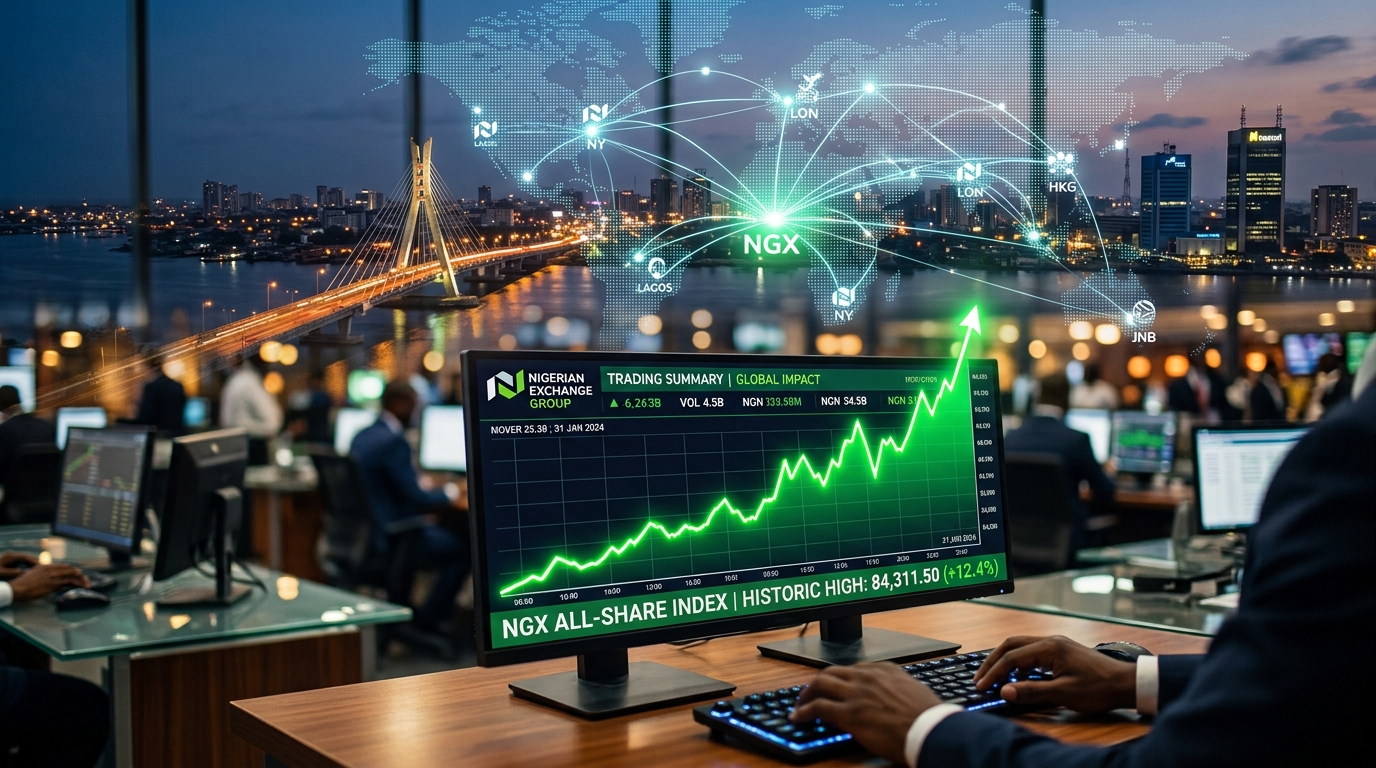





Nigeria has claimed the top spot among the world’s best-performing stock markets, overtaking South Korea in dollar-demanded returns to lead Bloomberg’s ranking of 92 global stock exchanges; a milestone that signals a fundamental shift in how international investors are viewing Africa’s largest economy.
Nigeria’s benchmark NGX All-Share Index has returned approximately 68 per cent in dollar terms since the start of 2026, narrowly surpassing South Korea’s KOSPI index, which gained 66 per cent over the same period. The data, tracked by Bloomberg across 92 global exchanges, places Nigeria at the summit of global equity market performance for the first time in the country’s history.
The shift in leadership was accelerated by a technical bear market this week, shedding 22 per cent from its June 19 peak as investor sentiment toward artificial intelligence and technology stocks deteriorated sharply. Currency pressure compounded the decline; the South Korean won has lost 5 per cent of its value against the dollar year-to-date, making it the fourth worst-performing currency in Asia.
Nigeria’s story runs in precisely the opposite direction. The naira has gained 4 per cent against the dollar since January, boosting returns for foreign investors. The rally has been underpinned by macroeconomic reforms under the Tinubu administration, higher global oil prices, improved foreign exchange liquidity, and a financial services sector delivering some of the most extraordinary returns in the market. Fortis Global Insurance Plc stands out as the single most dramatic performer, generating returns of approximately 1,400 per cent in dollar terms in 2026 alone.
On July 8, the NGX All-Share Index advanced 2.27 per cent to 242,459.98 points, with total market capitalisation rising by N3.45 trillion to N155.59 trillion in a single session, driven significantly by a 10 per cent jump in Airtel Africa shares.
The rally is attracting institutional attention at the highest level. S&P Dow Jones Indices has placed Nigeria on its 2027 watchlist for a possible reclassification from standalone to frontier market status, a move that would significantly expand the pool of institutional capital eligible to invest in Nigerian equities. The index provider cited significant regulatory reforms aimed at improving market transparency, accessibility, and enforcement, while noting that consistency in policy implementation remains a requirement before full reclassification is considered.
Investors are also monitoring the anticipated listing of Dangote Petroleum Refinery and Petrochemicals, which is expected to be one of the most significant IPO events in Nigeria’s capital market history and could deepen market liquidity considerably.
The contrast between Nigeria and South Korea’s 2026 market trajectories carries a lesson that extends beyond financial markets. South Korea’s rally was built almost entirely on a single investment theme: AI stocks. When sentiment on that theme turned, the market had no other foundation to stand on. Nigeria’s rally is built on reforms, commodity strength, currency stability, and domestic financial sector growth, fundamentals that do not disappear overnight when a global trend reverses.
For Nigeria brands, business, and the marketing professionals who serve them, a stock market leading the world is not merely a financial headline. It is a signal of investor confidence in the Nigerian economy, and investor confidence, when sustained, translates into the kind of capital inflows, business expansion, and consumer spending growth that shapes the commercial environment every brand in Nigeria operates within.
The world’s best performing stock market is in Lagos. That is not a small thing.
ALSO WATCH: MARKETING EDGE ONTV




Comment
No comments found.