
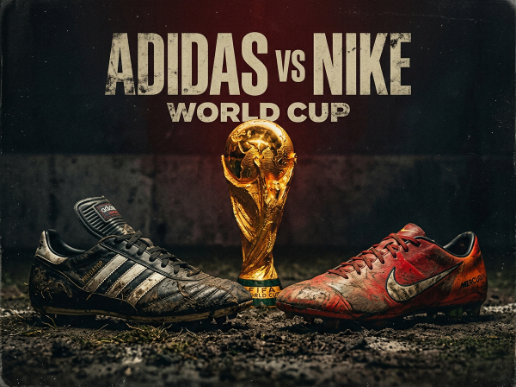


The 2026 FIFA World Cup is not only about the teams on the pitch. It is about two fundamentally different visions of what football means, and Adidas and Nike are betting billions on which one wins.
One brand is telling players to break the script. The other is telling them to carry the weight of history. One celebrates individual rebellion. The other celebrates collective identity. And during the next month, those two philosophies will clash on a stage watched by five billion people.
The stakes are unprecedented. Forty-eight teams. One hundred and four matches. Over ten billion dollars in revenue. The tournament spans three countries for the first time. And for Nike, there is one more advantage: it is happening in the United States, its home market.
The Fearlessness Gamble
Nike is not trying to win the 2026 World Cup through official sponsorship. Adidas owns that ground; the German brand is the official FIFA sponsor with the match ball supplier contract they have held since 1970. Instead, Nike is fighting for something more valuable: the emotional permission to be fearless.
The “Rip the Script” campaign features Cristiano Ronaldo, Kylian Mbappé, Ted Lasso, and Kim Kardashian. It is a deliberate statement: football transcends the pitch. It lives in culture, entertainment, and rebellion. Nike dresses twelve teams, the United States, Brazil, France, and England among them. The Brazil contract alone is worth one hundred million dollars annually through 2038.
“SCARY GOOD” is Nike Football’s brand identity. It is not about technical excellence or defensive solidity. It is about a creative attack. It is about players who trust instinct over instruction. It is about the moment when a footballer improvises, breaks formation, and wins because they refused to follow the plan.
This resonates because modern life punishes fearlessness. Gen Z is anxious. They are taught to follow predetermined paths, optimise metrics, and reduce risk. Nike’s “Why Do It?” reframe speaks directly to this: it does not demand blind action. It demands questioning. It demands young athletes ask themselves why they are playing at all, and then pursue that answer with complete commitment.
The psychological message is radical: “Your individual creativity matters more than the system.”
Every Brazilian striker who improvises. Every English winger who takes a risk. Every American player who plays with instinctive confidence they become a five-minute advertisement for fearlessness broadcast to five billion viewers.
The Legacy Anchor
Adidas operates from a completely different emotional foundation: heritage as strength, not constraint.
The brand is the official FIFA sponsor of the 2026 World Cup. It dresses fourteen teams: Argentina (the reigning champions), Spain, Germany, Mexico, and ten others. Adidas controls the official narrative. But more importantly, Adidas controls the emotional architecture of the tournament itself.
The 2026 kits are not vintage replicas. They are archaeological reinterpretations. The design philosophy is precise: dig into the past not to replicate it, but to unlock the emotional authority that comes from carrying history. Germany’s home kit pulls from 1990 and 2014 victories. Italy’s design honours one hundred and twenty-five years of football tradition. Argentina wears the weight of a World Cup victory.
This is not nostalgia. This is the deliberate use of history as a psychological anchor.
The campaign is “You Got This”, addressing the pressure and self-doubt athletes actually feel. Adidas tells players, “You are not playing as individuals. You are carrying the hopes of generations. Stand on the shoulders of giants. The legacy makes you stronger, not weaker.”
The kits are the message. The tradition is the strategy.
The Third Player
Puma is outfitting eleven teams, including Portugal. The brand is pursuing an aggressive Gen Z strategy with the “Go Wild” campaign, celebrating self-expression and joy. Puma has integrated artificial intelligence into kit design, creating something distinctly different from both Nike’s rebellion and Adidas’s heritage.
Between them, Nike, Adidas, and Puma dress thirty-seven of the forty-eight teams. They represent seventy-seven per cent of the World Cup.
Which Philosophy Wins?
The 2026 World Cup will reveal something deeper than which brand sells more merchandise.
It will reveal whether modern players and fans are more motivated by permission to break rules or by permission to carry legacy. Whether they want to be celebrated as rebels or as representatives. Whether football culture is moving toward individual expression or collective identity.
The tournament is in the United States. Nike is on home soil. But Adidas has structural authority. The official sponsorship. The match ball supplier contract. The heritage kits that carry generations of emotional weight.
One brand says: “The future belongs to those fearless enough to rewrite the script.”
The other says: “The future belongs to those strong enough to carry the past.”
The 2026 World Cup will settle which vision of football culture actually moves people. And that answer will reshape how both brands build their empires long after the final whistle.
ALSO WATCH:MARKETING EDGE ONTV



Comment
No comments found.