
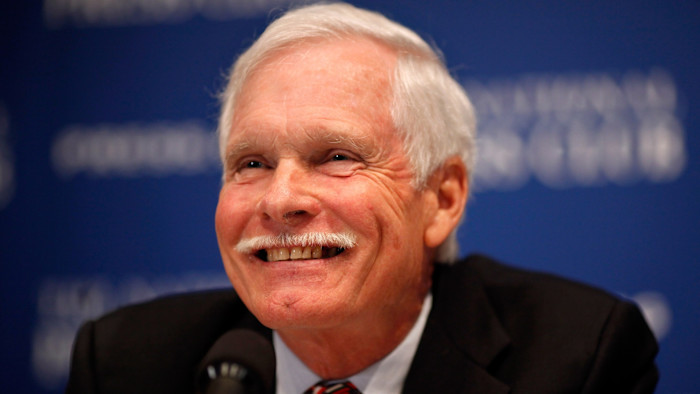





Ted Turner, the media mogul who fundamentally changed how the world consumes news by launching CNN as the first dedicated 24-hour rolling news channel, has died at the age of 87.
The network he founded announced his passing, triggering an outpouring of tributes from world leaders, journalists and media figures who credited him with creating a communications revolution whose influence on global journalism and public life is impossible to overstate.
Turner launched Cable News Network on June 1, 1980, at a time when the very concept of round-the-clock television news was widely dismissed as impractical and commercially unviable. The channel was mocked in its early years as the Chicken Noodle Network by sceptics who believed it would fail.
Turner’s instinct proved more reliable than his critics. CNN demonstrated its value almost immediately, providing continuous coverage of the 1981 assassination attempt on President Ronald Reagan and the 1986 Challenger space shuttle disaster.
The network truly came of age during the 1990 to 1991 Gulf War, when its live rolling coverage from Baghdad gave the world an unprecedented real-time window into an active military conflict. The impact was so profound that President George Bush reportedly said he learned more from CNN than he did from the CIA.
Turner’s path to media dominance was neither conventional nor comfortable. He entered the communications business by taking over the family billboard company following the death of his father, who took his own life. He subsequently purchased a radio station in Atlanta, Georgia, which within a decade had become the foundation of the Turner Broadcasting System. From that single Atlanta radio station, Turner built one of the most consequential media empires in American history, redefining not just how news was delivered but how the entire world related to information, conflict and shared human experience.
CNN founding team member Mary Alice Williams described Turner to the BBC as a visionary who believed in the transformative power of connected global media. She credited him with creating a network that could connect the whole world so people could see each other, recognise shared struggles and work toward shared solutions. “CNN was founded on that belief and we all bought into it,” Williams said. Current CNN Chief Executive and Chairman Mark Thompson paid tribute to Turner as the giant on whose shoulders the network stands. “Ted was an intensely involved and committed leader, intrepid, fearless and always willing to back a hunch and trust his own judgement. He was and always will be the presiding spirit of CNN,” Thompson said.
United States President Donald Trump, who has been a fierce and persistent critic of CNN’s current editorial direction, set that criticism aside to pay personal tribute to Turner. “Whenever I needed him, he was there, always willing to fight for a good cause,” Trump said, describing Turner as one of the greats of broadcast history and a personal friend. The tribute was notable given the adversarial relationship between Trump and the network Turner built, and reflected the degree to which Turner’s legacy as a media pioneer transcended the political battles that have since come to define CNN’s public identity.
Turner’s life extended well beyond journalism and broadcasting. He was a world-class competitive sailor, winning the prestigious America’s Cup in 1977. His rivalry with media magnate Rupert Murdoch, who launched Fox News in 1996 in direct competition with CNN, was legendary and occasionally physical. In 1983, when a Murdoch-sponsored yacht collided with Turner’s boat during an Australian race, Turner reportedly challenged Murdoch to a fist fight.
Turner also owned major American sports franchises including the Atlanta Braves baseball team, the Atlanta Hawks basketball team and the Atlanta Thrashers ice hockey team, making him one of the most diversified figures in American public life. His brash, outspoken personality earned him the nicknames the Mouth of the South and Captain Outrageous, and according to Thompson he was known to walk around CNN’s newsroom in his bathrobe, eager to debate the day’s news, having at one point lived inside the network’s headquarters.
In his later years Turner became one of America’s most significant philanthropists, donating one billion dollars to the United Nations in 1997 in what was at the time one of the largest individual charitable gifts in history.
He channelled millions more into environmental causes and invested heavily in clean energy, reflecting a lifelong commitment to conservation that complemented the idealistic vision of global connection that had inspired CNN’s founding. With his death, the media world loses not merely a businessman or a broadcaster but the architect of a new relationship between humanity and information, one that made it possible, for the first time in history, for people anywhere in the world to witness events anywhere else as they actually happened.


Comment
No comments found.