






The global experiential marketing services market is steadily expanding as brands intensify efforts to move beyond traditional advertising and build deeper consumer connections through immersive engagement.
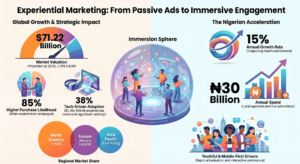
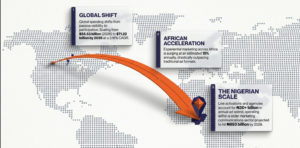
According to Business Research Insights, the market, valued at 55.53 billion dollars in 2026, is projected to climb to 71.22 billion dollars by 2035, reflecting a 3.16 percent compound annual growth rate as companies increasingly prioritise experience driven strategies over passive communication.
This upward trajectory is not only being shaped by global demand but also by a decisive shift in how brands define value. Rather than relying solely on visibility, organisations are now actively investing in experiences that influence perception, drive participation, and ultimately shape purchasing behaviour.
EXPERIENTIAL MARKETING
As a result, experiential marketing has moved from a supporting tactic to a central growth lever within the broader marketing ecosystem, now accounting for a larger share of marketing services activity than several traditional formats.
Across regions, North America continues to dominate with nearly 40 percent of market share, followed by Europe and a fast rising Asia Pacific region.
ALSO WATCH:MARKETING EDGE
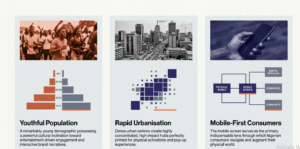
However, attention is increasingly turning toward emerging markets, where demographic advantages, urban expansion, and digital adoption are accelerating growth. In this context, Nigeria is becoming a critical focal point.
According to the Experiential Marketers Association of Nigeria (EXMAN), which shared insights via its Instagram platform in September last year, experiential marketing in Nigeria and across Africa is growing at an estimated 15 percent annually.
The association noted that brands investing in immersive storytelling consistently record stronger engagement and deeper consumer loyalty, reinforcing the shift toward experience led brand building.
EXPERIENTIAL MARKETING
This growth is already translating into economic value. Industry estimates show that experiential agencies and live activations now account for over 30 billion naira in annual advertising spend in Nigeria, operating within a wider marketing communications industry projected to reach 893 billion naira by 2028. At the same time, a youthful population, with a strong preference for interactive and personalised engagement, continues to drive demand for more dynamic brand experiences.
EXPERIENTIAL MARKETING
Beyond scale, the market is also evolving in structure and execution. According to Exposé Marketing Solutions Limited’s report, Nigeria’s experiential landscape is being shaped by mobile first consumers, rapid urbanisation, and a strong cultural inclination toward entertainment driven engagement, all of which are pushing brands to rethink how they connect with audiences.
At a global level, technology is accelerating this transformation. Data from Business Research Insights shows that immersive and tech driven formats already command about 38 percent of marketing services activity, supported by rising adoption of artificial intelligence, augmented reality, and hybrid physical digital experiences.
In fact, about 85 percent of consumers indicate a higher likelihood of purchase after participating in experiential campaigns, while most marketers now integrate technology to improve engagement and track performance.
ALSO WATCH:MARKETING EDGE ONTV
Meanwhile, insights from MARKETING EDGE highlight that continuous innovation, evolving consumer expectations, and competitive pressure are pushing agencies to refine their offerings, particularly through hybrid experiences that blend physical interaction with digital amplification.

EXPERIENTIAL MARKETING
In practical terms, this evolution is reshaping how campaigns are designed. Experiential marketing is no longer limited to activations or events; it now spans pop ups, interactive installations, product tours, and digitally enhanced environments that allow consumers to actively participate in brand narratives.
Whispa Konnect further emphasises that the real strength of experiential marketing lies in its ability to move consumers from passive awareness to emotional connection.
According to the firm, immersive engagement allows audiences to feel a brand rather than simply receive its message, thereby strengthening recall, loyalty, and advocacy in ways traditional formats struggle to achieve.
However, despite its strong momentum, the market still faces constraints. High execution costs, resource limitations, and sustainability concerns continue to challenge adoption, particularly for smaller players.
Additionally, measuring return on investment remains complex, as brands must balance quantitative metrics with qualitative outcomes such as sentiment and experience.
ALSO WATCH:MARKETING EDGE ONTV
Even so, industry players are pushing forward. Leading global firms including Omnicom Group, Publicis Experiences, GES, and Stagwell continue to invest in innovation, partnerships, and technology integration to strengthen their market positions.
At the same time, Nigerian agencies are increasingly aligning with global standards while tailoring campaigns to local culture and consumer behaviour.
Futuristically, as brands compete for attention in an increasingly saturated environment, they are shifting decisively toward strategies that prioritise interaction, emotion, and memorability.
Consequently, experiential marketing is no longer optional; it is becoming a defining force in how brands grow, differentiate, and sustain relevance in both global and Nigerian markets.




Comment
No comments found.