
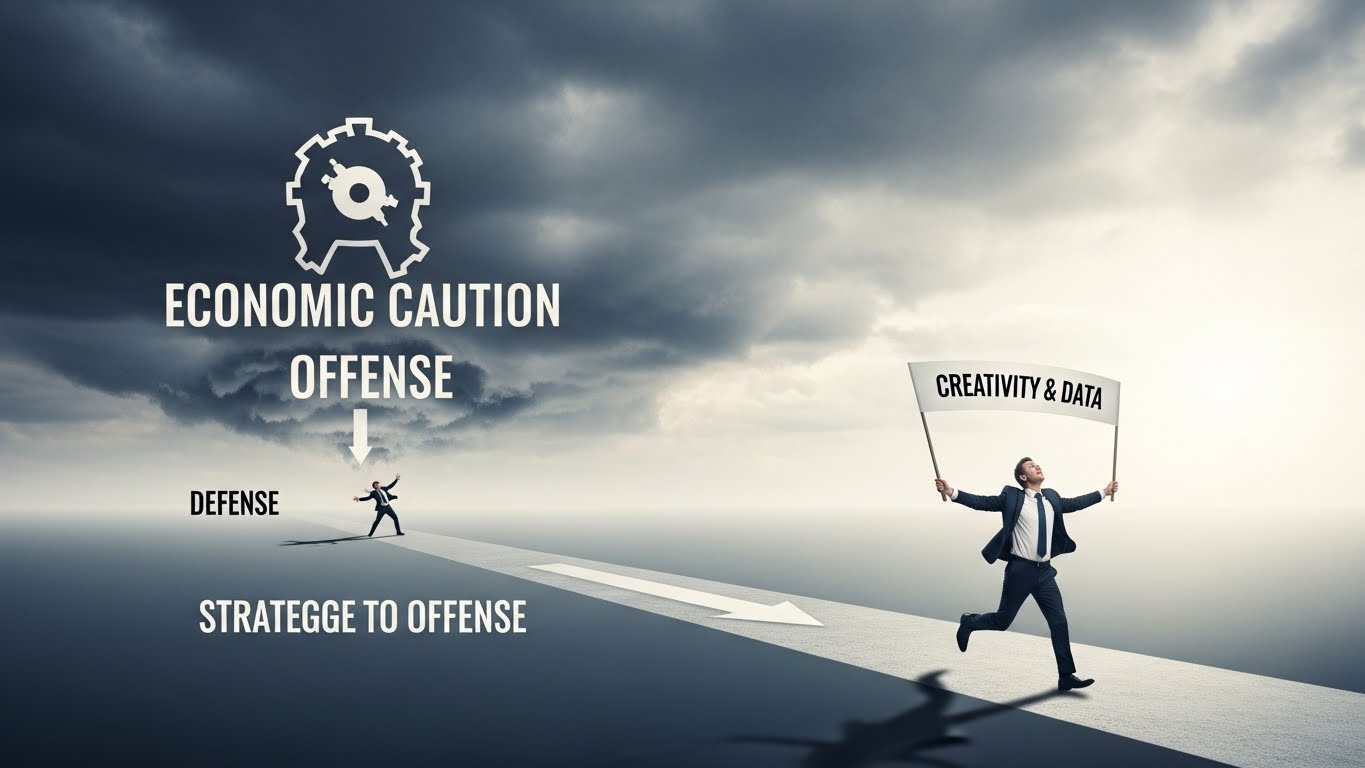


When annual budgets are tightened, confidence usually follows suit. Forecasts are lowered, teams prepare for slower quarters, and organizations, almost predictably, fall into caution mode. Despite this cycle of corporate doom, one discipline is perfectly positioned to rewrite the story: marketing.
Marketing, unlike other divisions reduce activity in response to cost pressure, stands at the crossroads of customer behaviour, pricing information, product relevance, and creative demand development. In times of economic instability, this vantage point is not only useful, but also crucial. Brands that opt to lead rather than retreat outperform during tough economic times.
The real post-budget challenge: shrinking confidence, not shrinking spend.
C-suites around the world are experiencing more anxiety. Marketing expenses are not shrinking, but expectations are changing. Gartner’s 2024 CMO Spend Survey discovered that, while budgets averaged 8.2% of corporate sales, CMOs were under growing pressure to explain every line item. Similarly, WARC indicated that 62% of marketers predict increased scrutiny of ROI in 2025, even if investment levels remain unchanged.
The issue is not that brands have ceased spending; rather, they are spending more wisely. This provides a new responsibility for marketers: build trust in the organization by proving areas where value and growth still exist.
Pricing, value, and the psychology of demand
Buring recessions, pricing strategy is one of the tools that is misused. Brands that don’t adjust their value proposition to account for inflation’s impact on consumer behaviour run the danger of becoming irrelevant before they even lose market share.
Marketing professionals are now obligated to:
Rethink pricing in light of communicating value
Find the subsets of customers with the highest price elasticity.
Instead of discounting without considering consumer behaviour, use data to fine-tune your promotions.
Create more compelling value stories based on actual consumer data.
Not through increasing expenditure, but through making better informed decisions, does the marketing function become vital at this stage.
Data as a confidence engine
The organization seeks clarity during periods of uncertainty
Furthermore, facts provide light.
The marketers have the most valuable, but frequently underutilized, resource for demand truth: first-party consumer signals and media efficiency analytics. There is a noticeable change happening all across the world: marketers can now test, forecast, and scale faster than ever before with the help of AI-assisted analytics.
The majority of the potential $4.4 trillion in yearly economic value that generative AI may release, according to a 2024 McKinsey report, would accrue to marketing and sales. Successful businesses aren’t only pouring more money into their operations; they’re also improving their metrics.
Creativity as an economic multiplier
Though funds may be tight, imagination need not be.
Brands reawaken the power of grand concepts at times of limitation, as history demonstrates.
Two decades of research by WARC shows that firms which keep investing in creativity even when times are tough end up with more profits in the end. When rivals distance themselves from creativity, it becomes a point of differentiation.
What this implies for marketers is:
Making better use of limitations to hone messages
Rather than giving up on storytelling, discovering new distribution efficiencies
Rethinking advertising campaign with flexible, modular creative frameworks
Using AI to scale versions while preserving their strategic essence
Forget about creativity being a “nice to have”, it’s becoming an “economic necessity.”
The marketing leader’s duty shifts from defence to offense
Organizations frequently resort to protective thinking during the post-budget season. However, marketing has always had an edge since it is the only function that re-energize consumers, increase demand, and restore momentum.
By focusing on:
Prioritizing value clarity over price cutting
Self-assurance based on facts rather than intuition
Taking risks creatively rather than hushedly
Not only can marketers elevate campaigns, but entire organizations may be boosted as well.
Leaders in this field need to be aware of the mental and financial challenges their employees face at the present. Brands that are prepared to innovate instead of retreat will seize the opportunity, even though uncertainty is real.
The bottom line
The mandate for growth remains unchanged, even as budgets have tightened.
Here is where marketing takes center stage, no longer as an expense center, but as a strategic catalyst for revitalization.
During times of economic caution, marketers need to step up their game.
When businesses perceive danger, marketers should perceive opportunity.
When everyone else is slashing, it’s the marketers’ job to be creative.
That is the process of rewriting a story.
Regrowth starts in that way.
ALSO WATCH MARKETING EDGE ONTV




Comment
No comments found.