
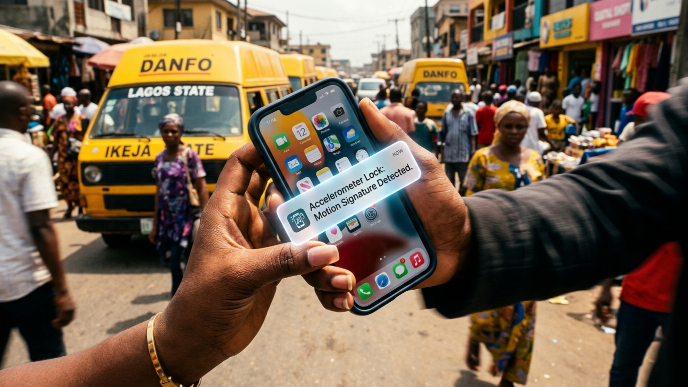



It happens in three seconds. A woman checks her phone at a Lagos bus stop, eyes on her screen. A figure approaches from behind. She feels a sudden impact, not violent, just decisive. Her hand opens involuntarily. The phone is gone. She turns to see the perpetrator already disappearing into traffic, her device already being wiped and resold before she finishes processing what happened.
This isn’t a rare incident. It’s routine. In urban centres across Africa, Asia, and Latin America, phone snatching has become epidemic, a crime of opportunity so normalised that victims often don’t bother reporting. The phone represents more than a device. It’s access to banking, identity documents, private communications, and financial accounts. A stolen phone isn’t an inconvenience. It’s vulnerability.
For years, consumers accepted this risk as the cost of carrying smartphones. Security measures existed: passwords, biometrics, find-my-phone services, but none addressed the fundamental problem: by the time you realise your phone is gone, thieves already possess it. They have seconds to act before you can remotely lock it.
Now Apple is reportedly engineering a response targeting the crime’s defining characteristic: the sudden movement. Using accelerometer technology already embedded in iPhones, the company is developing a feature that detects patterns mimicking phone snatching. When the device experiences sudden acceleration that matches snatch-and-grab movement, it immediately locks, rendering the phone useless to thieves seconds after theft.
The economics of phone theft
Understanding why phone snatching persists requires understanding its economics. A stolen iPhone sells for $150-400 on the black market, depending on model and condition. For the perpetrator, that represents the week or month of income. For the victim, that represents months of savings. The asymmetry drives crime.
Street criminals operate on efficiency metrics. A successful snatch takes three seconds, generates $200 revenue, and carries minimal legal consequences if caught. The mathematics are compelling. Phone snatching has become a preferred crime because the risk-reward ratio favours perpetrators.
But those economies collapse if a stolen phone becomes immediately worthless. If Apple’s feature prevents resale, looking device permanently or making it untraceable on secondary markets, the entire crime calculus shifts. A stolen phone generating zero revenue becomes a pointless target. Criminals move toward easier marks.
The cascading impact
Phone theft creates ripples extending far beyond the individual victim. When people fear carrying phones, economic participation declines. Small business owners hesitate to use phones for payments. Elderly people avoid mobile banking. Women modify their behaviour, avoiding public spaces where snatching occurs. The gear becomes as economically damaging as the theft itself.
In developing markets, where mobile phones represent the primary computing device and banking interface, phone security directly impacts financial inclusion and economic participation. When theft feels inevitable, people retreat from the digital economy, constraining their own opportunity.
What Apple’s solution actually solves
The accelerometer detection targets the crime’s defining moment, the sudden, violent separation between person and device. Unlike passwords that thieves circumvent over time, unlike GPS tracking that operates after theft, sudden-movement detection prevents utility in real-time.
The technical implementation remains unclear. Does this feature require Apple Watch pairing? How does the system distinguish between legitimate dropping and criminal snatching? Does a locked phone remain trackable or become truly inaccessible? These details matter for both effectiveness and privacy implications.
The questions remaining
Apple’s solution addresses symptoms rather than causes. Phone snatching persists because poverty creates an incentive structure that rewards it. Technology can increase friction, but cannot eliminate motivation when a $200 theft represents significant income.
The feature also raises privacy questions. Constant accelerometer monitoring consumes power whilst creating data about user movement patterns. How Apple balances protection against surveillance remains unresolved.
When innovation meets street reality
What makes this development noteworthy is that a technology company is recognising ground-level crime as an engineering problem worth solving. For years, theft remained an accepted externality of smartphone adoption. Now, accelerometer and processing power finally make prevention feasible.
Whether Apple’s feature succeeds depends less on technical sophistication than on adoption. If thieves discover workarounds or if the feature proves unreliable, criminals adapt. But if sudden-movement detection proves reliable, it could fundamentally disrupt phone snatching economics, transforming crime from a quick-money opportunity into a pointless risk.
The woman at the Lagos bus stop may never know her phone was stolen because it locked before the thief could access it. That moment, when technology prevents crime before impact cascades, represents what innovation protecting real people actually looks like.
ALSO WATCH:MARKETING EDGE ONTV




Comment
No comments found.