


For over a decade, Big Brother Naija was the safest bet in Nigerian advertising. Brands that secured headline sponsorship did not need to justify the investment; the numbers justified themselves. A captive satellite audience of millions, guaranteed youth market access, and a cultural conversation that dominated every office, every barbershop, and every social media feed for ten weeks straight. The show was not just entertainment. It was infrastructure for brand building.
That infrastructure is now under strain, and the industry is watching closely.
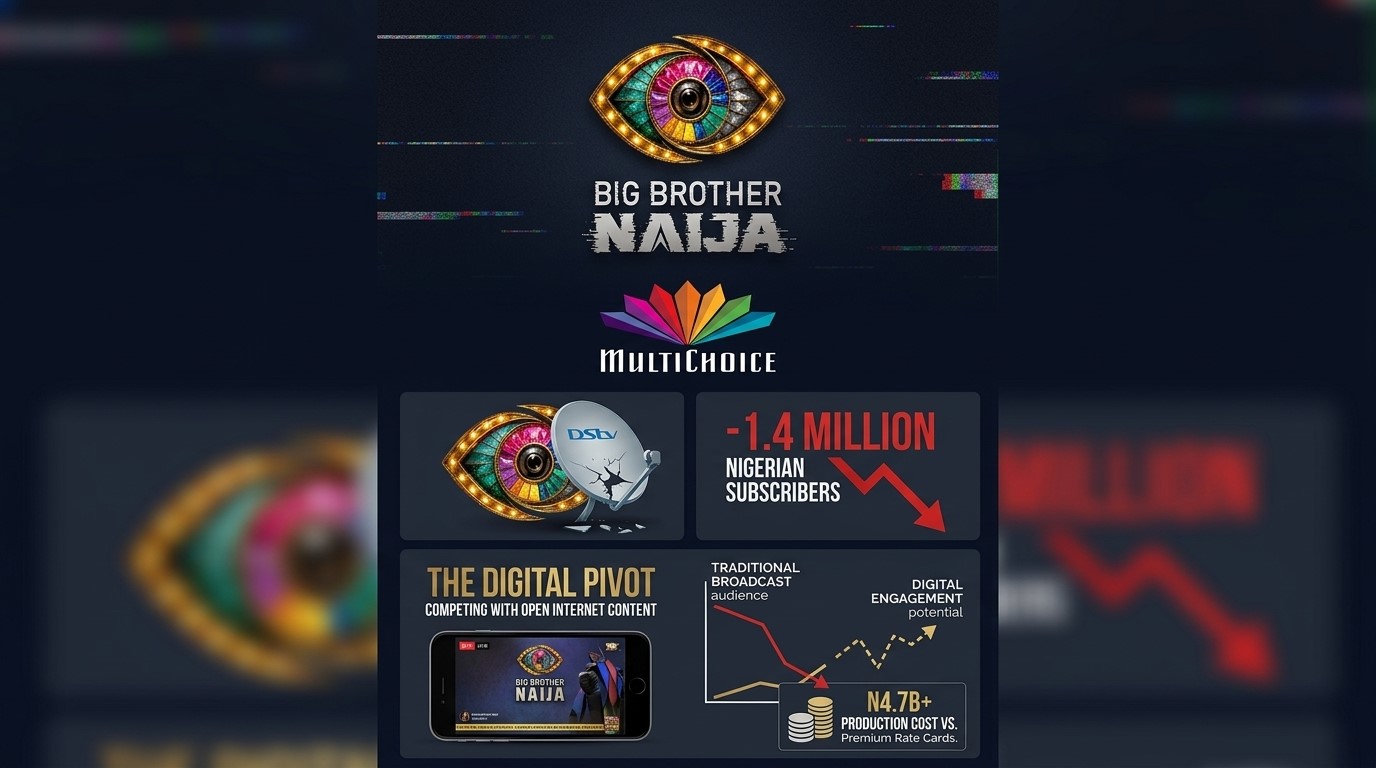
Between 2023 and 2025, MultiChoice Group lost nearly 1.4 million Nigerian subscribers, representing 77 per cent of total customer churn across its Rest of Africa business. As household budgets tightened under a persistent inflation and naira devaluation, subscription revenues fell by 44 per cent. The satellite audience that once gave BBNaija its commercial invincibility has shrunk considerably, and with it, the guaranteed reach that justified premium rate cards valued at up to N10 billion at peak.
Furthermore, the show’s production costs have not shrunk commensurately. Season 7 alone cost over N4.7 billion to produce. The commercial model that once balanced those costs against a massive captive broadcast audience now depends increasingly on digital engagement; a fundamentally different and significantly more competitive environment where BBNaija competes with every other piece of content available to a Nigerian smartphone user at any given moment.
Approximately 25 brands are participating in the 2026 season, with betPawa as headline sponsor, Guiness as gold sponsor, and Minimie as associate sponsor. The sponsorship machine, as one industry commentator has noted, remains active, not anywhere near obsolete. However, the question being asked increasingly in marketing boardrooms across Lagos is not whether BBNaija still attracts sponsors. It is whether the conversion rates and cultural dominance those sponsors are paying for are being delivered at the same level they once were.
Viewers are not being shy about their assessment. Social media conversation around recent seasons has been marked by a recurring complaint; that the show has lost its edge, that the housemates are less compelling, that the drama feels manufactured rather than organic. Whether those complaints reflect genuine audience disengagement or simply the louder voices of a more opinionated digital era is a question the data has not fully settled.
What is clear is that the television ecosystem around the show is changing, but the show itself remains arguably the country’s most commercially significant entertainment property. That distinction matters enormously for the brands currently invested in it, and for the brands considering whether to invest in future seasons.
The shift from satellite to digital is not unique to BBNaija. It is happening across the entire African pay television market. Nevertheless, BBNaija’s commercial model was built more explicitly than most on the assumption of a captive, subscription-paying broadcast audience. Adapting that model to a world where viewership is fragmented, digital, and free requires a different kind of value proposition, one that MultiChoice and the show’s sponsors are actively working to define.
The 2026 season is, in many ways, a live test of whether BBNaija can make that transition without sacrificing the commercial premium that has made it West Africa’s most valuable entertainment sponsorship property for nearly a decade.
The show is not dying. However, it is changing. And in the high-stakes world of multi-billion-naira brand partnerships, the difference between those two things is everything.
ALSO WATCH: MARKETING EDGE ONTV



Comment
No comments found.