


By Adetokunbo Modupe
The controversy surrounding two Nigerian fast-food brands raises fundamental questions about brand ownership, consumer perception, competitive positioning and the commercial value of reputation.
In marketing, imitation is often described as the sincerest form of flattery. But in business, imitation can become a costly controversy, particularly when one brand believes another is benefiting from the goodwill, recognition and reputation it has painstakingly built.
The controversy between Item 7 Go and Item 7 Move, highlighted in The Guardian newspaper on October 15, 2026, under the headline “Item 7 Go vs Item 7 Move: Copycat Strategy or Trademark Infringement?”, presents an interesting case study in brand identity, differentiation and commercial exploitation.
According to the report by Eniola Daniel, Item 7 Go, established in 2012 by Ibigbemi Oloruntobi, has grown from a modest food business in Ilorin into a quick-service restaurant chain operating across several Nigerian cities. Item 7 Move, a newer business operating in Owerri, has attracted attention for its similar name and market positioning.
Beyond the legal controversy lies a fundamental marketing question: When does similarity become an attempt to exploit another brand’s success?
Who Really Owns Item 7?
In Nigeria, the expression Item 7 has long been associated with food, particularly refreshments served at social gatherings. It is an expression deeply embedded in everyday vocabulary.
Can any business legitimately claim exclusive ownership of a phrase that predates its commercial existence?
Not necessarily.
While commonly used expressions may be difficult to monopolise, businesses can develop distinctive commercial identities around them. Through consistent investment in product quality, consumer engagement, distribution, and marketing, an otherwise generic expression can acquire a specific commercial association.
Consider Apple, Shell and Orange. These are ordinary words that have become powerful commercial identities through deliberate brand building.
Their commercial strength does not arise from ownership of the everyday words themselves, but from the distinctive reputation and goodwill developed around them.
A business may not own the expression Item 7 in every context, but it may possess enforceable rights over a distinctive trademark or commercial identity developed around it.
Similar Names, Different Identities?
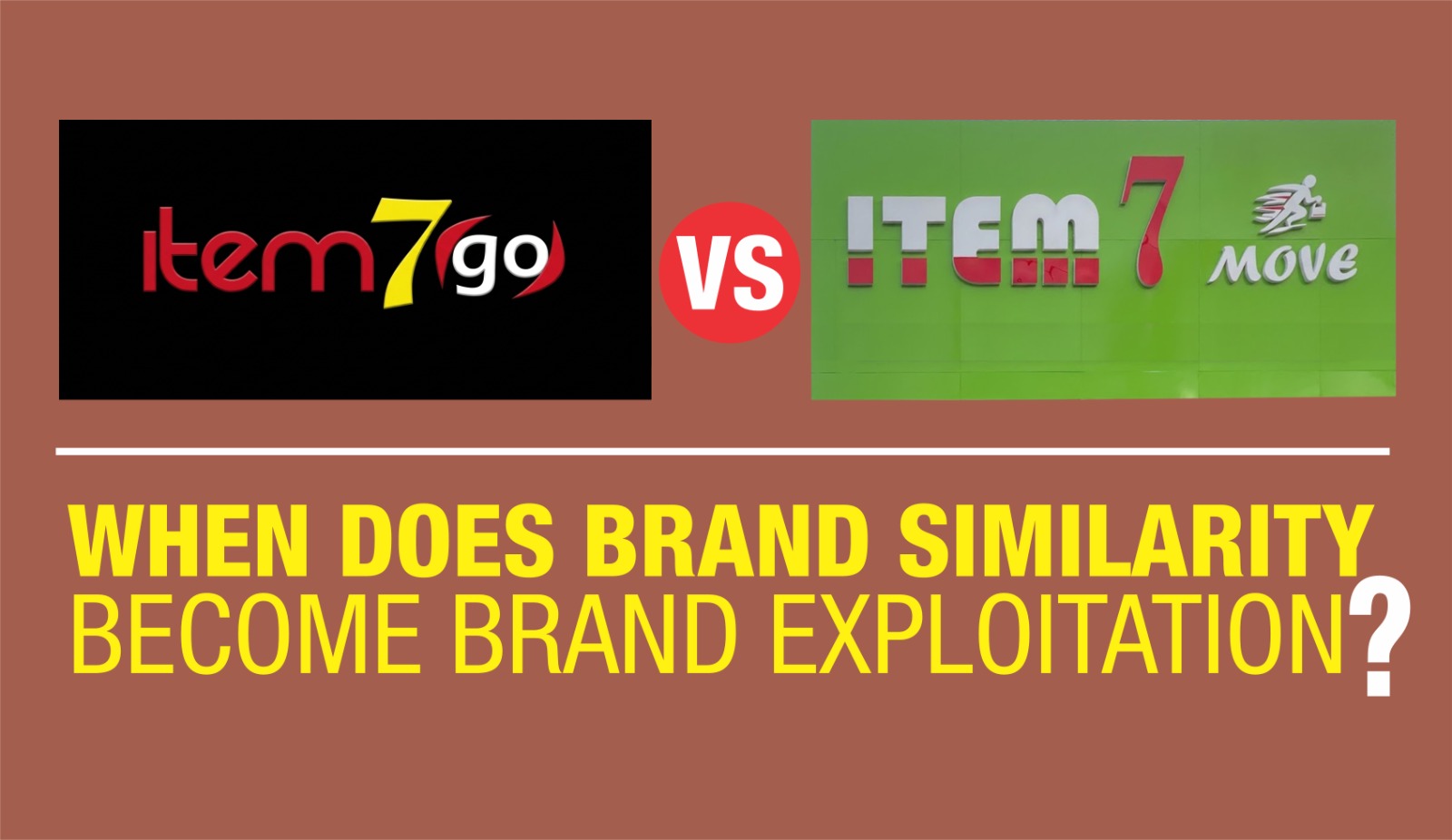
A visual examination of both brands reveals interesting differences.
Item 7 Move uses predominantly green, white and red colours, with bold lettering and a red numeral seven. Item 7 Go adopts black, red and yellow, with a more contemporary typographic treatment.
Visually, the two identities are distinguishable.
However, brand identity extends beyond logos and colours.
Both businesses share the dominant expression Item 7, followed by words suggesting movement, convenience and accessibility: Move and Go.
In the fast-food business, these expressions communicate similar propositions.
Could consumers interpret one as an extension, franchise or alternative format of the other? Possibly.
But possibility alone does not establish deliberate imitation or consumer deception.
The critical issue is whether the overall similarity creates a likelihood of confusion in the marketplace.
The Niger Chemists Precedent: A Lesson in Brand Protection
Interestingly, Nigeria confronted a comparable controversy over six decades ago. In the landmark case of Niger Chemists Limited v. Nigeria Chemists & D.K. Brown (1961) All N.L.R. 180; [1961] NGHC 8, decided on March 16, 1961, the High Court of Nigeria, presided over by Justice Palmer, examined a dispute involving two pharmaceutical businesses operating under remarkably similar names.
The established business, Niger Chemists Limited, challenged another operator in Onitsha using the name Nigeria Chemists in the same trade.
The court ruled in favour of Niger Chemists, recognising that deliberate deception or evidence of actual consumer confusion was not essential where similar business names were likely to mislead the public.
The marketing implication remains profound. A business does not necessarily have to reproduce another company’s logo, colours or entire identity to create a misleading commercial association.
Similarity in naming, business category and consumer perception may be sufficient to threaten established goodwill.
However, an important distinction exists. Unlike the circumstances in Niger Chemists, Item 7 is a colloquial reference to food, which may complicate claims of exclusive ownership.
Nevertheless, the precedent reinforces a fundamental principle: The real commercial asset being protected is not merely a name, but the goodwill and consumer recognition associated with it.
Copyright, Passing Off and the Marketing Question
Much of the public conversation about competing brands confuses copyright infringement, trademark infringement and passing off. They are different legal concepts. Copyright generally protects original artistic expressions, including qualifying logo designs. Trademark protection covers distinctive signs that identify the commercial origin of goods or services.
Passing off addresses situations where a business misrepresents its goods or services in a way likely to mislead consumers into associating them with another business with established goodwill.
For a passing-off claim, the complainant generally needs to demonstrate goodwill, misrepresentation and resulting or probable commercial damage.
This is where marketing becomes particularly relevant. The question is not simply whether two logos resemble one another. It is whether their combined branding, communication and marketplace conduct create a misleading association.
That requires evidence, not speculation.
Success Attracts Competition, Association and Exploitation
Every successful brand creates commercial opportunities, sometimes for competitors.
When a business establishes strong consumer recognition, its name becomes more than an identification. It becomes an asset that can influence purchasing decisions, build confidence, and attract loyalty.
Naturally, competitors may seek to participate in the market it has developed.
There is nothing inherently wrong with that. Competition encourages innovation, improves service delivery and expands consumer choice.
However, legitimate competition becomes questionable when a business appears to rely on another’s established identity to accelerate its own market acceptance.
The challenge is distinguishing inspiration from imitation and competitive positioning from potential exploitation.
The Item 7 controversy should therefore remind businesses that brand differentiation must go beyond attractive logos. It requires distinctive positioning, consistent communication, legal protection and deliberate reputation management.
Ultimately, the stronger a brand becomes, the more attractive it may become to competitors, imitators and businesses seeking association with its commercial success.
That is perhaps the greatest irony of successful brand building: a business does not merely attract customers and competitors. It may also attract those seeking to exploit the very reputation that made it successful.
And that is the bigger marketing lesson from Item 7 Go and Item 7 Move.
A successful brand must not only compete for customers. It must be prepared to defend the identity, goodwill and reputation that made it successful.


Comment
No comments found.