


Political parties, campaign organisations, advertising agencies and media owners must treat compliance as a legal obligation rather than an election-season formality, legal practitioner S. Charles Odenigbo has warned.
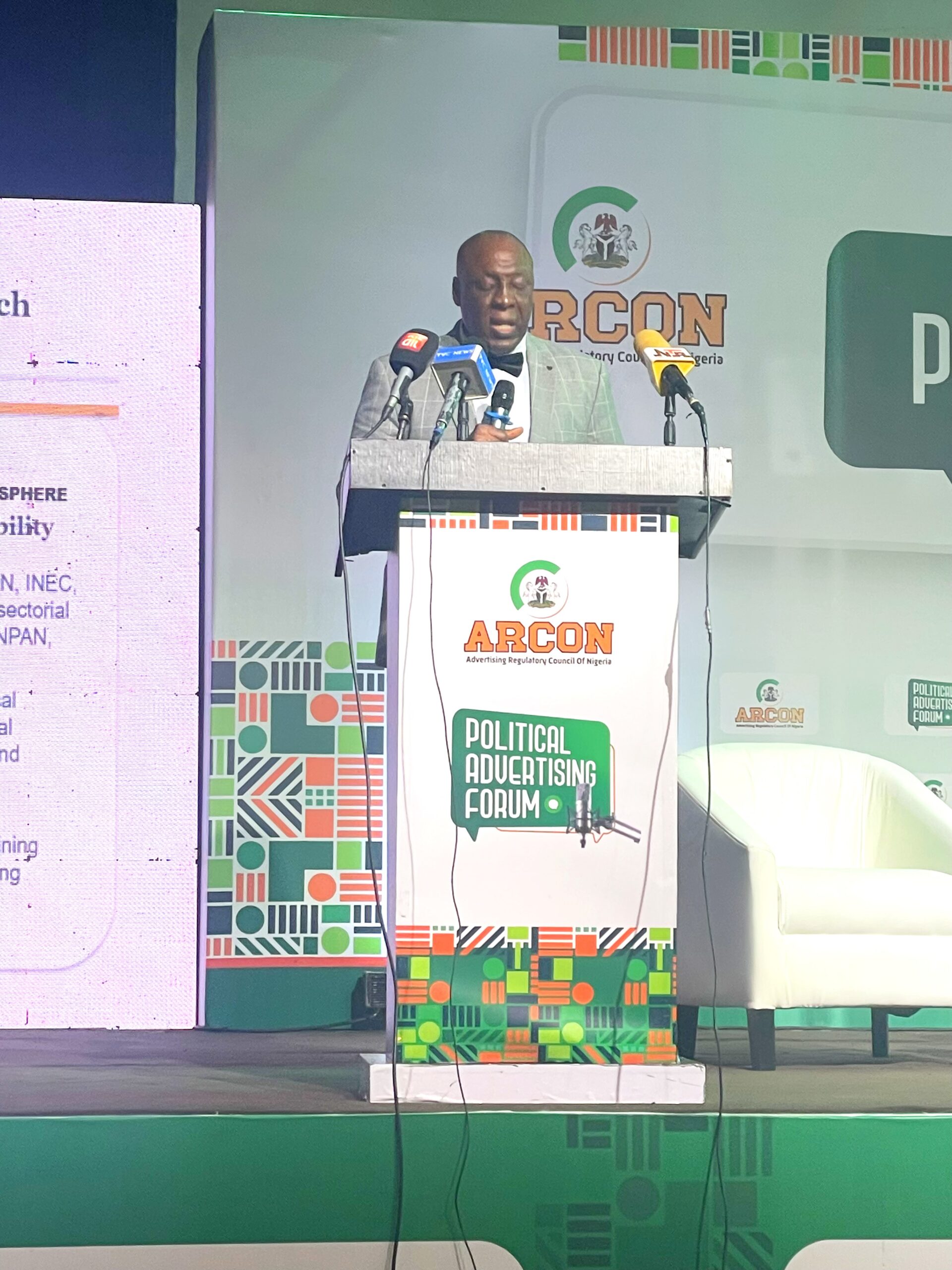
Odenigbo, Director-General of the Center for Media Law & Development (CMLD), delivered the warning in his keynote address at the Stakeholders’ Engagement on Political Advertising Regulation, organised by the Advertising Regulatory Council of Nigeria (ARCON) in Lagos.
Speaking at D’Podium Event Centre, Ikeja, on “Political Advertising Campaigns in Nigeria: The Regulatory Guidelines and Compliance Obligations,” he urged stakeholders to obtain approval before exposing political advertisements, substantiate campaign claims and resist messages that exploit ethnic or religious divisions.
“The ARCON Act, the Nigerian Code of Advertising, the Electoral Act, and the Nigeria Broadcasting Code are not aspirational documents. They are binding instruments,” he said.
His central message was that compliance extends beyond the organisation that publishes an advertisement. Sponsors, campaign beneficiaries, agencies and other participants must understand their responsibilities.
Odenigbo challenged the industry to reconsider how responsibility for political advertisements is examined.
Rather than concentrating only on who exposed, published or displayed an advertisement, he proposed a broader question:
“Who Sponsored, Commissioned, Authorised, Financed, Coordinated the Media Purchase or Benefitted from the Advertisement”?
He recommended that sponsors and beneficiaries maintain contractual agreements with agencies, media owners, influencers, media buyers, planners and consultants. Such agreements, he explained, would help define rights, duties, obligations, indemnity and liability if disputes arise.
Addressing sanctions, Odenigbo cited Section 34(3) of the ARCON Act as prescribing a fine of not less than ₦500,000 or one year’s imprisonment for an individual, and not less than ₦1 million for a corporate body.
He also referred to ARCON statements issued in February and August 2026 warning against unapproved political advertisements and content that violated religious and ethnic guidelines.
“Some of our eminent guests will remember when these provisions were treated as formalities. That era is over,” he said.
A central requirement outlined in the address was prior vetting by the Advertising Standards Panel (ASP).
According to Odenigbo, the obligation covers political advertising across television, radio, newspapers, outdoor platforms and digital channels. Submissions should include the creative material, media schedule and relevant documentation.
He explained that the ARCON Vetting Guidelines require a Certificate of Approval before exposure, with copies accompanying media placement instructions. Media organisations, state signage agencies and local government councils, he added, are required to reject unvetted advertisements.
“The process is not designed as an obstacle; it is designed to ensure that what enters the public space is decent, truthful, and respectful of Nigeria’s cultural and religious sensitivities.”
For campaign organisations, this means incorporating vetting into production schedules rather than seeking approval after materials have been prepared for immediate release.
Media houses, he said, must also refuse unapproved content, irrespective of the advertiser’s political influence.
Odenigbo identified Articles 76, 77, 78 and 79 of the Nigerian Code of Advertising Practice, 2023, as key provisions governing political advertising.
In his explanation, Article 76 requires decency, fairness and substantiation. Political criticism remains permissible, but campaign materials should not descend into personal abuse, character assassination, vulgarity or defamatory content.
“Advertisements should address issues, policies, and performance rather than engage in reckless attacks on the personal lives, family matters, or private affairs of political opponents.”
He said candidates and political parties must establish the factual basis of claims about achievements, public records, government projects and opponents.
Explaining Article 77, Odenigbo said political advertisements must clearly identify their sponsors, with verifiable names, physical addresses and telephone numbers submitted to the ASP. He stated that anonymous groups and committees of friends are prohibited under the provision.
He described Article 78 as prohibiting the exploitation of ethnic, religious, sectional or regional sentiments in ways capable of provoking hostility or threatening national cohesion. Article 79, he added, requires compliance with constitutional, electoral and other applicable rules.
He also cited Section 221 of the Constitution as restricting associations other than political parties from canvassing votes for candidates or contributing to party or candidate funds.
The growth of online political communication, Odenigbo argued, has increased the urgency of enforcement.
“I have watched this profession evolve from hand-painted billboards to a digital ecosystem where a single post reaches millions before a regulator has had breakfast,” he said.
He explained that Article 85 extends advertising regulation to internet and electronic-media advertisements directed at the Nigerian market. His examples included websites, blogs, social platforms, messaging applications, podcasts and artificial intelligence-generated content.
Political advertisers using these channels, he said, must ensure that claims are verifiable, sponsored communications are identifiable and manipulated or inflammatory materials are not circulated.
“The fact that a campaign message originates from social media does not diminish regulatory responsibility.”
For broadcasters, Odenigbo emphasised fairness, balance, professionalism and equal opportunity under the Nigeria Broadcasting Code.
He warned against promoting or suppressing particular parties or candidates and against transmitting material capable of inciting violence, hatred or public disorder.
He also reminded stakeholders of the campaign silence period, stating that partisan political campaigns and advertisements must end no later than 24 hours before polling day. In discussing INEC’s campaign guidelines, he cited Section 100 of the Electoral Act, 2026, in connection with the embargo.
These obligations, he stressed, do not disappear because an advertiser is politically powerful.
“The Broadcasting Code does not permit stations to abandon fairness when the advertiser is a political party.”
Odenigbo acknowledged concerns about high state-level outdoor advertising fees and their potential effect on political competition. However, he said such disputes should be pursued through appropriate channels rather than used to justify ignoring federal requirements.
He also proposed including one or two INEC representatives on the ASP, expressly describing the suggestion as his personal opinion.
For him, cooperation among regulators, parties, agencies, media owners and security institutions must support lawful communication—not shield influential actors.
“Synergy is not a euphemism for compromise, nor a suggestion that the regulator should look the other way when powerful interests violate the law.”
Looking towards the 2027 election cycle, Odenigbo warned that digital proliferation, political competition and financial incentives would test the industry’s commitment to compliance.
His appeal was for stakeholders to submit advertisements for approval, keep messages factual and issue-based, observe spending limits and respect the campaign embargo.
“The regulatory framework I have described is not designed to make your work impossible. It is designed to make it lawful. The distinction matters. Comply with the law, or face the consequences.”




Comment
No comments found.