
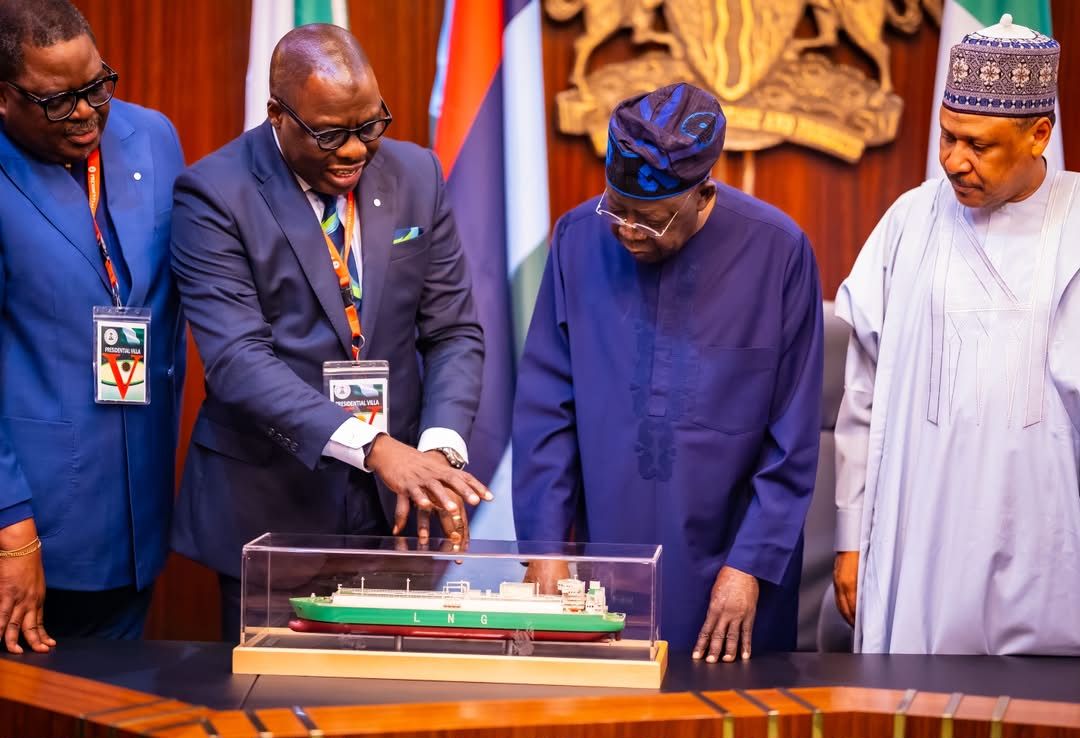




The Managing Director and Chief Executive Officer of Nigeria LNG Limited, Leye Falade, has reaffirmed the company’s commitment to using Nigeria’s vast gas resources to strengthen domestic energy supply and drive broader economic development.
Consequently, Falade made this known after leading an NLNG delegation on a courtesy visit to President Bola Ahmed Tinubu, GCFR, where discussions focused on the company’s contribution to Nigeria’s economy, energy security and infrastructure development.
So, sharing details of the engagement on his LinkedIn page, the NLNG chief executive said the meeting provided an opportunity to reinforce the company’s position as a strategic national asset and a key partner in the Federal Government’s development agenda.
ALSO WATCH:MARKETING EDGE ONTV HOSTS DEMILADE
According to him, the discussions covered NLNG’s contribution to government revenues, domestic energy supply and social development, alongside progress on the Train 7 expansion project and the Bonny Bodo Road.
Remarkably, he also drew attention to NLNG’s growing role in the domestic Liquefied Petroleum Gas market, noting that the company currently supplies about 500,000 tonnes of LPG annually, representing roughly 40 percent of Nigeria’s domestic LPG supply.
Besides this, he said the company’s commitment to the domestic LPG market reflects a deliberate effort to ensure that the benefits of Nigeria’s gas resources extend beyond exports to households, businesses and other segments of the local economy.
Beyond LPG supply, the MD/CEO reiterated NLNG’s determination to complete Train 7, strengthen Nigeria’s competitiveness in the global LNG market and create additional value for the country and its stakeholders.
ALSO WATCH:MARKETING EDGE ONTV HOSTS YBO
Therefore, he further stressed that Nigeria’s gas opportunity goes beyond increasing export volumes, pointing to the need for deeper domestic utilisation that can strengthen energy security, expand industrial activity, support jobs and stimulate economic opportunities.
However, Oil and gas expert said NLNG would continue to work closely with the Federal Government to unlock the potential of Nigeria’s gas resources, while expressing appreciation to President Tinubu for receiving the delegation and for the administration’s support.
Furthermore, some industry observers have welcomed the renewed emphasis on domestic gas utilisation, particularly the company’s contribution to the LPG market. They said expanding supply, infrastructure and distribution could help improve access to cooking gas and deepen the local LPG value chain.
Some observers also described Train 7 as an important component of Nigeria’s long term gas strategy, arguing that its completion, alongside stronger domestic gas utilisation, could increase the economic impact of the country’s gas resources.
For Falade, the broader objective is clear: Nigeria must move beyond simply exporting its gas and build a stronger industrial and domestic energy ecosystem around it.
He also received industry commendations for his leadership experience, particularly his previous tenure at Brunei LNG, where he was credited with driving operational excellence, safety, commercial expansion and initiatives around methane management.
His transition from an international LNG operation in Brunei to the leadership of NLNG has been described by industry stakeholders as a reflection of growing Nigerian expertise in the global energy sector.
Stakeholders therefore expect the new leadership at NLNG to deepen operational performance, strengthen global competitiveness and expand the company’s contribution to Nigeria’s economic and energy ambitions.



Comment
No comments found.