
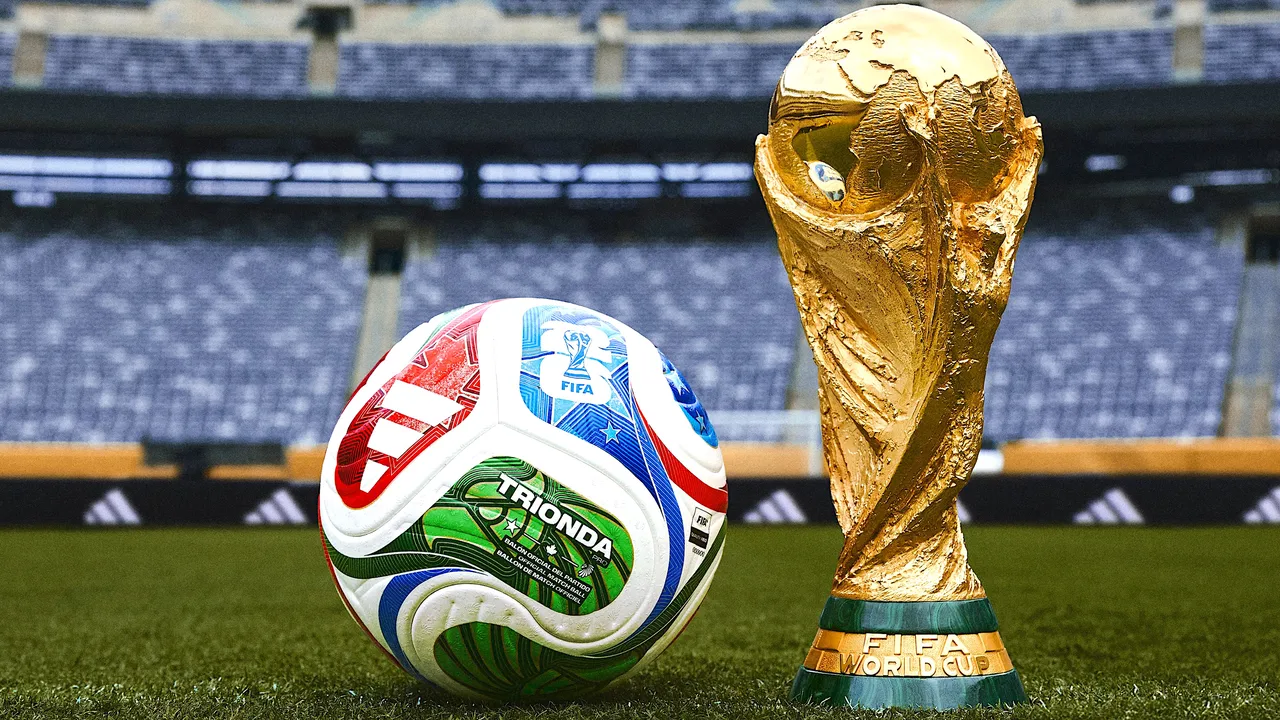


For the first time in football history, the match ball needs to be charged before kickoff.
The Adidas Trionda, official match ball of the 2026 FIFA World Cup, carries a 14-gram motion sensor that fires 500 times per second, capturing position, speed, spin, and direction in real time. Before every game, it sits on a wireless induction pad. A full charge lasts six hours, enough to cover a match and extra time. At $170, it is the most expensive standard match ball ever used at a World Cup. It is also, technically, a piece of consumer electronics.
That detail, a ball that charges like a phone, is the headline that travelled around the world this week. But for anyone who writes briefs, builds campaigns, or thinks seriously about what football means as a cultural and commercial space, the more urgent question is not what is inside the ball. It is what the ball makes possible.
Here is what is actually happening on the pitch at this World Cup.
The Trionda does not work alone. Its sensor data is combined with up to 45 stadium cameras per venue and player-positioning data pulled from body-worn trackers to construct a live, three-dimensional model of every moment of play. That model feeds directly into the VAR room, where officials can now flag a positional offside, down to a margin of 10 centimetres, in near real time, without the extended delays that turned previous tournaments into exercises in collective frustration. Every participating player at this World Cup has been 3D-scanned, with their digital avatars incorporated into the semi-automated offside system. The ball, the players, and the pitch are, together, a continuously updated data environment.
Meanwhile, the referee is wearing a camera on his head.
FIFA has deployed referee body cameras across all 104 games of the tournament: small, high-definition, stabilised cameras mounted on the referees’ headsets, designed to give broadcasters and fans a view of the match that has never been offered before. Lenovo, FIFA’s official technology partner, applied AI-based real-time stabilisation software to reduce motion blur by up to 50 per cent, with the footage transmitted in 1080i quality over a private 5G network. When the technology was trialled at the 2025 Club World Cup, referee-cam clips drew approximately two million views each weekend in the Bundesliga alone.
None of this is incidental. It is infrastructure. And infrastructure, at this scale and this level of visibility, always reshapes the creative and commercial possibilities around it.
Consider what has shifted.
Football has always generated data, possession percentages, pass maps, and expected goals. But that data arrived after the fact, packaged for analysts and post-match pundits. What the Trionda system produces is different in kind, not just in quantity. It is granular, timestamped, tied to individual actions, and available in real time. Every touch of the ball by every player, in every match, across a 104-game tournament, is now a data point that can be queried, visualised, and narrated.
For a creative director, that is not a technical footnote. It is a content engine.
The brands that will dominate the conversation around this World Cup are not necessarily the ones with the biggest media spends or the most visible pitch-side hoardings. They are the ones who understand what real-time data makes possible in terms of storytelling. A brand that can turn Trionda’s 500-times-per-second read of a Messi touch or a Ronaldo free kick into something a viewer feels, through a campaign asset, an in-stadium activation, a social moment, a broadcast integration, is a brand that is using this tournament correctly.
The referee camera opens a different but related door. The body camera offers a first-person view of what the referee sees, the line of the wall in a free kick, the angle on a challenge, the chaos of a goalmouth scramble. That perspective has never been commercially available before. It is intimate, kinetic, and completely unlike anything football broadcasting has produced in the past. For brands built around precision, clarity, or human judgement, think automotive, financial services, tech, that POV is not just a broadcast novelty. It is a creative territory.
The broader shift is this: FIFA has spent the last decade absorbing criticism that technology was making football slower, colder, and more bureaucratic. VAR, as originally implemented, became a symbol of everything fans hated about the game being managed rather than played. The 2026 infrastructure is a direct response to that criticism, not by removing technology but by making it faster and less visible. FIFA’s director of innovation Johannes Holzmüller rejected the idea that technology was creating a new version of the sport, arguing it was instead restoring the game’s traditional flow.
That framing matters commercially. A World Cup where technology is seamless rather than disruptive is a World Cup where the emotional experience of watching football is intact, and an intact emotional experience is the most valuable environment an advertiser can occupy.
The Trionda needs charging. So does your 2026 brief.
ALSO WATCH: MARKETING EDGE ONTV




Comment
No comments found.